Seekatz Anna M, Aas Johannes, Gessert Charles E, Rubin Timothy A, Saman Daniel M, Bakken Johan S, Young Vincent B
Department of Internal Medicine, Division of Infectious Diseases, Department of Microbiology and Immunology, University of Michigan, Ann Arbor, Michigan, USA;
Essentia Health, Department of Gastroenterology, Duluth, Minnesota, USA;
mBio. 2014 Jun 17;5(3):e00893-14. doi: 10.1128/mBio.00893-14.
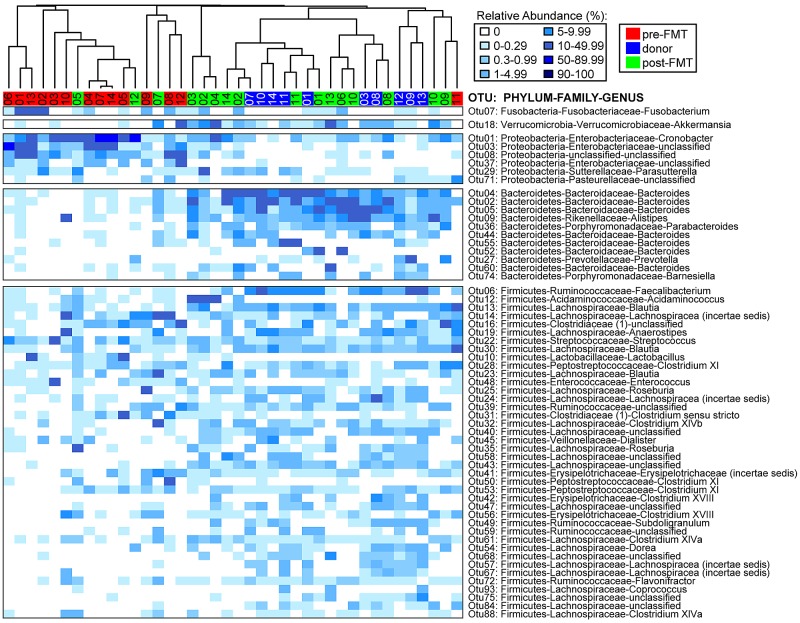
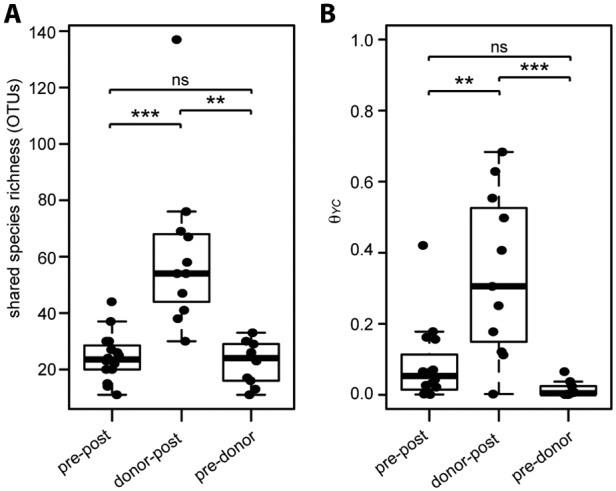
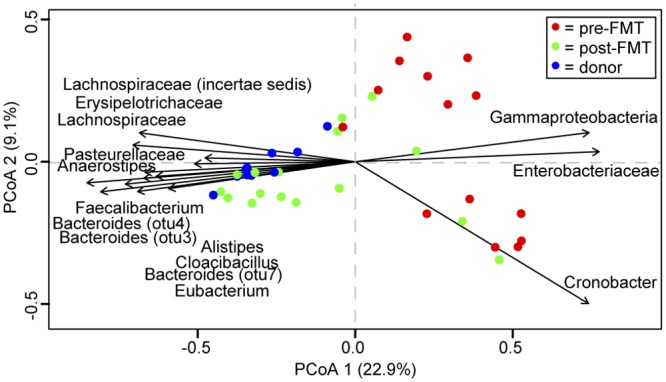
Clostridium difficile infection is one of the most common health care-associated infections, and up to 40% of patients suffer from recurrence of disease following standard antibiotic therapy. Recently, fecal microbiota transplantation (FMT) has been successfully used to treat recurrent C. difficile infection. It is hypothesized that FMT aids in recovery of a microbiota capable of colonization resistance to C. difficile. However, it is not fully understood how this occurs. Here we investigated changes in the fecal microbiota structure following FMT in patients with recurrent C. difficile infection, and imputed a hypothetical functional profile based on the 16S rRNA profile using a predictive metagenomic tool. Increased relative abundance of Bacteroidetes and decreased abundance of Proteobacteria were observed following FMT. The fecal microbiota of recipients following transplantation was more diverse and more similar to the donor profile than the microbiota prior to transplantation. Additionally, we observed differences in the imputed metagenomic profile. In particular, amino acid transport systems were overrepresented in samples collected prior to transplantation. These results suggest that functional changes accompany microbial structural changes following this therapy. Further identification of the specific community members and functions that promote colonization resistance may aid in the development of improved treatment methods for C. difficile infection.
Within the last decade, Clostridium difficile infection has surpassed other bacterial infections to become the leading cause of nosocomial infections. Antibiotic use, which disrupts the gut microbiota and its capability in providing colonization resistance against C. difficile, is a known risk factor in C. difficile infection. In particular, recurrent C. difficile remains difficult to treat with standard antibiotic therapy. Fecal microbiota transplantation (FMT) has provided a successful treatment method for some patients with recurrent C. difficile infection, but its mechanism and long-term effects remain unknown. Our results provide insight into the structural and potential metabolic changes that occur following FMT, which may aid in the development of new treatment methods for C. difficile infection.
艰难梭菌感染是最常见的医疗保健相关感染之一,高达40%的患者在接受标准抗生素治疗后会出现疾病复发。最近,粪便微生物群移植(FMT)已成功用于治疗复发性艰难梭菌感染。据推测,FMT有助于恢复能够对艰难梭菌产生定植抗性的微生物群。然而,目前尚不完全清楚这一过程是如何发生的。在此,我们研究了复发性艰难梭菌感染患者接受FMT后粪便微生物群结构的变化,并使用预测宏基因组工具根据16S rRNA谱推算出一个假设的功能概况。FMT后观察到拟杆菌门的相对丰度增加,变形菌门的丰度降低。移植后受者的粪便微生物群比移植前的微生物群更加多样化,且与供体谱更相似。此外,我们在推算的宏基因组谱中观察到差异。特别是,氨基酸转运系统在移植前采集的样本中占比过高。这些结果表明,该治疗后功能变化伴随着微生物结构变化。进一步鉴定促进定植抗性的特定群落成员和功能可能有助于开发改进的艰难梭菌感染治疗方法。
在过去十年中,艰难梭菌感染已超过其他细菌感染,成为医院感染的主要原因。抗生素的使用会破坏肠道微生物群及其提供对艰难梭菌定植抗性的能力,是艰难梭菌感染的已知危险因素。特别是,复发性艰难梭菌感染用标准抗生素治疗仍然困难。粪便微生物群移植(FMT)为一些复发性艰难梭菌感染患者提供了一种成功的治疗方法,但其机制和长期效果仍然未知。我们的结果为FMT后发生的结构和潜在代谢变化提供了见解,这可能有助于开发新的艰难梭菌感染治疗方法。