Zhou Heng, Yuan Yuan, Liu Yuan, Deng Wei, Zong Jing, Bian Zhou-Yan, Dai Jia, Tang Qi-Zhu
Department of Cardiology, Renmin Hospital, Wuhan University, Wuhan, Hubei 430060, P.R. China ; Cardiovascular Research Institute, Wuhan University, Wuhan, Hubei 430060, P.R. China.
Exp Ther Med. 2014 May;7(5):1116-1122. doi: 10.3892/etm.2014.1598. Epub 2014 Mar 4.
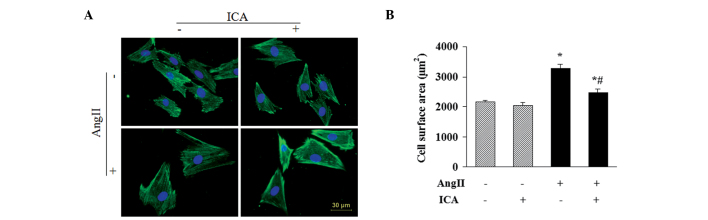
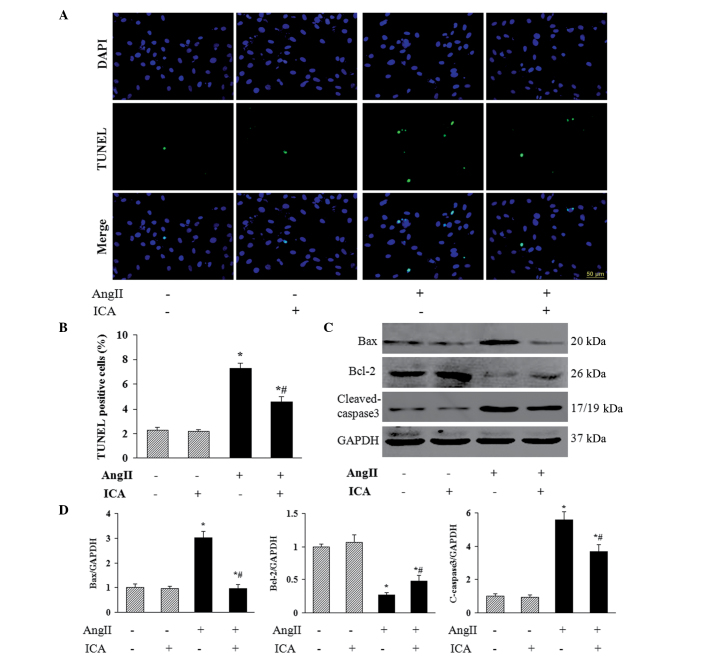
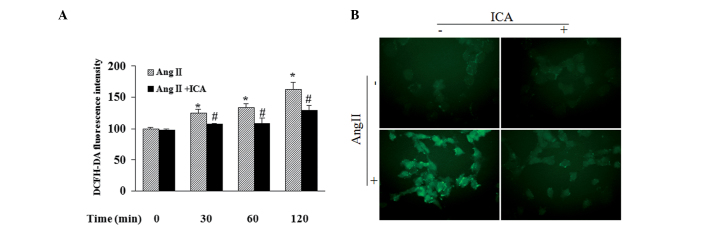
Icariin, the major active component isolated from plants of the Epimedium family, has been reported to have potential protective effects on the cardiovascular system. However, it is not known whether icariin has a direct effect on angiotensin II (Ang II)-induced cardiomyocyte enlargement and apoptosis. In the present study, embryonic rat heart-derived H9c2 cells were stimulated by Ang II, with or without icariin administration. Icariin treatment was found to attenuate the Ang II-induced increase in mRNA expression levels of hypertrophic markers, including atrial natriuretic peptide and B-type natriuretic peptide, in a concentration-dependent manner. The cell surface area of Ang II-treated H9c2 cells also decreased with icariin administration. Furthermore, icariin repressed Ang II-induced cell apoptosis and protein expression levels of Bax and cleaved-caspase 3, while the expression of Bcl-2 was increased by icariin. In addition, 2',7'-dichlorofluorescein diacetate incubation revealed that icariin inhibited the production of intracellular reactive oxygen species (ROS), which were stimulated by Ang II. Phosphorylation of c-Jun N-terminal kinase (JNK) and p38 in Ang II-treated H9c2 cells was blocked by icariin. Therefore, the results of the present study indicated that icariin protected H9c2 cardiomyocytes from Ang II-induced hypertrophy and apoptosis by inhibiting the ROS-dependent JNK and p38 pathways.
淫羊藿苷是从淫羊藿属植物中分离出的主要活性成分,据报道其对心血管系统具有潜在的保护作用。然而,淫羊藿苷是否对血管紧张素II(Ang II)诱导的心肌细胞肥大和凋亡有直接影响尚不清楚。在本研究中,用Ang II刺激胚胎大鼠心脏来源的H9c2细胞,同时给予或不给予淫羊藿苷。结果发现,淫羊藿苷处理能以浓度依赖的方式减弱Ang II诱导的肥大标志物(包括心钠素和B型利钠肽)mRNA表达水平的升高。给予淫羊藿苷后,Ang II处理的H9c2细胞的细胞表面积也减小。此外,淫羊藿苷抑制Ang II诱导的细胞凋亡以及Bax和裂解的半胱天冬酶-3的蛋白表达水平,而淫羊藿苷能增加Bcl-2的表达。另外,二氯荧光素二乙酸酯孵育显示,淫羊藿苷抑制了Ang II刺激产生的细胞内活性氧(ROS)的生成。淫羊藿苷可阻断Ang II处理的H9c2细胞中c-Jun氨基末端激酶(JNK)和p38的磷酸化。因此,本研究结果表明,淫羊藿苷通过抑制ROS依赖的JNK和p38信号通路,保护H9c2心肌细胞免受Ang II诱导的肥大和凋亡。