Masunaga Shin-Ichiro, Sakurai Yoshinori, Tano Keizo, Tanaka Hiroki, Suzuki Minoru, Kondo Natsuko, Narabayashi Masaru, Watanabe Tsubasa, Nakagawa Yosuke, Maruhashi Akira, Ono Koji
Department of Radiation Life and Medical Science, Research Reactor Institute, Kyoto University, Osaka 590-0494, Japan.
Exp Ther Med. 2014 Jul;8(1):291-301. doi: 10.3892/etm.2014.1704. Epub 2014 May 8.
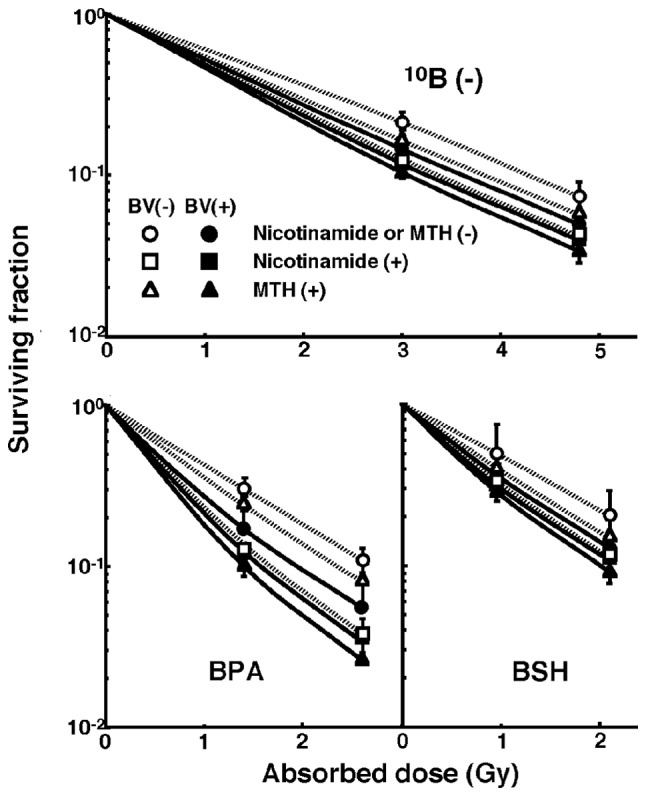
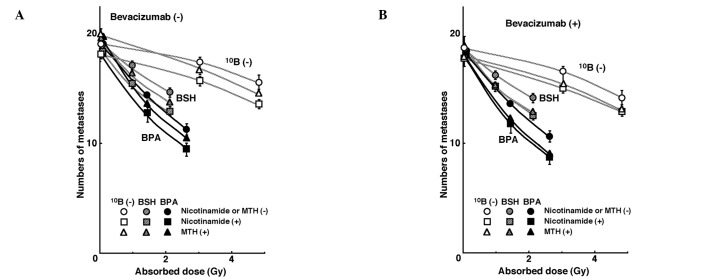
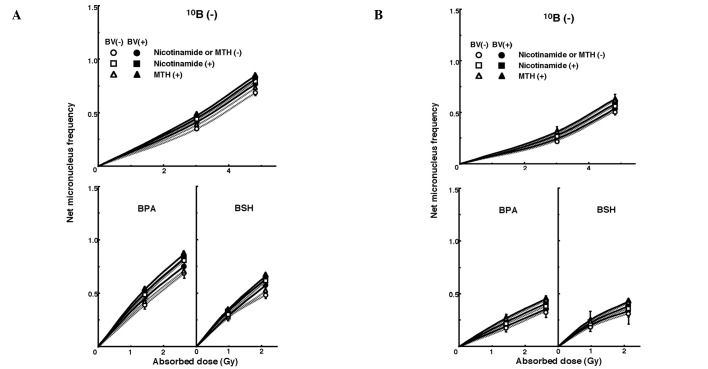
The aim of the present study was to evaluate the effect of bevacizumab on local tumor response and lung metastatic potential during boron neutron capture therapy (BNCT) and in particular, the response of intratumor quiescent (Q) cells. B16-BL6 melanoma tumor-bearing C57BL/6 mice were continuously administered bromodeoxyuridine (BrdU) to label all proliferating (P) tumor cells. The tumors were irradiated with thermal neutron beams following the administration of a B-carrier [L--boronophenylalanine-B (BPA) or sodium mercaptoundecahydrododecaborate-B (BSH)], with or without the administration of bevacizumab. This was further combined with an acute hypoxia-releasing agent (nicotinamide) or mild temperature hyperthermia (MTH, 40°C for 60 min). Immediately following the irradiation, cells from certain tumors were isolated and incubated with a cytokinesis blocker. The responses of the Q cells and the total (P+Q) cell populations were assessed based on the frequency of micronuclei using immunofluorescence staining for BrdU. In other tumor-bearing mice, 17 days following irradiation, lung metastases were enumerated. Three days following bevacizumab administration, the sensitivity of the total tumor cell population following BPA-BNCT had increased more than that following BSH-BNCT. The combination with MTH, but not with nicotinamide, further enhanced total tumor cell population sensitivity. Regardless of the presence of a B-carrier, MTH enhanced the sensitivity of the Q cell population. Regardless of irradiation, the administration of bevacizumab, as well as nicotinamide treatment, demonstrated certain potential in reducing the number of lung metastases especially in BPA-BNCT compared with BSH-BNCT. Thus, the current study revealed that BNCT combined with bevacizumab has the potential to sensitize total tumor cells and cause a reduction in the number of lung metastases to a similar level as nicotinamide.
本研究的目的是评估贝伐单抗在硼中子俘获疗法(BNCT)期间对局部肿瘤反应和肺转移潜能的影响,特别是对肿瘤内静止(Q)细胞的反应。给荷B16-BL6黑色素瘤肿瘤的C57BL/6小鼠连续注射溴脱氧尿苷(BrdU)以标记所有增殖(P)肿瘤细胞。在给予硼载体[L-硼苯丙氨酸硼(BPA)或巯基十一氢十二硼酸钠硼(BSH)]后,用热中子束照射肿瘤,同时给予或不给予贝伐单抗。这进一步与急性缺氧释放剂(烟酰胺)或轻度温度热疗(MTH,40°C持续60分钟)相结合。照射后立即从某些肿瘤中分离细胞并用胞质分裂阻滞剂进行孵育。使用针对BrdU的免疫荧光染色,基于微核频率评估Q细胞和总(P+Q)细胞群体的反应。在其他荷瘤小鼠中,照射后17天,对肺转移灶进行计数。给予贝伐单抗三天后,BPA-BNCT后总肿瘤细胞群体的敏感性比BSH-BNCT后增加得更多。与MTH联合使用而非与烟酰胺联合使用,进一步提高了总肿瘤细胞群体的敏感性。无论是否存在硼载体,MTH均增强了Q细胞群体的敏感性。无论是否照射,与BSH-BNCT相比,给予贝伐单抗以及烟酰胺治疗在减少肺转移灶数量方面都显示出一定潜力,尤其是在BPA-BNCT中。因此,当前研究表明,BNCT联合贝伐单抗有可能使总肿瘤细胞敏感化,并使肺转移灶数量减少至与烟酰胺相似的水平。