Wang Ning, Xu Zhiwen, Wang Kunhao, Zhu Minghui, Li Yang
Department of Computer Science and Technology, Jilin University, Changchun 130012, P.R. China ; Symbol Computation and Knowledge Engineer of Ministry of Education, Jilin University, Changchun 130012, P.R. China.
Oncol Lett. 2014 Apr;7(4):1279-1283. doi: 10.3892/ol.2014.1814. Epub 2014 Jan 20.
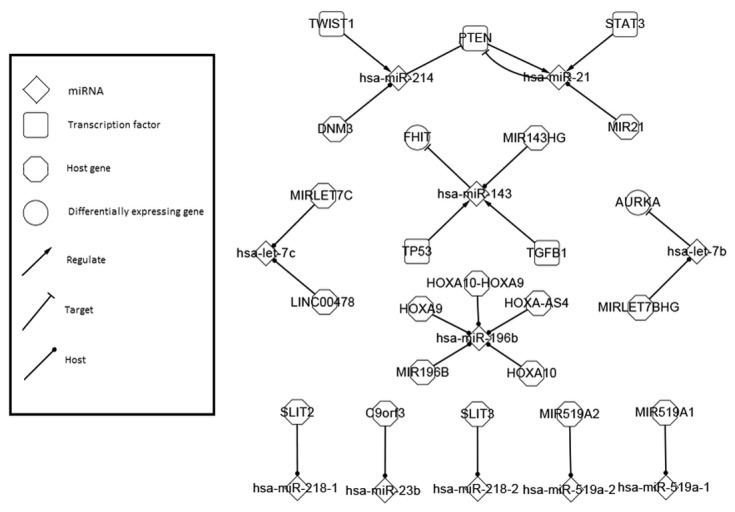
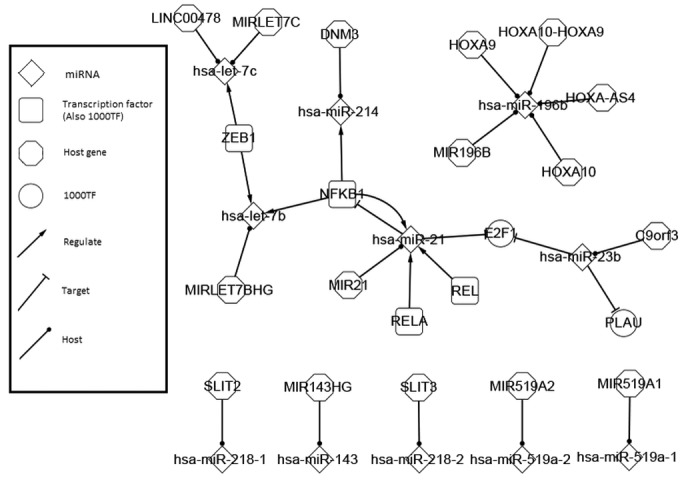
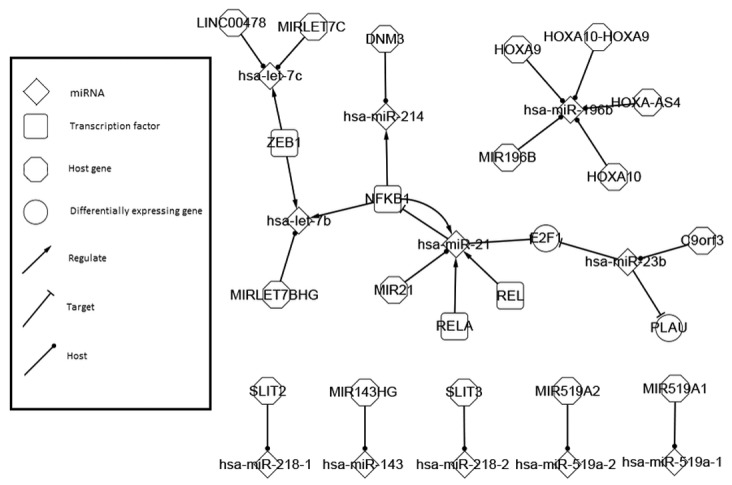
Over recent years, genes and microRNA (miRNA/miR) have been considered as key biological factors in human carcinogenesis. During cancer development, genes may act as multiple identities, including target genes of miRNA, transcription factors and host genes. The present study concentrated on the regulatory networks consisting of the biological factors involved in cervical cancer in order to investigate their features and affect on this specific pathology. Numerous raw data was collected and organized into purposeful structures, and adaptive procedures were defined for application to the prepared data. The networks were therefore built with the factors as basic components according to their interacting associations. The networks were constructed at three levels of interdependency, including a differentially-expressed network, a related network and a global network. Comparisons and analyses were made at a systematic level rather than from an isolated gene or miRNA. Critical hubs were extracted in the core networks and notable features were discussed, including self-adaption feedback regulation. The present study expounds the pathogenesis from a novel point of view and is proposed to provide inspiration for further investigation and therapy.
近年来,基因和微小RNA(miRNA/miR)被认为是人类致癌过程中的关键生物学因素。在癌症发展过程中,基因可能具有多种身份,包括miRNA的靶基因、转录因子和宿主基因。本研究聚焦于由宫颈癌相关生物学因素组成的调控网络,以探究其特征及其对这种特定病理学的影响。收集了大量原始数据并将其组织成有目的的结构,并定义了适用于所准备数据的适应性程序。因此,根据这些因素之间的相互作用关联,以这些因素为基本组成部分构建了网络。这些网络在三个相互依存层次上构建,包括差异表达网络、相关网络和全局网络。比较和分析是在系统层面进行的,而不是从单个孤立的基因或miRNA出发。在核心网络中提取了关键枢纽,并讨论了显著特征,包括自适应反馈调节。本研究从一个新的角度阐述了发病机制,并旨在为进一步的研究和治疗提供启示。