Wang Hao, Luo Jiamao, Liu Chun, Niu Huilin, Wang Jing, Liu Qi, Zhao Zhongming, Xu Hua, Ding Yanqing, Sun Jingchun, Zhang Qingling
Department of Pathology, Nanfang Hospital, Southern Medical University, Guangzhou, 510515, China.
Department of Pathology, College of Basic Medicine, Southern Medical University, Guangzhou, 510515, China.
BMC Bioinformatics. 2017 Sep 2;18(1):388. doi: 10.1186/s12859-017-1796-4.
Colorectal cancer (CRC) is one of the most common malignancies worldwide with poor prognosis. Studies have showed that abnormal microRNA (miRNA) expression can affect CRC pathogenesis and development through targeting critical genes in cellular system. However, it is unclear about which miRNAs play central roles in CRC's pathogenesis and how they interact with transcription factors (TFs) to regulate the cancer-related genes.
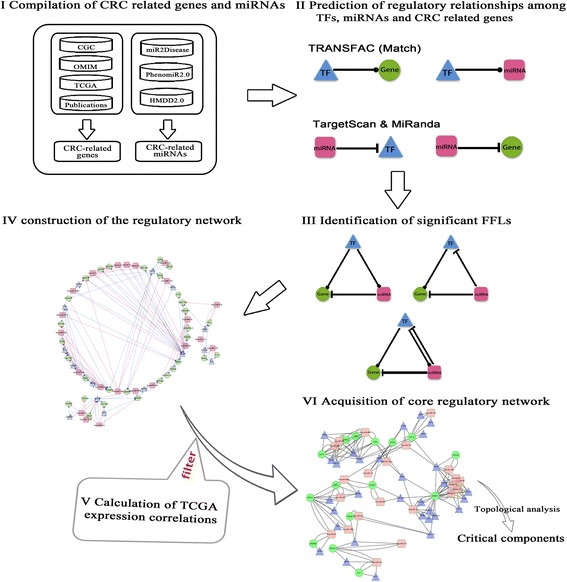
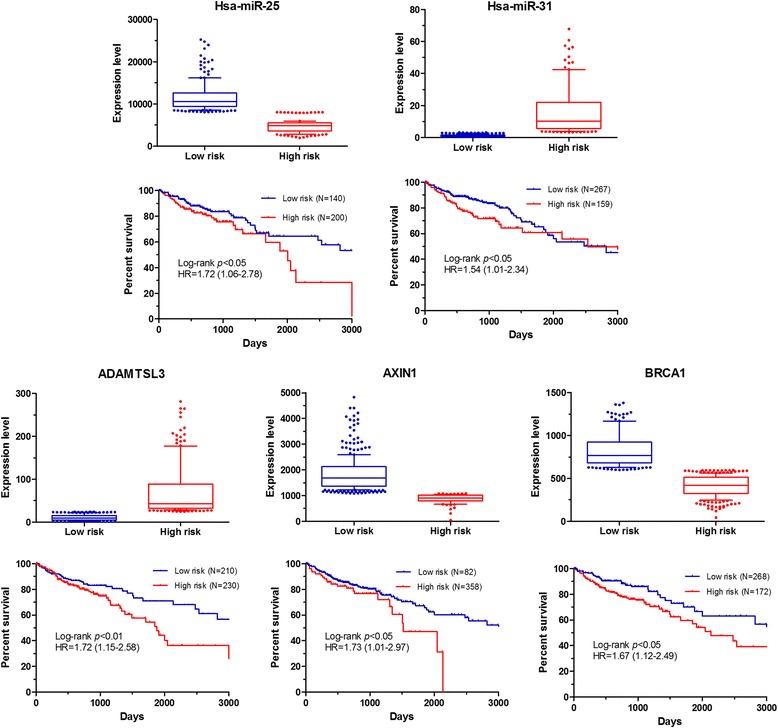
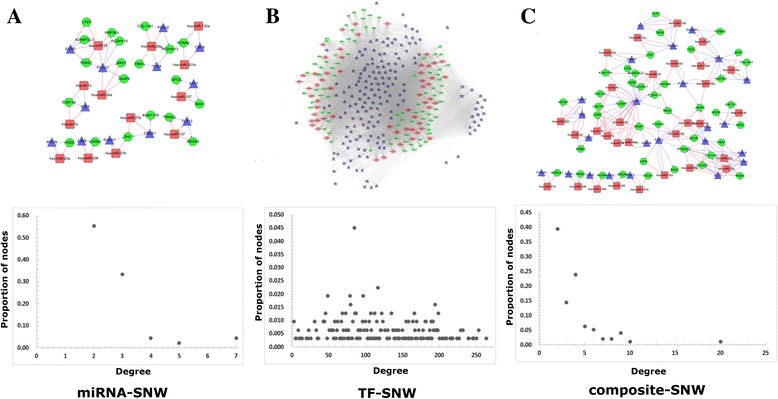
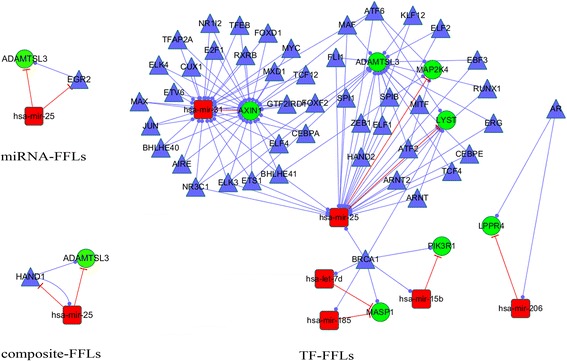
To address this issue, we systematically explored the major regulation motifs, namely feed-forward loops (FFLs), that consist of miRNAs, TFs and CRC-related genes through the construction of a miRNA-TF regulatory network in CRC. First, we compiled CRC-related miRNAs, CRC-related genes, and human TFs from multiple data sources. Second, we identified 13,123 3-node FFLs including 25 miRNA-FFLs, 13,005 TF-FFLs and 93 composite-FFLs, and merged the 3-node FFLs to construct a CRC-related regulatory network. The network consists of three types of regulatory subnetworks (SNWs): miRNA-SNW, TF-SNW, and composite-SNW. To enhance the accuracy of the network, the results were filtered by using The Cancer Genome Atlas (TCGA) expression data in CRC, whereby we generated a core regulatory network consisting of 58 significant FFLs. We then applied a hub identification strategy to the significant FFLs and found 5 significant components, including two miRNAs (hsa-miR-25 and hsa-miR-31), two genes (ADAMTSL3 and AXIN1) and one TF (BRCA1). The follow up prognosis analysis indicated all of the 5 significant components having good prediction of overall survival of CRC patients.
In summary, we generated a CRC-specific miRNA-TF regulatory network, which is helpful to understand the complex CRC regulatory mechanisms and guide clinical treatment. The discovered 5 regulators might have critical roles in CRC pathogenesis and warrant future investigation.
结直肠癌(CRC)是全球最常见的恶性肿瘤之一,预后较差。研究表明,异常的微小RNA(miRNA)表达可通过靶向细胞系统中的关键基因影响CRC的发病机制和发展。然而,尚不清楚哪些miRNA在CRC发病机制中起核心作用,以及它们如何与转录因子(TFs)相互作用以调节癌症相关基因。
为解决这一问题,我们通过构建CRC中的miRNA-TF调控网络,系统地探索了由miRNA、TFs和CRC相关基因组成的主要调控基序,即前馈环(FFLs)。首先,我们从多个数据源汇编了CRC相关的miRNA、CRC相关基因和人类TFs。其次,我们鉴定了13,123个三节点FFLs,包括25个miRNA-FFLs、13,005个TF-FFLs和93个复合FFLs,并将这些三节点FFLs合并以构建CRC相关调控网络。该网络由三种类型的调控子网(SNWs)组成:miRNA-SNW、TF-SNW和复合SNW。为提高网络的准确性,我们使用CRC中的癌症基因组图谱(TCGA)表达数据对结果进行筛选,从而生成了一个由58个重要FFLs组成的核心调控网络。然后,我们对重要FFLs应用枢纽识别策略,发现了5个重要成分,包括两个miRNA(hsa-miR-25和hsa-miR-31)、两个基因(ADAMTSL3和AXIN1)和一个TF(BRCA1)。后续的预后分析表明,所有这5个重要成分对CRC患者的总生存期都有良好的预测作用。
总之,我们生成了一个CRC特异性的miRNA-TF调控网络,这有助于理解复杂CRC调控机制并指导临床治疗。发现的这5个调控因子可能在CRC发病机制中起关键作用,值得未来进一步研究。