Yu Dandan, Xu Ling, Liu Xiao-Hong, Fan Yu, Lü Long-Bao, Yao Yong-Gang
Key Laboratory of Animal Models and Human Disease Mechanisms of Chinese Academy of Sciences & Yunnan Province, Kunming Institute of Zoology, Kunming, Yunnan, China.
Key Laboratory of Animal Models and Human Disease Mechanisms of Chinese Academy of Sciences & Yunnan Province, Kunming Institute of Zoology, Kunming, Yunnan, China; Kunming College of Life Science, University of Chinese Academy of Sciences, Kunming, Yunnan, China.
PLoS One. 2014 Jun 19;9(6):e99859. doi: 10.1371/journal.pone.0099859. eCollection 2014.
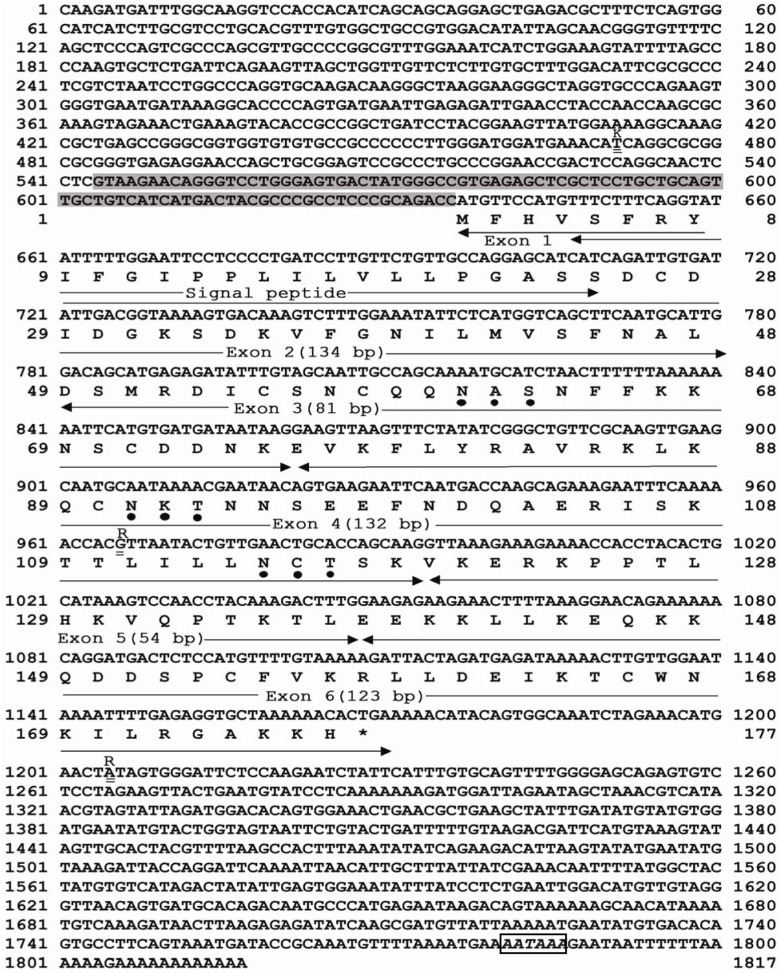
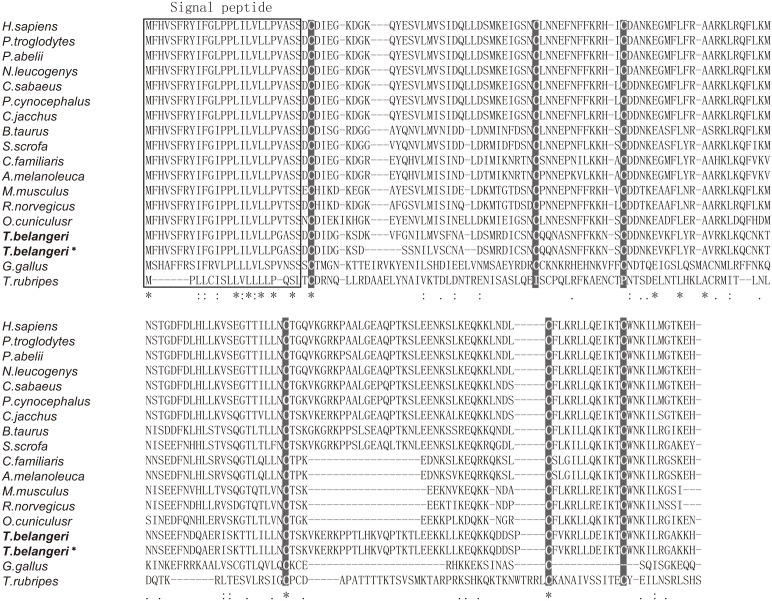
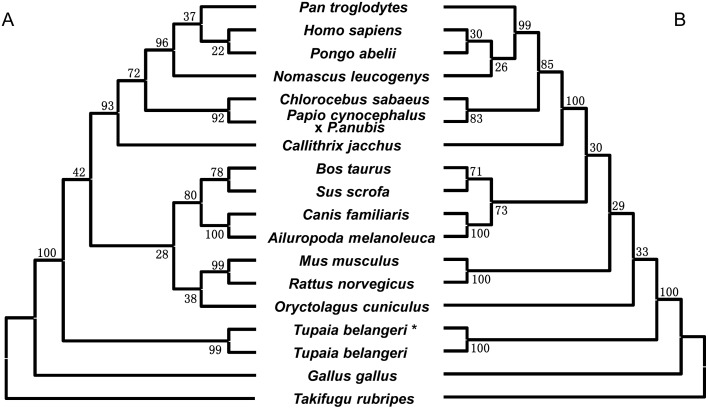
Interleukin-7 (IL7) is a pleiotropic cytokine that is actively involved in the immune system. The Chinese tree shrew (Tupaia belangeri chinensis) has been proposed as an alternative experimental animal to primates in biomedical research. However, there is a lack of biological knowledge about the immune system of the tree shrew. In this study, we cloned the IL7 gene (tIL7) in the Chinese tree shrew and quantified the expression of mRNA transcripts in eight tissues (heart, liver, spleen, lung, kidney, intestine, skeletal muscle and brain) from 20 individuals. Eleven tIL7 mRNA transcripts were identified in different tissues. The canonical form (tIL7c) had a length of 1817 bp and encoded a predicted gene product with 177 amino acids. Phylogenetic analyses based on the amino acid sequences revealed a considerably large genetic difference between tree shrew and human. Quantification of mRNA expression of transcripts tIL7c, tIL7-sv1, tIL7-sv2 and tIL7-sv3 showed that these transcripts were expressed in all tissues, albeit the expression levels varied in different tissues. Transcripts tIL7c, tIL7-sv1, and tIL7-sv2 had the lowest expression in brain, and tIL7-sv3 had a dramatically high mRNA expression in skeletal muscle and heart. The mRNA expression levels of tIL7c and tIL7-sv1 were significantly increased upon ploy(I:C) stimulation in tree shrew primary renal cells. As with human full-length IL7, tIL7c, tIL7-sv1, tIL7-sv2 and tIL7-sv3 showed similar a subcellular localization pattern. Our results identified diverse tIL7 transcripts in the Chinese tree shrew, which may play a potential role in modulating IL7-regulated biological effects.
白细胞介素-7(IL7)是一种多效性细胞因子,积极参与免疫系统。中国树鼩(Tupaia belangeri chinensis)已被提议作为生物医学研究中灵长类动物的替代实验动物。然而,关于树鼩免疫系统的生物学知识匮乏。在本研究中,我们克隆了中国树鼩的IL7基因(tIL7),并对20只个体的八个组织(心脏、肝脏、脾脏、肺、肾脏、肠道、骨骼肌和脑)中的mRNA转录本表达进行了定量。在不同组织中鉴定出11种tIL7 mRNA转录本。标准形式(tIL7c)长度为1817 bp,编码一个预测的含177个氨基酸的基因产物。基于氨基酸序列的系统发育分析显示,树鼩和人类之间存在相当大的遗传差异。对转录本tIL7c、tIL7-sv1、tIL7-sv2和tIL7-sv3的mRNA表达定量表明,这些转录本在所有组织中均有表达,尽管在不同组织中的表达水平有所不同。转录本tIL7c、tIL7-sv1和tIL7-sv2在脑中表达最低,而tIL7-sv3在骨骼肌和心脏中mRNA表达极高。在树鼩原代肾细胞中,ploy(I:C)刺激后tIL7c和tIL7-sv1的mRNA表达水平显著增加。与人类全长IL7一样,tIL7c、tIL7-sv1、tIL7-sv2和tIL7-sv3表现出相似的亚细胞定位模式。我们的结果在中华树鼩中鉴定出多种tIL7转录本,它们可能在调节IL7调控的生物学效应中发挥潜在作用。