Stigliano Egidio, Di Sansebastiano Gian-Pietro, Neuhaus Jean-Marc
Laboratory of Cell and Molecular Biology, University of Neuchâtel, Rue Emile-Argand 11, Neuchâtel CH-2000, Switzerland.
DiSTeBA (Department of Biological and Environmental Sciences and Technologies), University of Salento, Campus ECOTEKNE, S.P. 6, Lecce-Monteroni, Lecce 73100, Italy.
Int J Mol Sci. 2014 Jun 18;15(6):11030-9. doi: 10.3390/ijms150611030.
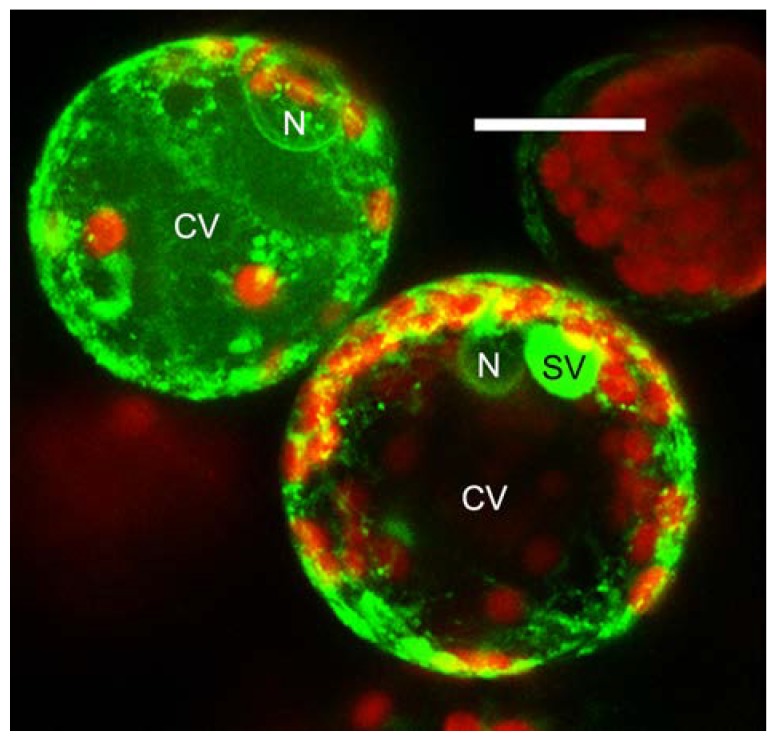
Plant chitinases have been studied for their importance in the defense of crop plants from pathogen attacks and for their peculiar vacuolar sorting determinants. A peculiarity of the sequence of many family 19 chitinases is the presence of a C-terminal extension that seems to be important for their correct recognition by the vacuole sorting machinery. The 7 amino acids long C-terminal vacuolar sorting determinant (CtVSD) of tobacco chitinase A is necessary and sufficient for the transport to the vacuole. This VSD shares no homology with other CtVSDs such as the phaseolin's tetrapeptide AFVY (AlaPheValTyr) and it is also sorted by different mechanisms. While a receptor for this signal has not yet been convincingly identified, the research using the chitinase CtVSD has been very informative, leading to the observation of phenomena otherwise difficult to observe such as the presence of separate vacuoles in differentiating cells and the existence of a Golgi-independent route to the vacuole. Thanks to these new insights in the endoplasmic reticulum (ER)-to-vacuole transport, GFPChi (Green Fluorescent Protein carrying the chitinase A CtVSD) and other markers based on chitinase signals will continue to help the investigation of vacuolar biogenesis in plants.
植物几丁质酶因其在保护作物免受病原体侵袭方面的重要性以及其独特的液泡分选决定因素而受到研究。许多19家族几丁质酶序列的一个特点是存在一个C末端延伸,这似乎对液泡分选机制对它们的正确识别很重要。烟草几丁质酶A的7个氨基酸长的C末端液泡分选决定因素(CtVSD)对于转运到液泡是必要且充分的。这个VSD与其他CtVSD(如菜豆蛋白的四肽AFVY(丙氨酸-苯丙氨酸-缬氨酸-酪氨酸))没有同源性,并且它也是通过不同机制进行分选的。虽然尚未令人信服地鉴定出该信号的受体,但使用几丁质酶CtVSD的研究提供了很多信息,导致观察到了一些否则难以观察到的现象,例如分化细胞中存在单独的液泡以及存在一条不依赖高尔基体的通往液泡的途径。由于在内质网(ER)到液泡运输方面的这些新见解,GFPChi(携带几丁质酶A CtVSD的绿色荧光蛋白)和其他基于几丁质酶信号的标记物将继续有助于研究植物中的液泡生物发生。