May Sarah L, Zhou Qing, Lewellen Mitzi, Carter Cristan M, Coffey David, Highfill Steven L, Bucher Christoph M, Matise Ilze, Morse Herbert C, O'Sullivan M Gerard, Schutten Melissa, Johnson Charles, Bellgrau Donald, Blazar Bruce R, Modiano Jaime F
Masonic Cancer Center, University of Minnesota, Minneapolis, Minnesota, United States of America; Department of Veterinary Clinical Sciences, College of Veterinary Medicine, University of Minnesota, St Paul, Minnesota, United States of America.
Masonic Cancer Center, University of Minnesota, Minneapolis, Minnesota, United States of America; Department of Pediatrics, School of Medicine, University of Minnesota, Minneapolis, Minnesota, United States of America.
PLoS One. 2014 Jun 19;9(6):e100629. doi: 10.1371/journal.pone.0100629. eCollection 2014.
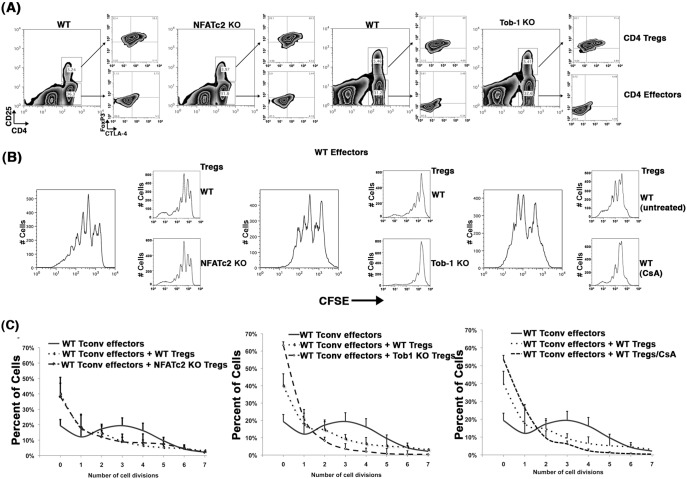
Nfatc2 and Tob1 are intrinsic negative regulators of T cell activation. Nfatc2-deficient and Tob1-deficient T cells show reduced thresholds of activation; however, whether these factors have independent or overlapping roles in negative regulation of T cell responses has not been previously examined. Here, we show that Nfatc2 knockout (KO) but not Tob1 KO mice have age-associated accumulation of persistently activated T cells in vivo and expansion of the CD44+ memory cell compartment and age-associated lymphocytic infiltrates in visceral organs, without significant changes in numbers of CD4+CD25+Foxp3+ regulatory T cells (Treg). In vitro, CD4+CD25- "conventional" T cells (Tconvs) from both KO strains showed greater proliferation than wild type (WT) Tconvs. However, while Tregs from Nfatc2 KO mice retained normal suppressive function, Tregs from Tob1 KOs had enhanced suppressive activity. Nfatc2 KO Tconvs expanded somewhat more rapidly than WT Tconvs under conditions of homeostatic proliferation, but their accelerated growth capacity was negated, at least acutely, in a lymphoreplete environment. Finally, Nfatc2 KO mice developed a previously uncharacterized increase in B-cell malignancies, which was not accelerated by the absence of Tob1. The data thus support the prevailing hypothesis that Nfatc2 and Tob1 are non-redundant regulators of lymphocyte homeostasis.
Nfatc2和Tob1是T细胞活化的内在负调节因子。Nfatc2缺陷型和Tob1缺陷型T细胞的活化阈值降低;然而,这些因子在T细胞反应的负调节中是具有独立作用还是重叠作用,此前尚未得到研究。在此,我们表明,Nfatc2基因敲除(KO)小鼠而非Tob1 KO小鼠在体内存在与年龄相关的持续活化T细胞积累、CD44+记忆细胞区室扩大以及内脏器官中与年龄相关的淋巴细胞浸润,而CD4+CD25+Foxp3+调节性T细胞(Treg)数量无显著变化。在体外,两种KO品系的CD4+CD25- “常规”T细胞(Tconvs)比野生型(WT)Tconvs表现出更强的增殖能力。然而,虽然Nfatc2 KO小鼠的Tregs保留了正常的抑制功能,但Tob1 KO小鼠的Tregs具有增强的抑制活性。在稳态增殖条件下,Nfatc2 KO Tconvs的扩增速度比WT Tconvs略快,但在淋巴细胞充足的环境中,它们加速生长的能力至少在急性情况下被抵消。最后,Nfatc2 KO小鼠出现了一种以前未被描述的B细胞恶性肿瘤增加的情况,而Tob1的缺失并未加速这种情况。因此,这些数据支持了普遍的假设,即Nfatc2和Tob1是淋巴细胞稳态的非冗余调节因子。