Bioinformatics Program, Taiwan International Graduate Program, Academia Sinica, Taipei 115, Taiwan, R.O.C.; Institute of Biomedical Informatics, National Yang-Ming University, Taipei 112, Taiwan, R.O.C.
Institute of Statistical Science, Academia Sinica, Taipei 115, Taiwan, R.O.C.
Neoplasia. 2014 May;16(5):441-50. doi: 10.1016/j.neo.2014.04.007. Epub 2014 Jun 17.
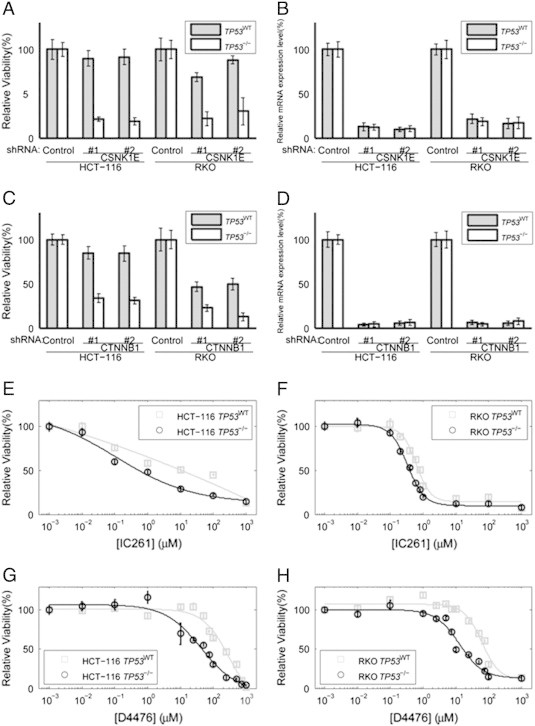
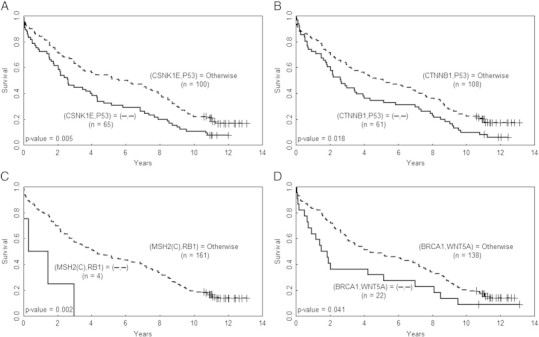
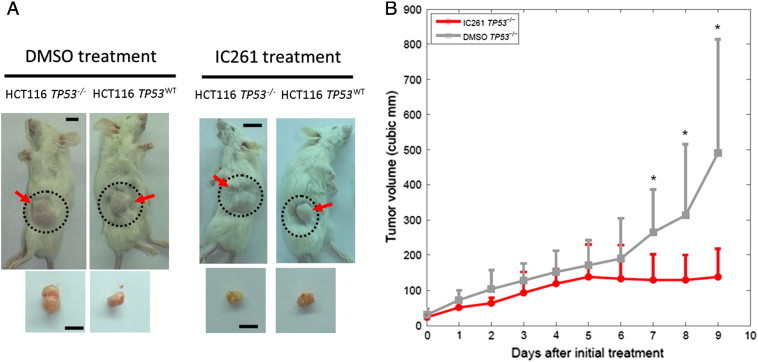
Two genes are called synthetic lethal (SL) if their simultaneous mutations lead to cell death, but each individual mutation does not. Targeting SL partners of mutated cancer genes can kill cancer cells specifically, but leave normal cells intact. We present an integrated approach to uncovering SL pairs in colorectal cancer (CRC). Screening verified SL pairs using microarray gene expression data of cancerous and normal tissues, we first identified potential functionally relevant (simultaneously differentially expressed) gene pairs. From the top-ranked pairs, ~20 genes were chosen for immunohistochemistry (IHC) staining in 171 CRC patients. To find novel SL pairs, all 169 combined pairs from the individual IHC were synergistically correlated to five clinicopathological features, e.g. overall survival. Of the 11 predicted SL pairs, MSH2-POLB and CSNK1E-MYC were consistent with literature, and we validated the top two pairs, CSNK1E-TP53 and CTNNB1-TP53 using RNAi knockdown and small molecule inhibitors of CSNK1E in isogenic HCT-116 and RKO cells. Furthermore, synthetic lethality of CSNK1E and TP53 was verified in mouse model. Importantly, multivariate analysis revealed that CSNK1E-P53, CTNNB1-P53, MSH2-RB1, and BRCA1-WNT5A were independent prognosis markers from stage, with CSNK1E-P53 applicable to early-stage and the remaining three throughout all stages. Our findings suggest that CSNK1E is a promising target for TP53-mutant CRC patients which constitute ~40% to 50% of patients, while to date safety regarding inhibition of TP53 is controversial. Thus the integrated approach is useful in finding novel SL pairs for cancer therapeutics, and it is readily accessible and applicable to other cancers.
两个基因如果同时突变会导致细胞死亡,而每个单独的突变都不会,那么这两个基因就被称为合成致死(SL)。靶向突变癌症基因的 SL 伙伴可以特异性杀死癌细胞,而正常细胞不受影响。我们提出了一种综合方法来揭示结直肠癌(CRC)中的 SL 对。我们使用癌症和正常组织的微阵列基因表达数据筛选验证 SL 对,首先确定了潜在的功能相关(同时差异表达)基因对。在排名最高的对中,从 171 名 CRC 患者中选择了约 20 个基因进行免疫组织化学(IHC)染色。为了寻找新的 SL 对,对所有 169 个单独的 IHC 组合进行协同相关性分析,以评估与五个临床病理特征(如总生存期)的相关性。在预测的 11 对 SL 中,MSH2-POLB 和 CSNK1E-MYC 与文献一致,我们使用 RNAi 敲低和 CSNK1E 的小分子抑制剂在同源 HCT-116 和 RKO 细胞中验证了前两对 CSNK1E-TP53 和 CTNNB1-TP53。此外,CSNK1E 和 TP53 的合成致死性在小鼠模型中得到了验证。重要的是,多变量分析显示 CSNK1E-P53、CTNNB1-P53、MSH2-RB1 和 BRCA1-WNT5A 是独立的预后标志物,与分期有关,CSNK1E-P53 适用于早期阶段,其余三个适用于所有阶段。我们的研究结果表明,CSNK1E 是一种很有前途的靶点,适用于约 40%至 50%的 TP53 突变型 CRC 患者,而目前关于抑制 TP53 的安全性仍存在争议。因此,这种综合方法在寻找癌症治疗的新型 SL 对方面是有用的,而且它易于获取和适用于其他癌症。