Kristjánsdóttir Björg, Partheen Karolina, Fung Eric T, Yip Christine, Levan Kristina, Sundfeldt Karin
Department of Obstetrics and Gynecology, Institute of Clinical Sciences, University of Gothenburg, Gothenburg, Sweden.
Cancer Med. 2014 Oct;3(5):1302-12. doi: 10.1002/cam4.282. Epub 2014 Jun 20.
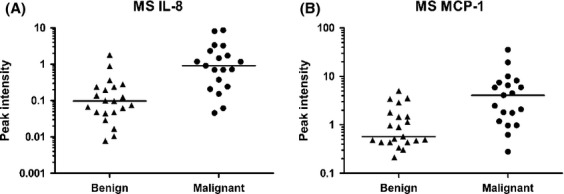
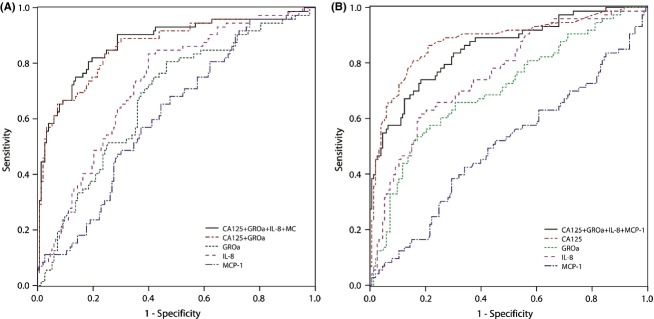
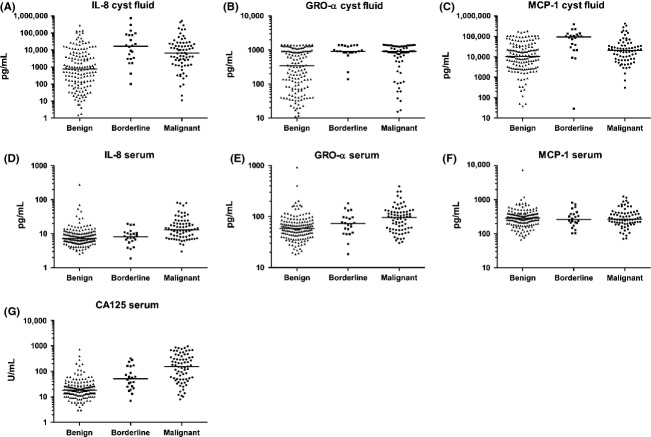
Mortality rates for epithelial ovarian cancer (EOC) are high, mainly due to late-stage diagnosis. The identification of biomarkers for this cancer could contribute to earlier diagnosis and increased survival rates. Given that chronic inflammation plays a central role in cancer initiation and progression, we selected and tested 15 cancer-related cytokines and growth factors in 38 ovarian cyst fluid samples. We used ovarian cyst fluid since it is found in proximity to the pathology and mined it for inflammatory biomarkers suitable for early detection of EOC. Immunoprecipitation and high-throughput sample fractionation were obtained by using tandem antibody libraries bead and mass spectrometry. Two proteins, monocyte chemoattractant protein-1 (MCP-1/CCL2) and interleucin-8 (IL-8/CXCL8), were significantly (P < 0.0001) higher in the malignant (n = 16) versus benign (n = 22) tumor cysts. Validation of MCP-1, IL-8, and growth-regulated protein-α (GROα/CXCL1) was performed with ELISA in benign, borderline, and malignant cyst fluids (n = 256) and corresponding serum (n = 256). CA125 was measured in serum from all patients and used in the algorithms performed. MCP-1, IL-8, and GROα are proinflammatory cytokines and promoters of tumor growth. From 5- to 100-fold higher concentrations of MCP-1, IL-8 and GROα were detected in the cyst fluids compared to the serum. Significant (P < 0.001) cytokine response was already established in borderline cyst fluids and stage I EOC. In serum a significant (P < 0.01) increase of IL-8 and GROα was found, but not until stage I and stage III EOC, respectively. These findings confirm that early events in tumorigenesis can be analyzed and detected in the tumor environment and we conclude that ovarian cyst fluid is a promising source in the search for new biomarkers for early ovarian tumors.
上皮性卵巢癌(EOC)的死亡率很高,主要原因是诊断时已处于晚期。确定该癌症的生物标志物有助于早期诊断并提高生存率。鉴于慢性炎症在癌症的发生和发展中起着核心作用,我们在38份卵巢囊肿液样本中筛选并检测了15种与癌症相关的细胞因子和生长因子。我们使用卵巢囊肿液是因为它靠近病变部位,并从中挖掘适合早期检测EOC的炎症生物标志物。通过使用串联抗体文库磁珠和质谱法进行免疫沉淀和高通量样本分级分离。在恶性(n = 16)与良性(n = 22)肿瘤囊肿中,两种蛋白质,单核细胞趋化蛋白-1(MCP-1/CCL2)和白细胞介素-8(IL-8/CXCL8)显著(P < 0.0001)升高。使用酶联免疫吸附测定法(ELISA)在良性、交界性和恶性囊肿液(n = 256)及相应血清(n = 256)中对MCP-1、IL-8和生长调节蛋白-α(GROα/CXCL1)进行验证。对所有患者的血清进行CA125检测并用于所执行的算法中。MCP-1、IL-8和GROα是促炎细胞因子和肿瘤生长促进剂。与血清相比,在囊肿液中检测到的MCP-1、IL-8和GROα浓度高5至100倍。在交界性囊肿液和I期EOC中已建立显著(P < 0.001)的细胞因子反应。在血清中,分别直到I期和III期EOC才发现IL-8和GROα有显著(P < 0.01)升高。这些发现证实肿瘤发生的早期事件可以在肿瘤环境中进行分析和检测,我们得出结论,卵巢囊肿液是寻找早期卵巢肿瘤新生物标志物的一个有前景的来源。