Huang Shiyong, Zhong XiaoMing, Gao Jun, Song Rongfeng, Wu Hongyu, Zi Shuming, Yang Shijie, Du Peng, Cui Long, Yang Chun, Li Zikang
Department of Anorectal Surgery and Colorectal Cancer Center, Xinhua Hospital, School of Medicine, Shanghai Jiao Tong University, No. 1665 Kongjiang Road, Shanghai 200092, China.
Department of Tumor Radiotherapy and Chemotherapy, Jiangxi Tumor Hospital, Nanchang, China.
Biomed Res Int. 2014;2014:256723. doi: 10.1155/2014/256723. Epub 2014 May 14.
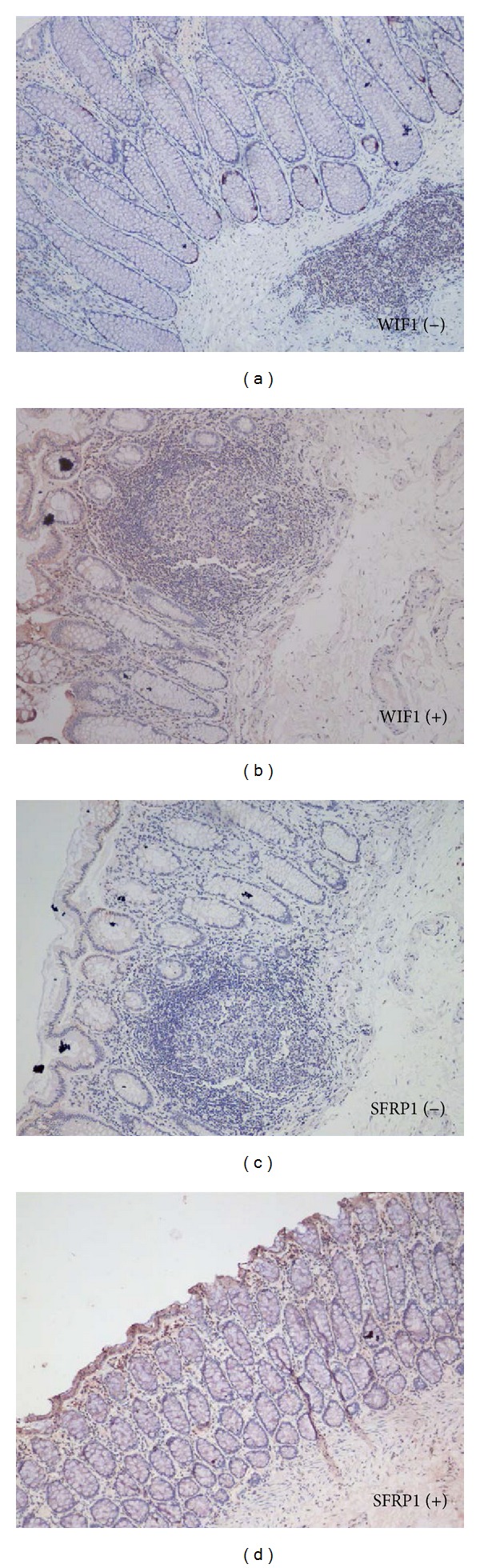
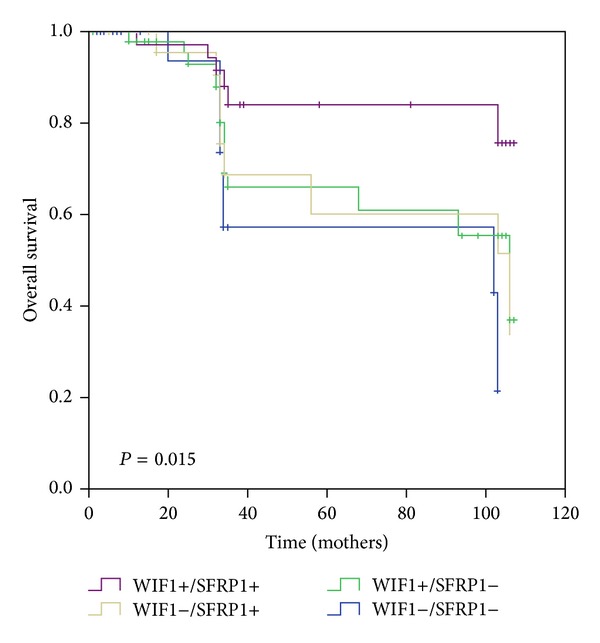
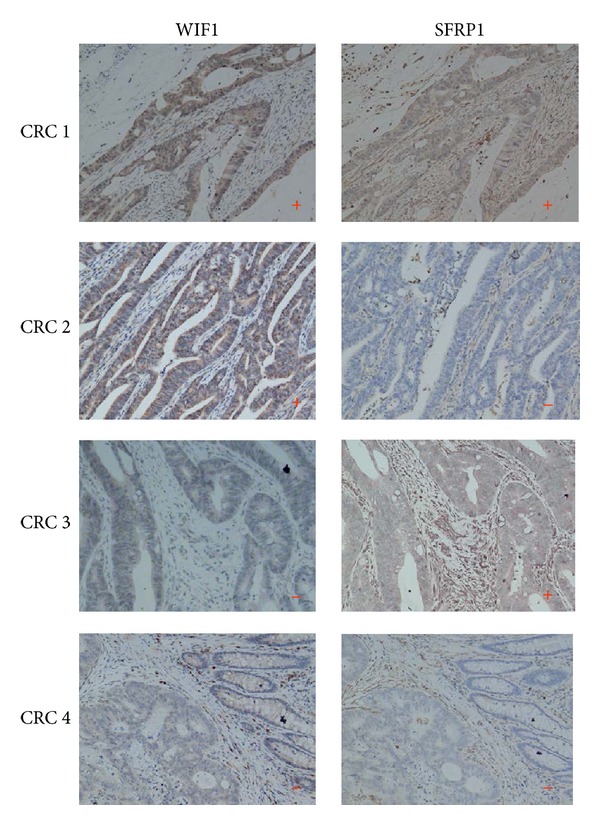
Colorectal tumorigenesis is ascribed to the activity of Wnt signaling pathway in a ligand-independent manner mainly through APC and CTNNB1 gene mutations and in a ligand-dependent manner through low expression of Wnt inhibitors such as WNT inhibitory factor 1 (WIF1) and secreted frizzled related protein 1 (SFRP1). In this study we found that WIF1 protein expression was increased and SFRP1 was decreased significantly in CRC tissue versus normal tissue, and high expression of WIF1 was associated with big tumor diameters and deep invasion, and loss of SFRP1 expression was associated with the left lesion site, deep invasion, and high TNM stage. Among the four expression patterns (WIF+/SFRP1+, WIF+/SFRP1-, WIF-/SFRP1+, and WIF-/SFRP1-) only coexpression of WIF1 and SFRP1 (WIF+/SFRP1+) was associated with favorable overall survival, together with low TNM stage, as an independent prognostic factor as shown in a multivariate survival model. The results indicated that WIF1 seemed to play an oncogenic role, while SFRP1 seemed to play an oncosuppressive role although both of them are secreted Wnt antagonists. Coexpression of SFRP1 and WIF1, rather than SFRP1 or WIF1 alone, could be used, together with low TNM stage, as a prognostic predictor of favorable outcomes in CRC.
结直肠癌的发生主要通过APC和CTNNB1基因突变以非配体依赖的方式归因于Wnt信号通路的活性,以及通过Wnt抑制剂如WNT抑制因子1(WIF1)和分泌型卷曲相关蛋白1(SFRP1)的低表达以配体依赖的方式归因于Wnt信号通路的活性。在本研究中,我们发现与正常组织相比,结直肠癌组织中WIF1蛋白表达增加而SFRP1显著降低,WIF1的高表达与肿瘤直径大及深层浸润相关,SFRP1表达缺失与病变位于左侧、深层浸润及高TNM分期相关。在四种表达模式(WIF+/SFRP1+、WIF+/SFRP1-、WIF-/SFRP1+和WIF-/SFRP1-)中,只有WIF1和SFRP1的共表达(WIF+/SFRP1+)与良好的总生存期相关,同时与低TNM分期相关,如多变量生存模型所示,作为一个独立的预后因素。结果表明,尽管WIF1和SFRP1都是分泌型Wnt拮抗剂,但WIF1似乎发挥致癌作用,而SFRP1似乎发挥肿瘤抑制作用。SFRP1和WIF1的共表达,而非单独的SFRP1或WIF1,可与低TNM分期一起作为结直肠癌预后良好的预测指标。