1] Novo Nordisk Foundation Center for Protein Research, Faculty of Health Sciences, University of Copenhagen, Copenhagen, Denmark. [2] The Danish National Research Foundation Centre for Cardiac Arrhythmia, Copenhagen, Denmark. [3] The Broad Institute of Harvard and MIT, Cambridge, Massachusetts, USA. [4].
1] The Broad Institute of Harvard and MIT, Cambridge, Massachusetts, USA. [2] Analytic and Translational Genetics Unit, Massachusetts General Hospital, Boston, Massachusetts, USA. [3] MD/PhD Program and Health Sciences and Technology Program, Harvard Medical School, Boston, USA. [4].
Nat Methods. 2014 Aug;11(8):868-74. doi: 10.1038/nmeth.2997. Epub 2014 Jun 22.
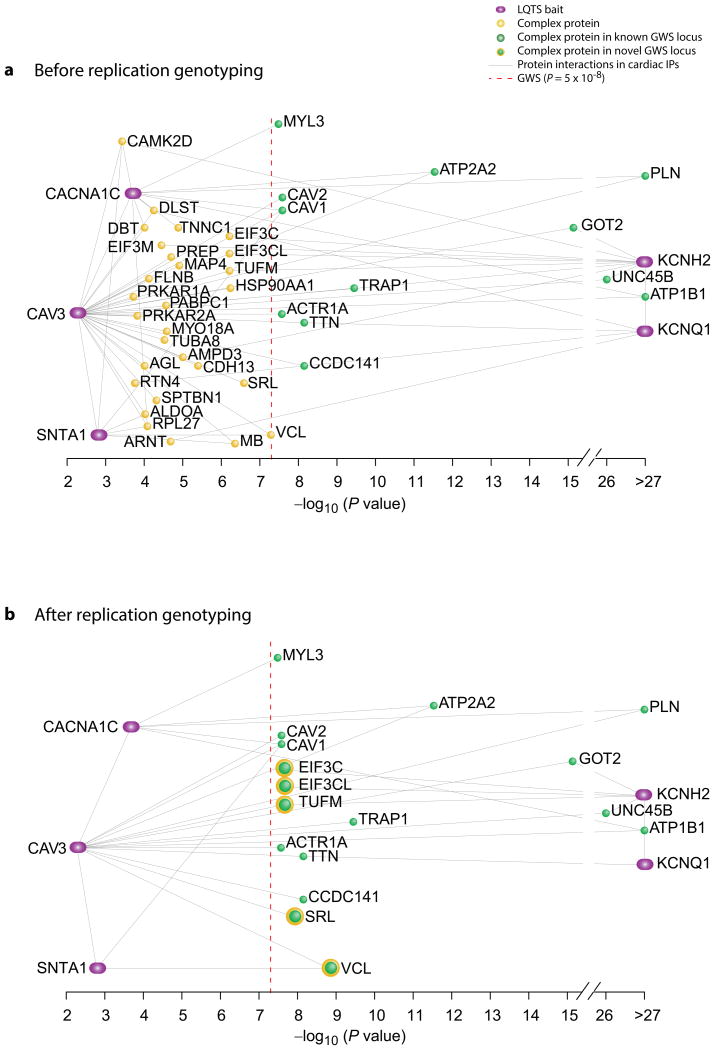
Genome-wide association studies (GWAS) have identified thousands of loci associated with complex traits, but it is challenging to pinpoint causal genes in these loci and to exploit subtle association signals. We used tissue-specific quantitative interaction proteomics to map a network of five genes involved in the Mendelian disorder long QT syndrome (LQTS). We integrated the LQTS network with GWAS loci from the corresponding common complex trait, QT-interval variation, to identify candidate genes that were subsequently confirmed in Xenopus laevis oocytes and zebrafish. We used the LQTS protein network to filter weak GWAS signals by identifying single-nucleotide polymorphisms (SNPs) in proximity to genes in the network supported by strong proteomic evidence. Three SNPs passing this filter reached genome-wide significance after replication genotyping. Overall, we present a general strategy to propose candidates in GWAS loci for functional studies and to systematically filter subtle association signals using tissue-specific quantitative interaction proteomics.
全基因组关联研究(GWAS)已经确定了数千个与复杂性状相关的基因座,但确定这些基因座中的因果基因并利用微妙的关联信号具有挑战性。我们使用组织特异性定量相互作用蛋白质组学来绘制涉及孟德尔疾病长 QT 综合征(LQTS)的五个基因的网络。我们将 LQTS 网络与来自相应常见复杂性状 QT 间期变异的 GWAS 基因座整合在一起,以鉴定候选基因,随后在非洲爪蟾卵母细胞和斑马鱼中得到证实。我们使用 LQTS 蛋白质网络通过鉴定蛋白质组学证据强烈支持的网络中基因附近的单核苷酸多态性(SNP)来筛选弱 GWAS 信号。经过复制基因分型后,通过此筛选的三个 SNP 达到全基因组显着性。总的来说,我们提出了一种用于功能研究的 GWAS 基因座候选基因的一般策略,并使用组织特异性定量相互作用蛋白质组学系统地筛选微妙的关联信号。