
髋关节和膝关节置换术研究对RSA标准化指南的遵循情况:一项系统评价
Adherence of hip and knee arthroplasty studies to RSA standardization guidelines. A systematic review.
作者信息
Madanat Rami, Mäkinen Tatu J, Aro Hannu T, Bragdon Charles, Malchau Henrik
机构信息
Helsinki University Central Hospital , Helsinki.
出版信息
Acta Orthop. 2014 Sep;85(5):447-55. doi: 10.3109/17453674.2014.934187. Epub 2014 Jun 23.
BACKGROUND AND PURPOSE
Guidelines for standardization of radiostereometry (RSA) of implants were published in 2005 to facilitate comparison of outcomes between various research groups. In this systematic review, we determined how well studies have adhered to these guidelines.
METHODS
We carried out a literature search to identify all articles published between January 2000 and December 2011 that used RSA in the evaluation of hip or knee prosthesis migration. 2 investigators independently evaluated each of the studies for adherence to the 13 individual guideline items. Since some of the 13 points included more than 1 criterion, studies were assessed on whether each point was fully met, partially met, or not met.
RESULTS
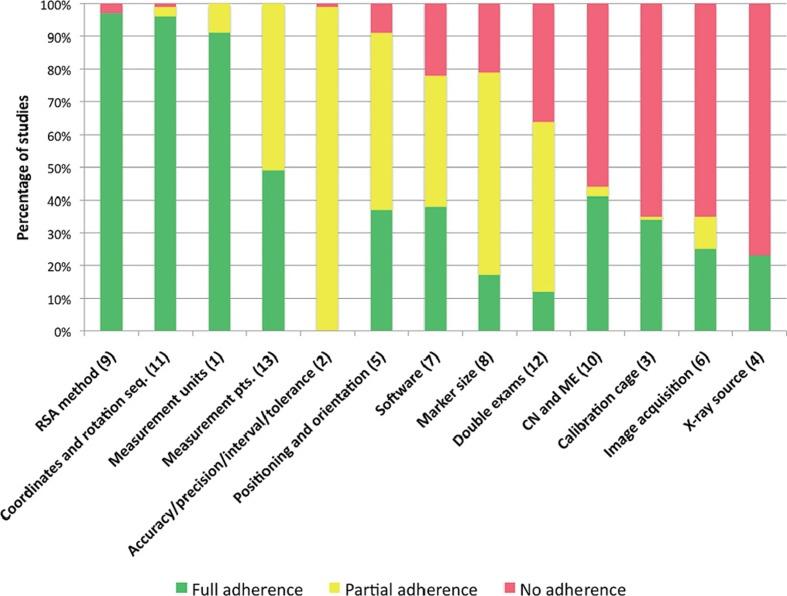
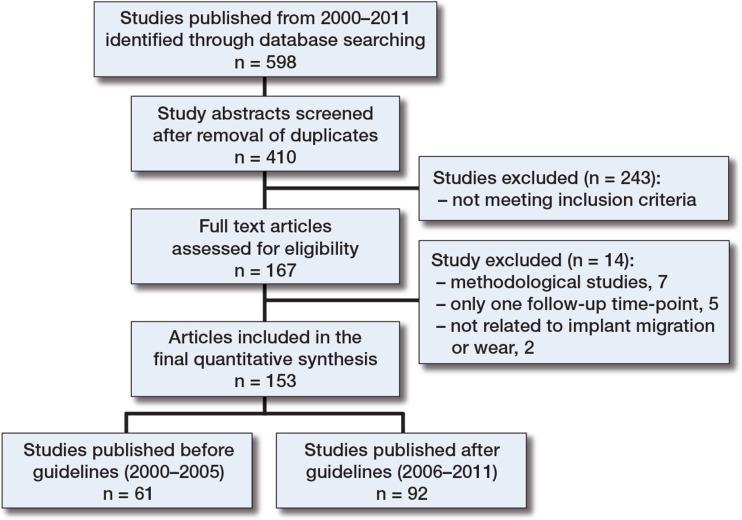
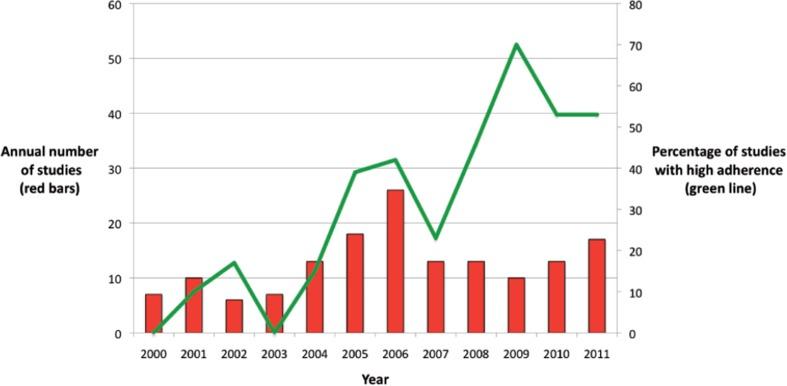
153 studies that met our inclusion criteria were identified. 61 of these were published before the guidelines were introduced (2000-2005) and 92 after the guidelines were introduced (2006-2011). The methodological quality of RSA studies clearly improved from 2000 to 2011. None of the studies fully met all 13 guidelines. Nearly half (43) of the studies published after the guidelines demonstrated a high methodological quality and adhered at least partially to 10 of the 13 guidelines, whereas less than one-fifth (11) of the studies published before the guidelines had the same methodological quality. Commonly unaddressed guideline items were related to imaging methodology, determination of precision from double examinations, and also mean error of rigid-body fitting and condition number cutoff levels.
INTERPRETATION
The guidelines have improved methodological reporting in RSA studies, but adherence to these guidelines is still relatively low. There is a need to update and clarify the guidelines for clinical hip and knee arthroplasty RSA studies.
背景与目的
2005年发布了植入物放射性立体测量法(RSA)的标准化指南,以促进不同研究组之间结果的比较。在这项系统评价中,我们确定了各研究对这些指南的遵循程度。
方法
我们进行了文献检索,以识别2000年1月至2011年12月期间发表的所有使用RSA评估髋关节或膝关节假体移位的文章。两名研究者独立评估每项研究对13项单独指南项目的遵循情况。由于13项要点中的一些包含多个标准,因此根据每项要点是否完全符合、部分符合或未符合来评估研究。
结果
共识别出153项符合我们纳入标准的研究。其中61项在指南发布之前(2000 - 2005年)发表,92项在指南发布之后(2006 - 2011年)发表。从2000年到2011年,RSA研究的方法学质量明显提高。没有一项研究完全符合所有13项指南。指南发布后发表的研究中近一半(43项)显示出较高的方法学质量,并且至少部分遵循了13项指南中的10项,而指南发布前发表的研究中只有不到五分之一(11项)具有相同的方法学质量。常见未涉及的指南项目与成像方法、通过两次检查确定精度以及刚体拟合的平均误差和条件数截止水平有关。
解读
这些指南改善了RSA研究中的方法学报告,但对这些指南的遵循程度仍然相对较低。有必要更新和澄清临床髋关节和膝关节置换术RSA研究的指南。
 Zotero 插件