Ten Brinke Bart, Beumer Annechien, Koenraadt Koen L M, Eygendaal Denise, Kraan Gerald A, Mathijssen Nina M C
a Department of Orthopaedic Surgery , Amphia Ziekenhuis , Breda.
b Department of Orthopaedic Surgery , Reinier de Graaf Hospital , Delft.
Acta Orthop. 2017 Jun;88(3):320-325. doi: 10.1080/17453674.2017.1291872. Epub 2017 Mar 2.
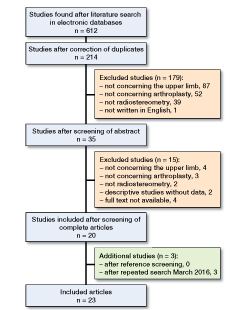
Background and purpose - Radiostereometric analysis (RSA) is an accurate method for measurement of early migration of implants. Since a relation has been shown between early migration and future loosening of total knee and hip prostheses, RSA plays an important role in the development and evaluation of prostheses. However, there have been few RSA studies of the upper limb, and the value of RSA of the upper limb is not yet clear. We therefore performed a systematic review to investigate the accuracy and precision of RSA of the upper limb. Patients and methods - PRISMA guidelines were followed and the protocol for this review was published online at PROSPERO under registration number CRD42016042014. A systematic search of the literature was performed in the databases Embase, Medline, Cochrane, Web of Science, Scopus, Cinahl, and Google Scholar on April 25, 2015 based on the keywords radiostereometric analysis, shoulder prosthesis, elbow prosthesis, wrist prosthesis, trapeziometacarpal joint prosthesis, humerus, ulna, radius, carpus. Articles concerning RSA for the analysis of early migration of prostheses of the upper limb were included. Quality assessment was performed using the MINORS score, Downs and Black checklist, and the ISO RSA Results - 23 studies were included. Precision values were in the 0.06-0.88 mm and 0.05-10.7° range for the shoulder, the 0.05-0.34 mm and 0.16-0.76° range for the elbow, and the 0.16-1.83 mm and 11-124° range for the TMC joint. Accuracy data from marker- and model-based RSA were not reported in the studies included. Interpretation - RSA is a highly precise method for measurement of early migration of orthopedic implants in the upper limb. However, the precision of rotation measurement is poor in some components. Challenges with RSA in the upper limb include the symmetrical shape of prostheses and the limited size of surrounding bone, leading to over-projection of the markers by the prosthesis. We recommend higher adherence to RSA guidelines and encourage investigators to publish long-term follow-up RSA studies.
背景与目的——放射性立体测量分析(RSA)是一种用于测量植入物早期移位的准确方法。由于已表明早期移位与全膝关节和髋关节假体未来的松动之间存在关联,RSA在假体的研发和评估中发挥着重要作用。然而,上肢的RSA研究较少,上肢RSA的价值尚不清楚。因此,我们进行了一项系统评价,以研究上肢RSA的准确性和精确性。
患者与方法——遵循PRISMA指南,本评价方案已在PROSPERO网站在线发表,注册号为CRD42016042014。2015年4月25日,基于关键词“放射性立体测量分析”、“肩关节假体”、“肘关节假体”、“腕关节假体”、“大多角骨-掌骨关节假体”、“肱骨”、“尺骨”、“桡骨”、“腕骨”,在Embase、Medline、Cochrane、Web of Science、Scopus、Cinahl和谷歌学术数据库中对文献进行了系统检索。纳入有关RSA用于分析上肢假体早期移位的文章。使用MINORS评分、Downs和Black清单以及ISO RSA结果进行质量评估。
结果——纳入了23项研究。肩关节的精确值范围为0.06 - 0.88毫米和0.05 - 10.7°,肘关节为0.05 - 0.34毫米和0.16 - 0.76°,大多角骨-掌骨关节为0.16 - 1.83毫米和11 - 124°。纳入的研究中未报告基于标记物和基于模型的RSA的准确性数据。
解读——RSA是一种用于测量上肢骨科植入物早期移位的高度精确的方法。然而,某些部件的旋转测量精度较差。上肢RSA面临的挑战包括假体形状对称以及周围骨骼尺寸有限,导致标记物被假体过度投影。我们建议更高程度地遵循RSA指南,并鼓励研究人员发表长期随访的RSA研究。