Huang Yongliang, Yu Jie, Wan Fang, Zhang Wenwu, Yang Huarong, Wang Li, Qi Hongyi, Wu Chunjie
College of Pharmacy, Chengdu University of Traditional Chinese Medicine, 1166 Liutai Road, Wenjiang District, Chengdu, Sichuan 611137, China.
College of Pharmaceutical Sciences, Southwest University, 2 Tiansheng Road, Beibei District, Chongqing 400716, China.
Oxid Med Cell Longev. 2014;2014:978034. doi: 10.1155/2014/978034. Epub 2014 May 11.
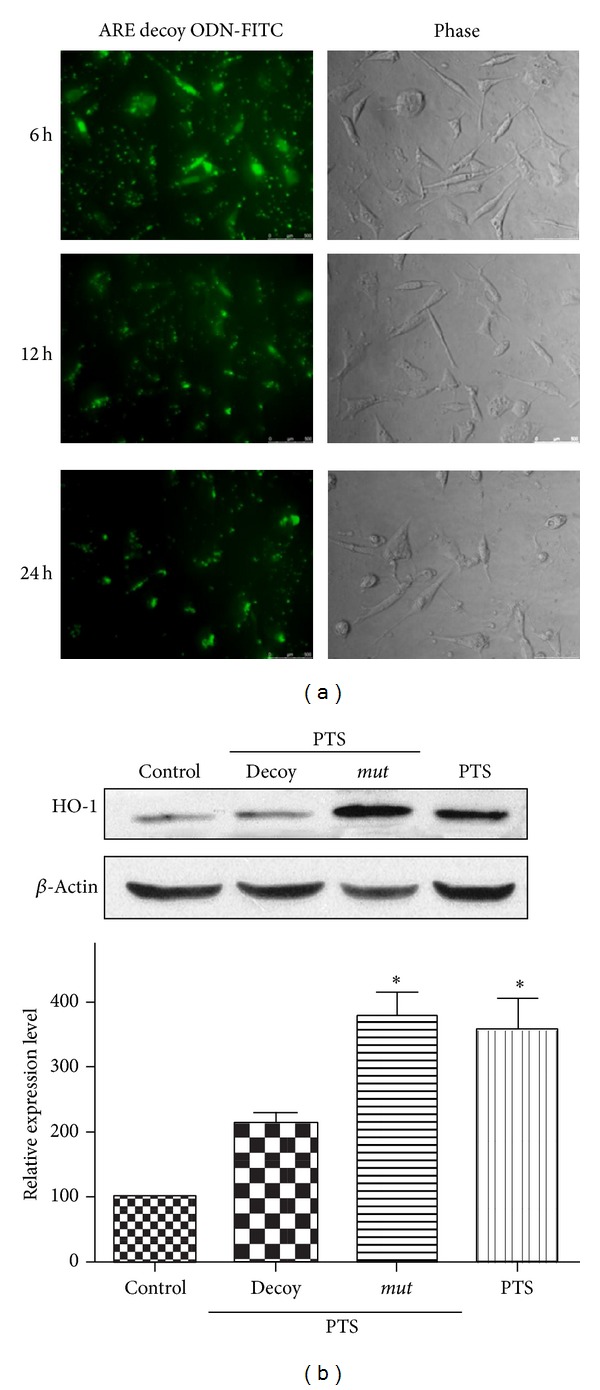
Panaxatriol saponins (PTS), the main components extracted from Panax notoginseng, have been shown to be efficacious in the prevention and treatment of cerebrovascular diseases in China. NF-E2-related factor 2 (Nrf2), a transcription factor regulating antioxidant and cytoprotective responses to oxidative stress, has received particular attention as a molecular target for pharmacological intervention of ischemic diseases. The aim of this study was to characterize the effect of PTS on the activation of Nrf2 signaling pathway and the potential role in its protective effect. We found that PTS induced heme oxygenase-1 (HO-1) expression in PC12 cells via activating Nrf2 signaling pathway. Phosphatidylinositol 3-kinase (PI3K)/Akt kinase was involved in the upstream of this PTS activated pathway. Moreover, combination of the main components in PTS significantly enhanced the expression of Nrf2 mediated phase II enzymes. Importantly, the protective effect of PTS against oxygen-glucose deprivation-reperfusion (OGD-Rep) induced cell death was significantly attenuated by PI3K inhibitor and antioxidant response element (ARE) decoy oligonucleotides, suggesting that both PI3K/Akt and Nrf2 signaling pathway are essential during this protective process. Taken together, our results suggest that PTS may activate endogenous cytoprotective mechanism against OGD-Rep induced oxidative injury via the activation of PI3K/Akt and Nrf2 signaling pathway.
三七三醇皂苷(PTS)是从三七中提取的主要成分,在中国已被证明对脑血管疾病的防治有效。核因子E2相关因子2(Nrf2)是一种调节抗氧化和细胞对氧化应激的保护反应的转录因子,作为缺血性疾病药物干预的分子靶点受到了特别关注。本研究的目的是表征PTS对Nrf2信号通路激活的影响及其保护作用的潜在机制。我们发现PTS通过激活Nrf2信号通路诱导PC12细胞中血红素加氧酶-1(HO-1)的表达。磷脂酰肌醇3激酶(PI3K)/Akt激酶参与了该PTS激活途径的上游过程。此外,PTS中的主要成分组合显著增强了Nrf2介导的Ⅱ相酶的表达。重要的是,PI3K抑制剂和抗氧化反应元件(ARE)诱饵寡核苷酸显著减弱了PTS对氧糖剥夺-再灌注(OGD-Rep)诱导的细胞死亡的保护作用,表明PI3K/Akt和Nrf2信号通路在这一保护过程中均至关重要。综上所述,我们的结果表明,PTS可能通过激活PI3K/Akt和Nrf2信号通路激活内源性细胞保护机制,以抵抗OGD-Rep诱导的氧化损伤。