Mohd Ghazali Mohd Alfazari, Al-Naqeb Ghanya, Krishnan Selvarajan Kesavanarayanan, Hazizul Hasan Mizaton, Adam Aishah
Pharmacology and Toxicology Research Laboratory, Faculty of Pharmacy, University Technology MARA (UiTM), 42300 Bandar Puncak Alam, Selangor Darul Ehsan, Malaysia ; Group on Affinity, Efficacy and Safety Studies (OASES), Brain and Neuroscience Communities of Research, University Technology MARA (UiTM), 40450 Shah Alam, Selangor Darul Ehsan, Malaysia ; School of Pharmaceutical Sciences, University Science of Malaysia (USM), 11800 Minden, Penang, Malaysia.
Department of Food Sciences and Technology, Faculty of Agriculture, University of Sana'a, Sana'a, Yemen.
Biomed Res Int. 2014;2014:539607. doi: 10.1155/2014/539607. Epub 2014 May 13.
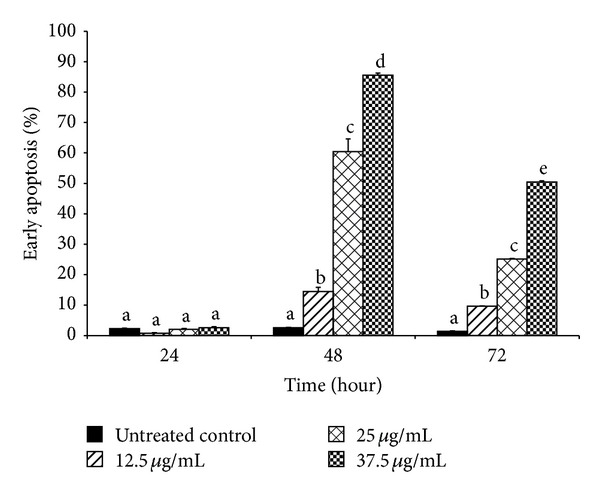
Polygonum minus (Polygonaceae) is a medicinal herb distributed throughout eastern Asia. The present study investigated antiproliferative effect of P. minus and its possible mechanisms. Four extracts (petroleum ether, methanol, ethyl acetate, and water) were prepared by cold maceration. Extracts were subjected to phytochemical screening, antioxidant, and antiproliferative assays; the most bioactive was fractionated using vacuum liquid chromatography into seven fractions (F1-F7). Antioxidant activity was measured via total phenolic content (TPC), 2,2-diphenyl-1-picrylhydrazyl (DPPH), and ferric reducing antioxidant power (FRAP) assays. Antiproliferative activity was evaluated using 3-(4,5-dimethylthiazol-2-yl)-2,5-diphenyltetrazolium bromide (MTT) assay. Most active fraction was tested for apoptosis induction and cell cycle arrest in HepG2 cells using flow cytometry and confocal microscopy. Apoptotic-related gene expression was studied by RT-PCR. Ethyl acetate extract was bioactive in initial assays. Its fraction, F7, exhibited highest antioxidant capacity (TPC; 113.16 ± 6.2 mg GAE/g extract, DPPH; EC50: 30.5 ± 3.2 μg/mL, FRAP; 1169 ± 20.3 μmol Fe (II)/mg extract) and selective antiproliferative effect (IC50: 25.75 ± 1.5 μg/mL). F7 induced apoptosis in concentration- and time-dependent manner and caused cell cycle arrest at S-phase. Upregulation of proapoptotic genes (Bax, p53, and caspase-3) and downregulation of antiapoptotic gene, Bcl-2, were observed. In conclusion, F7 was antiproliferative to HepG2 cells by inducing apoptosis, cell cycle arrest, and via antioxidative effects.
少花蓼(蓼科)是一种分布于东亚地区的药草。本研究调查了少花蓼的抗增殖作用及其可能的机制。通过冷浸法制备了四种提取物(石油醚、甲醇、乙酸乙酯和水)。对提取物进行了植物化学筛选、抗氧化和抗增殖测定;将生物活性最强的提取物用真空液相色谱法分离成七个馏分(F1 - F7)。通过总酚含量(TPC)、2,2 - 二苯基 - 1 - 苦基肼(DPPH)和铁还原抗氧化能力(FRAP)测定来测量抗氧化活性。使用3 -(4,5 - 二甲基噻唑 - 2 - 基)- 2,5 - 二苯基四氮唑溴盐(MTT)测定来评估抗增殖活性。使用流式细胞术和共聚焦显微镜对活性最强的馏分进行了诱导HepG2细胞凋亡和细胞周期阻滞的测试。通过逆转录 - 聚合酶链反应(RT - PCR)研究凋亡相关基因的表达。乙酸乙酯提取物在初步测定中具有生物活性。其馏分F7表现出最高的抗氧化能力(TPC;113.16±6.2毫克没食子酸当量/克提取物,DPPH;半数有效浓度(EC50):30.5±3.2微克/毫升,FRAP;1169±20.3微摩尔亚铁(II)/毫克提取物)和选择性抗增殖作用(半数抑制浓度(IC50):25.75±1.5微克/毫升)。F7以浓度和时间依赖性方式诱导凋亡,并导致细胞周期阻滞在S期。观察到促凋亡基因(Bax、p53和半胱天冬酶 - 3)上调,抗凋亡基因Bcl - 2下调。总之,F7通过诱导凋亡、细胞周期阻滞以及抗氧化作用对HepG2细胞具有抗增殖作用。