Spence Ashley K, Boddu Jay, Wang Dafu, James Brandon, Swaminathan Kankshita, Moose Stephen P, Long Stephen P
Proctor and Gamble, 8700 South Mason-Montgomery Road Mason, OH 45040, USA.
Department of Crop Sciences, University of Illinois, 389 Edward R. Madigan Laboratory, 1201W Gregory Drive, Urbana, IL 61801, USA.
J Exp Bot. 2014 Jul;65(13):3737-47. doi: 10.1093/jxb/eru209. Epub 2014 Jun 22.
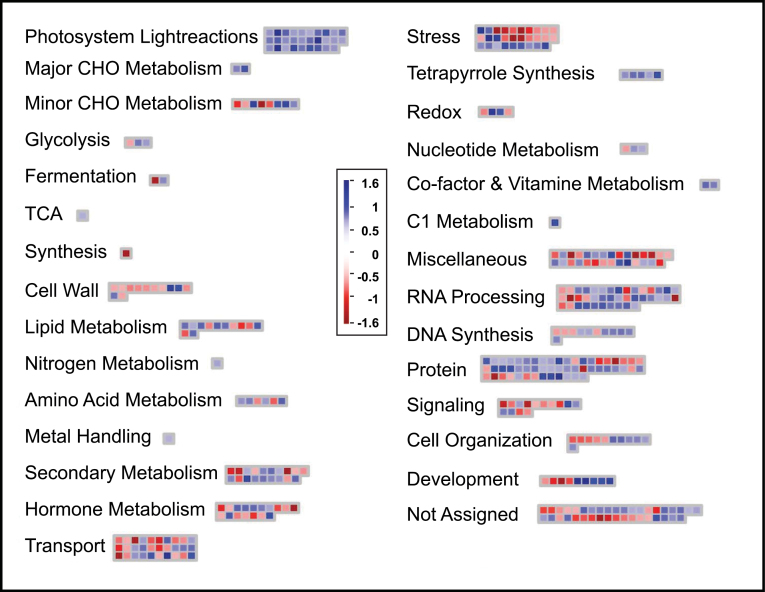
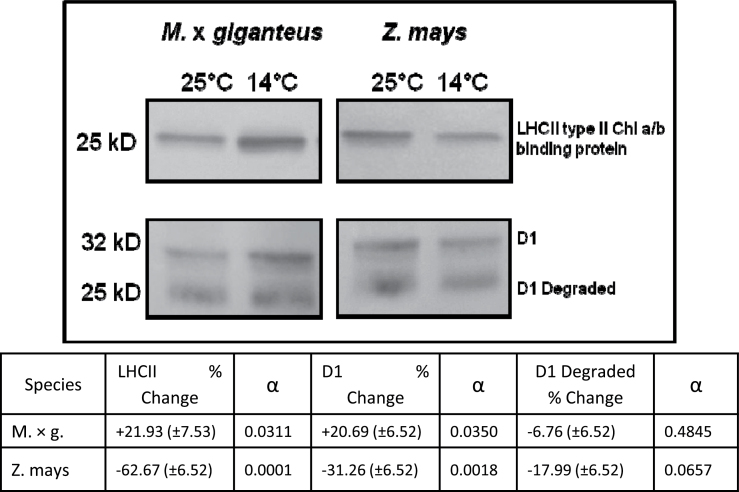
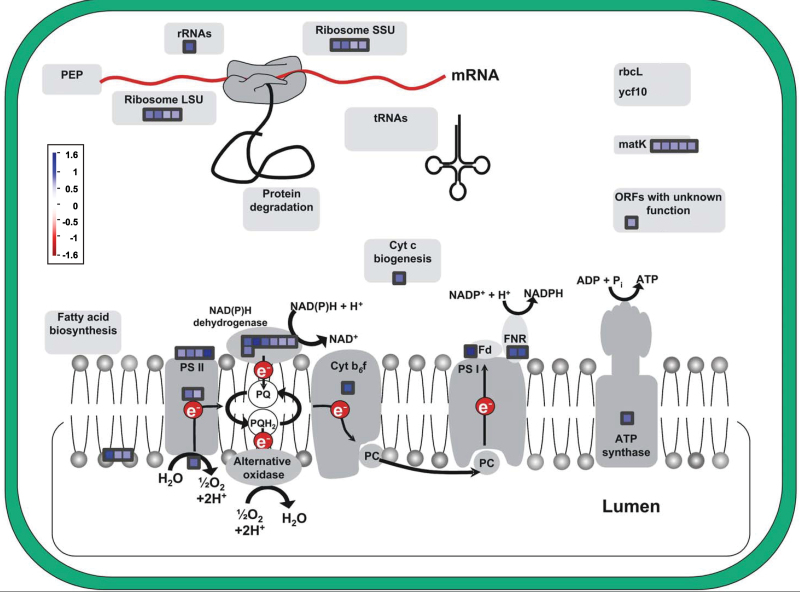
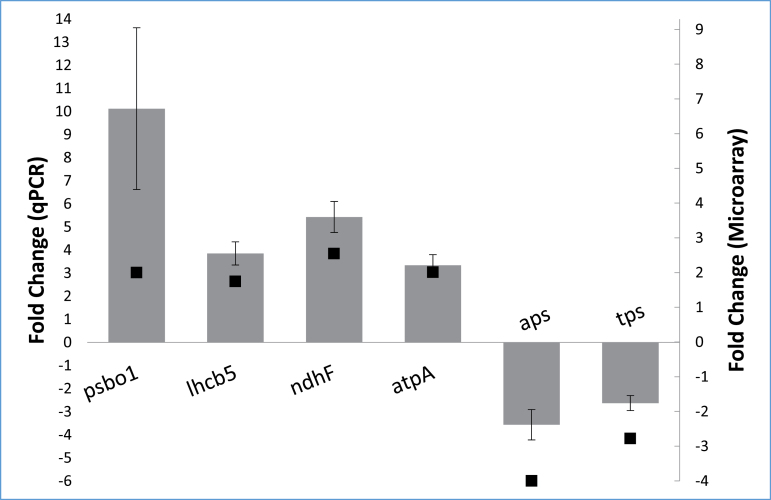
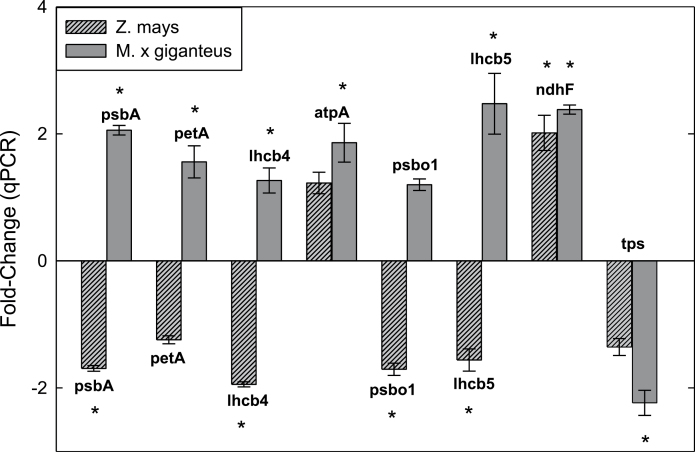
Miscanthus × giganteus is exceptional among C4 plants in its ability to acclimate to chilling (≤14 °C) and maintain a high photosynthetic capacity, in sharp contrast to maize, leading to very high productivity even in cool temperate climates. To identify the mechanisms that underlie this acclimation, RNA was isolated from M × giganteus leaves in chilling and nonchilling conditions and hybridized to microarrays developed for its close relative Zea mays. Among 21 000 array probes that yielded robust signals, 723 showed significant expression change under chilling. Approximately half of these were for annotated genes. Thirty genes associated with chloroplast membrane function were all upregulated. Increases in transcripts for the lhcb5 (chlorophyll a/b-binding protein CP26), ndhF (NADH dehydrogenase F, chloroplast), atpA (ATP synthase alpha subunit), psbA (D1), petA (cytochrome f), and lhcb4 (chlorophyll a/b-binding protein CP29), relative to housekeeping genes in M. × giganteus, were confirmed by quantitative reverse-transcription PCR. In contrast, psbo1, lhcb5, psbA, and lhcb4 were all significantly decreased in Z. mays after 14 days of chilling. Western blot analysis of the D1 protein and LHCII type II chlorophyll a/b-binding protein also showed significant increases in M. × giganteus during chilling and significant decreases in Z. mays. Compared to other C4 species, M. × giganteus grown in chilling conditions appears to counteract the loss of photosynthetic proteins and proteins protecting photosystem II typically observed in other species by increasing mRNA levels for their synthesis.
巨芒草(Miscanthus × giganteus)在C4植物中表现独特,它能够适应低温(≤14°C)并保持较高的光合能力,这与玉米形成鲜明对比,即便在凉爽的温带气候下也能实现很高的生产力。为了确定这种适应性背后的机制,研究人员从处于低温和非低温条件下的巨芒草叶片中提取RNA,并与为其近缘种玉米开发的微阵列进行杂交。在21000个能产生可靠信号的阵列探针中,有723个在低温条件下显示出显著的表达变化。其中约一半是针对已注释基因的。30个与叶绿体膜功能相关的基因均上调。通过定量逆转录PCR证实,相对于巨芒草中的管家基因,lhcb5(叶绿素a/b结合蛋白CP26)、ndhF(NADH脱氢酶F,叶绿体)、atpA(ATP合酶α亚基)、psbA(D1)、petA(细胞色素f)和lhcb4(叶绿素a/b结合蛋白CP29)的转录本有所增加。相比之下,在低温处理14天后,玉米中的psbo1、lhcb5、psbA和lhcb4均显著减少。对D1蛋白和LHCII II型叶绿素a/b结合蛋白的蛋白质免疫印迹分析也显示,在低温处理期间,巨芒草中的这些蛋白显著增加,而玉米中的则显著减少。与其他C4物种相比,在低温条件下生长的巨芒草似乎通过增加参与光合蛋白和保护光系统II的蛋白合成的mRNA水平,来抵消其他物种中通常观察到的光合蛋白和保护光系统II的蛋白的损失。