Sandholm Jouko, Tuomela Johanna, Kauppila Joonas H, Harris Kevin W, Graves David, Selander Katri S
Department of Medicine, University of Alabama at Birmingham, Birmingham, AL 35294, USA.
Department of Pathology, Oulu University Hospital, Oulu 90029, Finland ; Department of Surgery, Oulu University Hospital, Oulu 90029, Finland ; Department of Anatomy and Cell Biology, University of Oulu, Oulu 90570, Finland.
Oncol Lett. 2014 Jul;8(1):266-274. doi: 10.3892/ol.2014.2095. Epub 2014 Apr 25.
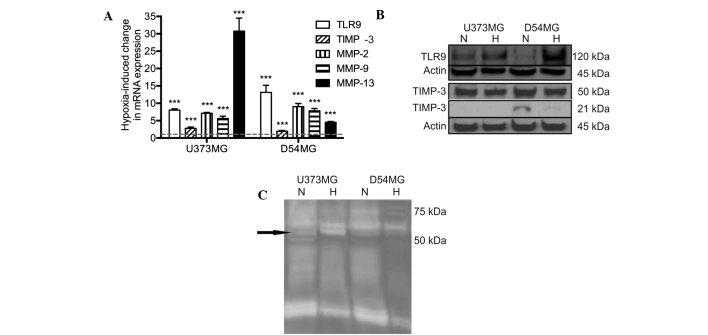
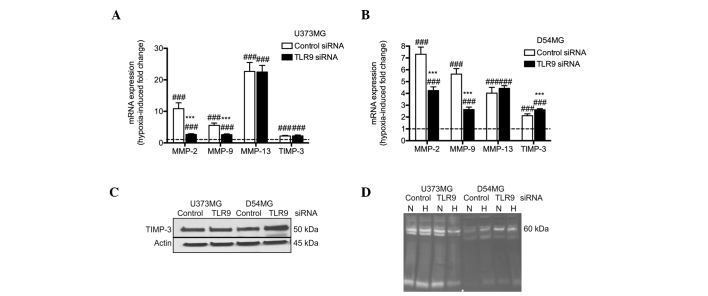
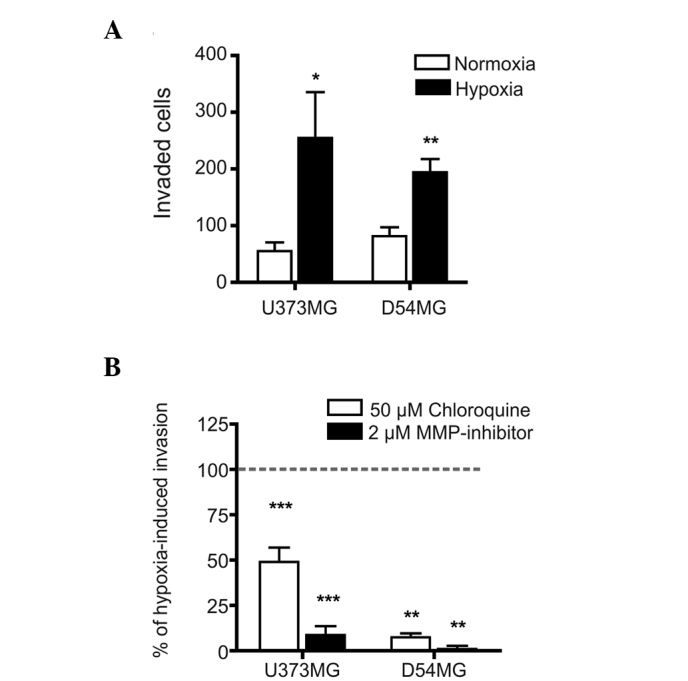
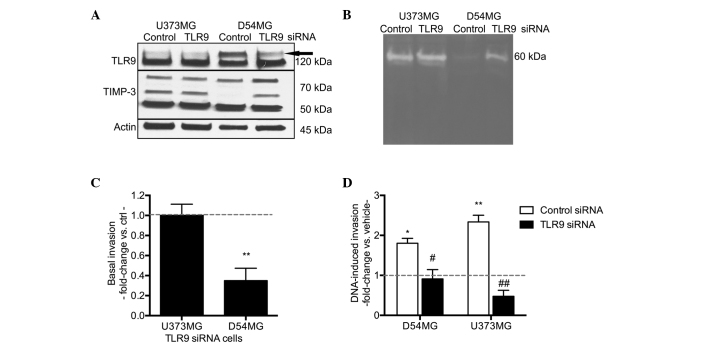
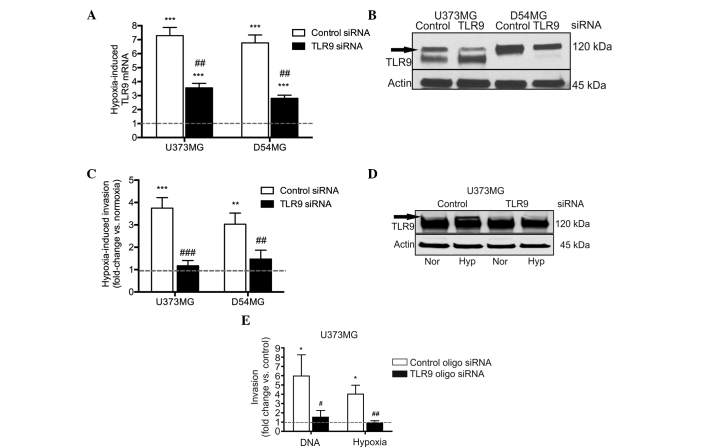
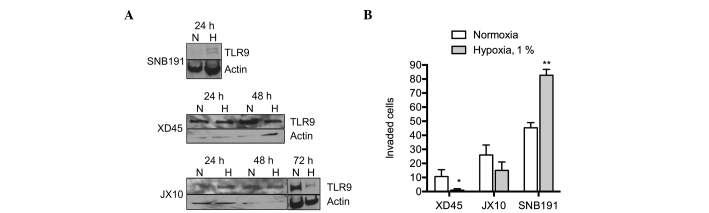
Toll-like receptor-9 (TLR9) is a cellular DNA sensor of the innate immune system. TLR9 is widely expressed in a number of tumors, including brain cancer; however, little is known regarding its regulation and involvement in cancer pathophysiology. The present study demonstrated that hypoxia upregulates and downregulates TLR9 expression in human brain cancer cells , in a cell-specific manner. In addition, hypoxia-induced TLR9 upregulation was associated with hypoxia-induced invasion; however, such invasion was not detected in cells where hypoxia had suppressed TLR9 expression. Furthermore, suppression of TLR9 expression through TLR9 siRNA resulted in an upregulation of matrix metalloproteinase (MMP)-2, -9 and -13 and tissue inhibitor of matrix metalloproteinases-3 (TIMP-3) mRNA, and a decreased invasion of cells in normoxia, in a cell-specific manner. In cells where hypoxia induced TLR9 expression, TLR9 expression and invasion were reduced by TLR9 siRNA. The decreased invasion observed in hypoxia was associated with the decreased expression of the MMPs and a concomitant increase in TIMP-3 expression. In conclusion, hypoxia regulates the invasion of brain cancer cells in a TLR9-dependent manner, which is considered to be associated with a complex expression pattern of TLR9-regulated mediators and inhibitors of invasion.
Toll样受体9(TLR9)是天然免疫系统的一种细胞内DNA传感器。TLR9在包括脑癌在内的多种肿瘤中广泛表达;然而,关于其在癌症病理生理学中的调控及作用知之甚少。本研究表明,缺氧以细胞特异性方式上调和下调人脑癌细胞中TLR9的表达。此外,缺氧诱导的TLR9上调与缺氧诱导的侵袭有关;然而,在缺氧抑制TLR9表达的细胞中未检测到这种侵袭。此外,通过TLR9 siRNA抑制TLR9表达会导致基质金属蛋白酶(MMP)-2、-9和-13以及基质金属蛋白酶组织抑制剂-3(TIMP-3)mRNA上调,并以细胞特异性方式降低常氧条件下细胞的侵袭。在缺氧诱导TLR9表达的细胞中,TLR9 siRNA可降低TLR9表达和侵袭。缺氧时观察到的侵袭减少与MMPs表达降低及TIMP-3表达同时增加有关。总之,缺氧以TLR9依赖的方式调节脑癌细胞的侵袭,这被认为与TLR9调节的侵袭介质和抑制剂的复杂表达模式有关。