Das Indrani, Basantray Itishree, Mamidi Prabhudutta, Nayak Tapas K, B M Pratheek, Chattopadhyay Subhasis, Chattopadhyay Soma
Infectious Disease Biology, Institute of Life Sciences, Bhubaneswar, Odisha, India.
School of Biological Sciences, National Institute of Science Education & Research, Bhubaneswar, Odisha, India.
PLoS One. 2014 Jun 24;9(6):e100531. doi: 10.1371/journal.pone.0100531. eCollection 2014.
The high morbidity and socio-economic loss associated with the recent massive global outbreak of Chikungunya virus (CHIKV) emphasize the need to understand the biology of the virus for developing effective antiviral therapies.
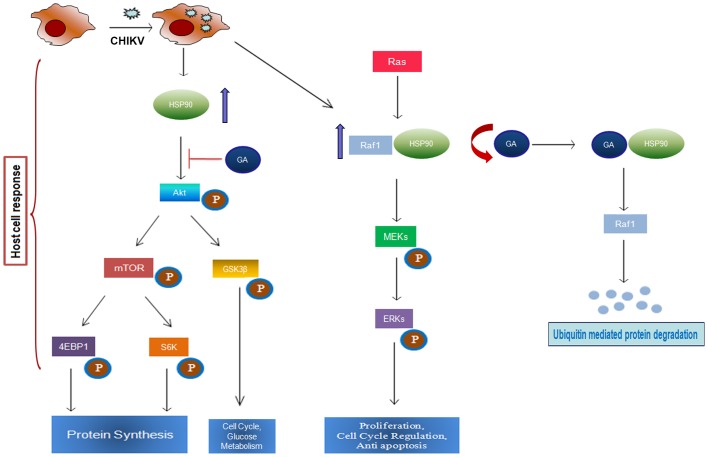
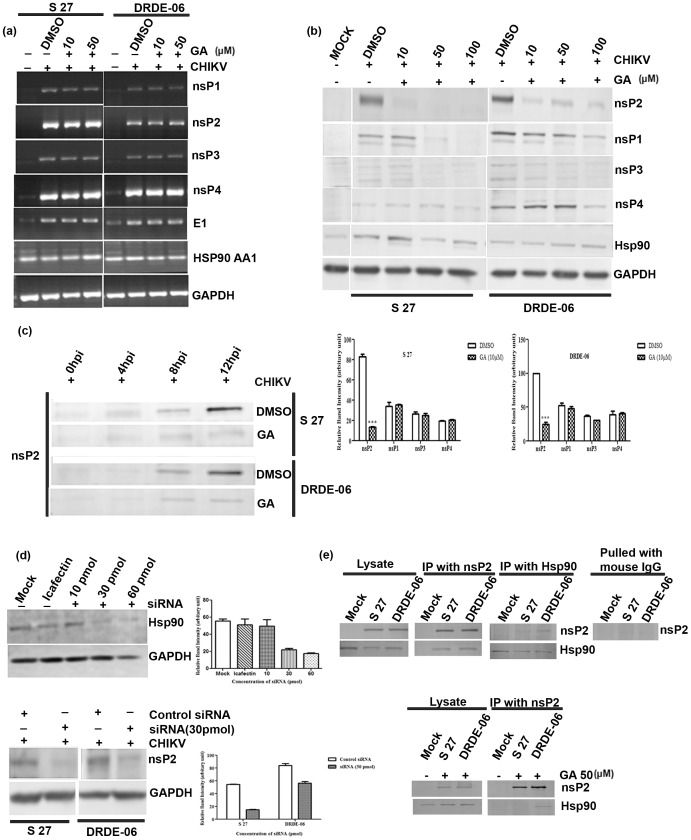
In this study, an attempt was made to understand the molecular mechanism involved in Heat shock protein 90 (Hsp90) mediated regulation of CHIKV infection in mammalian cells using CHIKV prototype strain (S 27) and Indian outbreak strain of 2006 (DRDE-06). Our results showed that Hsp90 is required at a very early stage of viral replication and Hsp90 inhibitor Geldanamycin (GA) can abrogate new virus particle formation more effectively in the case of S 27 than that of DRDE-06. Further analysis revealed that CHIKV nsP2 protein level is specifically reduced by GA treatment as well as HSP90-siRNA transfection; however, viral RNA remains unaltered. Immunoprecipitation analysis showed that nsP2 interacts with Hsp90 during infection; however this interaction is reduced in the presence of GA. In addition, our analysis on Hsp90 associated PI3K/Akt/mTOR signaling pathway demonstrated that CHIKV infection stabilizes Raf1 and activates Hsp90 client protein Akt, which in turn phosphorylates mTOR. Subsequently, this phosphorylation leads to the activation of two important downstream effectors, S6K and 4EBP1, which may facilitate translation of viral as well as cellular mRNAs. Hence, the data suggests that CHIKV infection is regulated by Hsp90 associated Akt phosphorylation and DRDE-06 is more efficient than S 27 in enhancing the activation of host signaling molecules for its efficient replication and virus production.
Hsp90 positively regulates Chikungunya virus replication by stabilizing CHIKV-nsP2 through its interaction during infection. The study highlights the possible molecular mechanism of GA mediated inhibition of CHIKV replication and differential effect of this drug on S 27 and DRDE-06, which will be informative for developing effective anti-CHIKV therapies in future.
近期基孔肯雅病毒(CHIKV)在全球大规模爆发,其高发病率及社会经济损失凸显了深入了解该病毒生物学特性以开发有效抗病毒疗法的必要性。
在本研究中,我们尝试利用CHIKV原型株(S 27)和2006年印度爆发株(DRDE - 06),来理解热休克蛋白90(Hsp90)介导的哺乳动物细胞中CHIKV感染调控的分子机制。我们的结果表明,Hsp90在病毒复制的极早期是必需的,并且热休克蛋白90抑制剂格尔德霉素(GA)在S 27的情况下比DRDE - 06更能有效地消除新病毒颗粒的形成。进一步分析显示,GA处理以及HSP90 - siRNA转染可特异性降低CHIKV nsP2蛋白水平;然而,病毒RNA保持不变。免疫沉淀分析表明,感染期间nsP2与Hsp90相互作用;然而,在GA存在的情况下这种相互作用会减弱。此外,我们对与Hsp90相关的PI3K/Akt/mTOR信号通路的分析表明,CHIKV感染使Raf1稳定并激活Hsp90客户蛋白Akt,进而使mTOR磷酸化。随后,这种磷酸化导致两个重要的下游效应物S6K和4EBP1的激活,这可能促进病毒以及细胞mRNA的翻译。因此,数据表明CHIKV感染受Hsp90相关的Akt磷酸化调控,并且DRDE - 06在增强宿主信号分子激活以实现其高效复制和病毒产生方面比S 27更有效。
Hsp90通过在感染期间与CHIKV - nsP2相互作用使其稳定,从而正向调节基孔肯雅病毒复制。该研究突出了GA介导的CHIKV复制抑制的可能分子机制以及该药物对S 27和DRDE - 06的不同作用,这将为未来开发有效的抗CHIKV疗法提供信息。