Thakur Satbir, Singla Arvind K, Chen Jie, Tran Uyen, Yang Yang, Salazar Carolina, Magliocco Anthony, Klimowicz Alexander, Jirik Frank, Riabowol Karl
Department of Biochemistry and Molecular Biology, Calgary, Alberta, CANADA.
Department of Biochemistry and Molecular Biology, Calgary, Alberta, CANADA; Oncology University of Calgary, Calgary, Alberta, CANADA.
Oncotarget. 2014 Jun 30;5(12):4244-56. doi: 10.18632/oncotarget.1988.
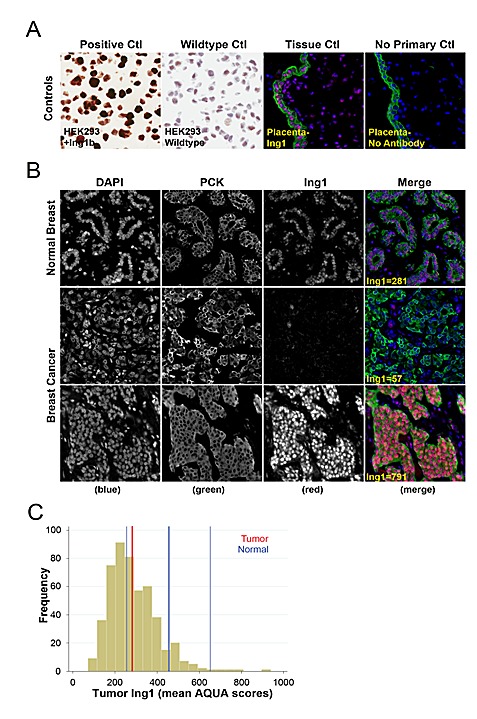
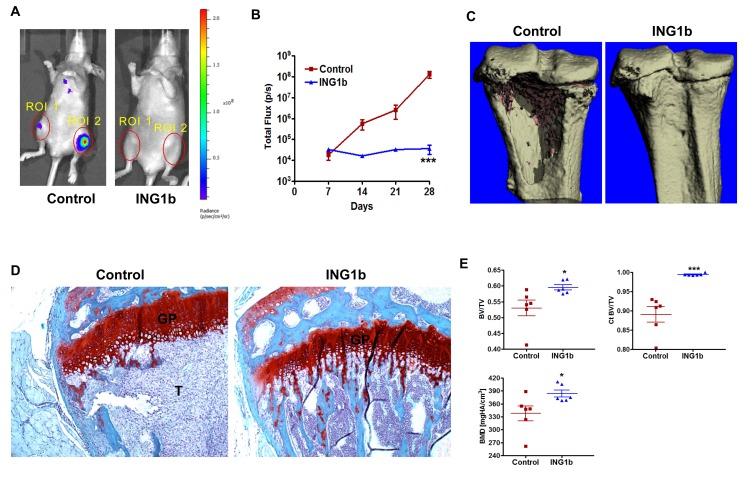
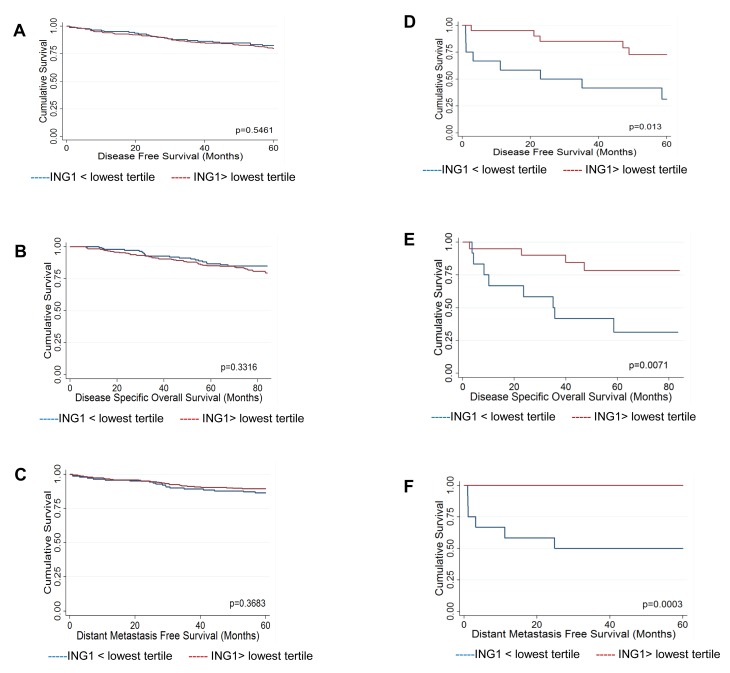
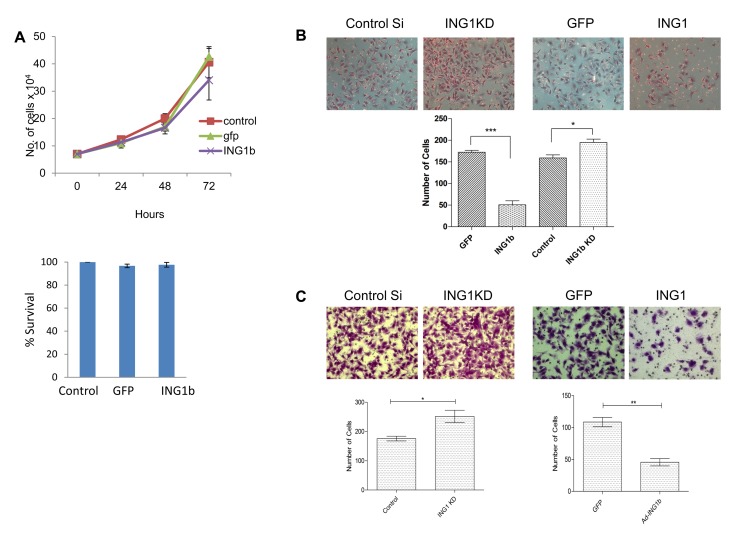
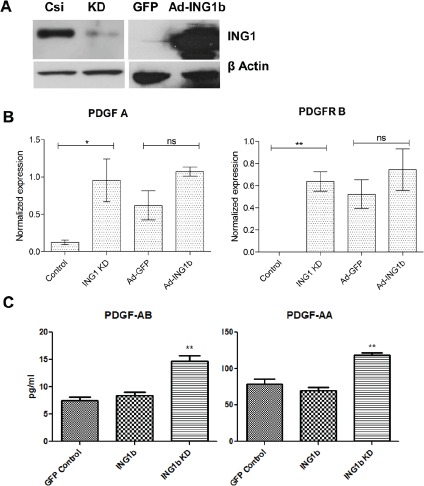
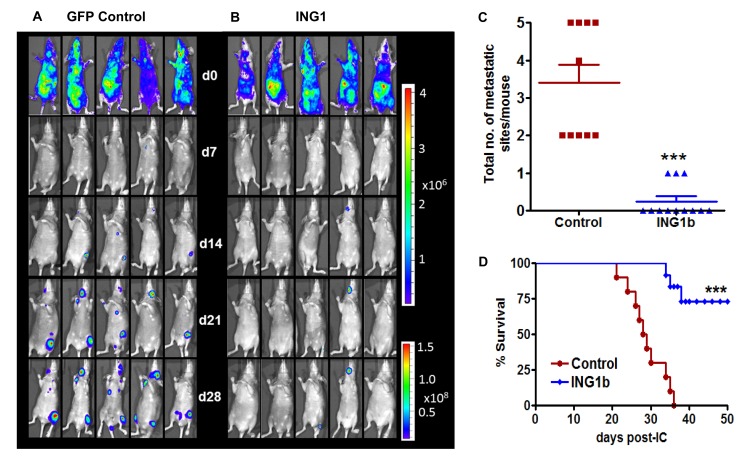
INhibitor of Growth 1 (ING1) expression is repressed in breast carcinomas, but its role in breast cancer development and metastasis is unknown. ING1 levels were quantified in >500 patient samples using automated quantitative fluorescence immunohistochemistry, and data were analysed for correlations to patient outcome. Effects of altering ING levels were examined in microarrays and metastasis assays in vitro, and in a mouse metastasis model in vivo. ING1 levels were lower in tumors compared to adjacent normal breast tissue and correlated with tumor size (p=0.019) and distant recurrence (p=0.001) in ER- or Her2+ patients. In these patients ING1 predicted disease-specific and distant metastasis-free survival. Transcriptome analysis showed that the pathway most affected by ING1 was breast cancer (p = 0.0008). Decreasing levels of ING1 increased, and increasing levels decreased, migration and invasion of MDA-MB231 cells in vitro. ING1 overexpression also blocked cancer cell metastasis in vivo and eliminated tumor-induced mortality in mouse models. Our data show that ING1 protein levels are downregulated in breast cancer and for the first time, we show that altering their levels regulates metastasis in vitro and in vivo, which indicates that ING1 may have a therapeutic role for inhibiting metastasis of breast cancer.
生长抑制因子1(ING1)在乳腺癌中表达受抑,但其在乳腺癌发生和转移中的作用尚不清楚。使用自动定量荧光免疫组化法对500多例患者样本中的ING1水平进行定量,并分析数据与患者预后的相关性。在体外微阵列和转移试验以及体内小鼠转移模型中检测改变ING水平的影响。与相邻正常乳腺组织相比,肿瘤中的ING1水平较低,并且与ER或Her2 +患者的肿瘤大小(p = 0.019)和远处复发(p = 0.001)相关。在这些患者中,ING1可预测疾病特异性和无远处转移生存期。转录组分析表明,受ING1影响最大的通路是乳腺癌(p = 0.0008)。降低ING1水平会增加,而升高ING1水平会降低MDA-MB231细胞在体外的迁移和侵袭。ING1过表达还可在体内阻断癌细胞转移,并消除小鼠模型中肿瘤诱导的死亡率。我们的数据表明,乳腺癌中ING1蛋白水平下调,并且我们首次表明改变其水平可在体外和体内调节转移,这表明ING1可能在抑制乳腺癌转移方面具有治疗作用。