U.S. Geological Survey, Alaska Science Center 4210 University Dr., Anchorage, Alaska, 99508.
Ecol Evol. 2014 May;4(10):1981-93. doi: 10.1002/ece3.1080. Epub 2014 Apr 22.
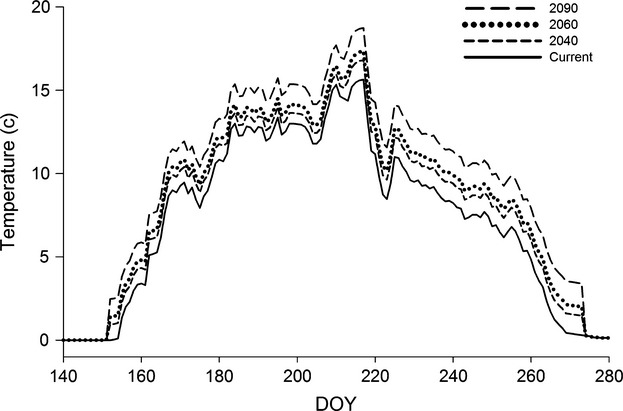
Lake ecosystems in the Arctic are changing rapidly due to climate warming. Lakes are sensitive integrators of climate-induced changes and prominent features across the Arctic landscape, especially in lowland permafrost regions such as the Arctic Coastal Plain of Alaska. Despite many studies on the implications of climate warming, how fish populations will respond to lake changes is uncertain for Arctic ecosystems. Least Cisco (Coregonus sardinella) is a bellwether for Arctic lakes as an important consumer and prey resource. To explore the consequences of climate warming, we used a bioenergetics model to simulate changes in Least Cisco production under future climate scenarios for lakes on the Arctic Coastal Plain. First, we used current temperatures to fit Least Cisco consumption to observed annual growth. We then estimated growth, holding food availability, and then feeding rate constant, for future projections of temperature. Projected warmer water temperatures resulted in reduced Least Cisco production, especially for larger size classes, when food availability was held constant. While holding feeding rate constant, production of Least Cisco increased under all future scenarios with progressively more growth in warmer temperatures. Higher variability occurred with longer projections of time mirroring the expanding uncertainty in climate predictions further into the future. In addition to direct temperature effects on Least Cisco growth, we also considered changes in lake ice phenology and prey resources for Least Cisco. A shorter period of ice cover resulted in increased production, similar to warming temperatures. Altering prey quality had a larger effect on fish production in summer than winter and increased relative growth of younger rather than older age classes of Least Cisco. Overall, we predicted increased production of Least Cisco due to climate warming in lakes of Arctic Alaska. Understanding the implications of increased production of Least Cisco to the entire food web will be necessary to predict ecosystem responses in lakes of the Arctic.
由于气候变暖,北极的湖泊生态系统正在迅速变化。湖泊是气候变化综合作用的敏感体,也是北极景观的突出特征,尤其是在阿拉斯加北极沿海平原等低地永冻地区。尽管有许多关于气候变暖影响的研究,但鱼类种群将如何应对湖泊变化对于北极生态系统来说还不确定。北极茴鱼(Coregonus sardinella)作为一种重要的消费者和猎物资源,是北极湖泊的晴雨表。为了探索气候变暖的后果,我们使用生物能量模型模拟了北极沿海平原湖泊在未来气候情景下北极茴鱼产量的变化。首先,我们使用当前的温度来拟合北极茴鱼的消耗量,以观察其年度生长情况。然后,我们在保持食物供应不变的情况下,估计未来温度的生长情况,并保持摄食率不变。预测的水温升高会导致北极茴鱼产量减少,特别是在食物供应不变的情况下,体型较大的鱼类产量减少更为明显。在保持摄食率不变的情况下,随着水温升高,所有未来情景下的北极茴鱼产量都有所增加。随着预测时间的延长,变化幅度更大,这反映了未来气候预测不确定性的不断扩大。除了水温直接影响北极茴鱼的生长外,我们还考虑了湖泊冰期物候和北极茴鱼猎物资源的变化。冰盖覆盖期缩短会导致产量增加,这与水温升高的效果相似。改变猎物质量对夏季鱼类产量的影响大于冬季,而且对年轻而非老年北极茴鱼的相对生长影响更大。总的来说,我们预测由于阿拉斯加北极地区湖泊的气候变暖,北极茴鱼的产量将会增加。了解北极湖泊中北极茴鱼产量增加对整个食物网的影响,对于预测湖泊生态系统的反应是必要的。