Kobayashi Megumi, Otsuka Yumiko, Kanazawa So, Yamaguchi Masami K, Kakigi Ryusuke
Department of Integrative Physiology, National Institute for Physiological Sciences, 38 Nishigo-Naka, Myodaiji, Okazaki, Aichi 444-8585, Japan.
BMC Neurosci. 2014 Jun 26;15:81. doi: 10.1186/1471-2202-15-81.
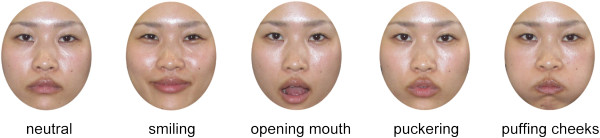
Using near-infrared spectroscopy (NIRS), our previous neural adaptation studies found that infants' bilateral temporal regions process facial identity (FiHN 5:153, 2011). In addition, we revealed that size-invariant processing of facial identity develops by 5 months of age (NR 23:984-988, 2012), while view-invariant processing develops around 7 months of age (FiHN 5:153, 2011). The aim in the current study was to examine whether infants' brains process facial identity across the non-rigid transformation of facial features by using the neural adaptation paradigm. We used NIRS to compare hemodynamic changes in the bilateral temporal areas of 5- to 6-month-olds and 7- to 8-month-olds during presentations of an identical face and of different faces.
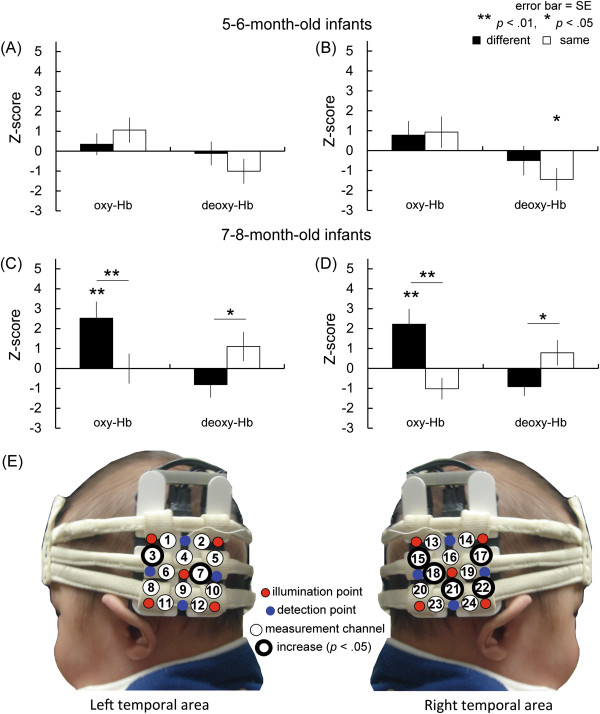
We found that (1) the oxyhemoglobin concentration around the T5 and T6 positions increased significantly during the presentation of different faces only in 7- to 8-month-olds and (2) 7- to 8-month-olds, but not 5- to 6-month-olds, showed attenuation in these channels to the presentation of the same face rather than to the presentation of different faces, regardless of non-rigid changes in facial features.
Our results suggest that the processing of facial identity with non-rigid facial transformation develops around 7 months after birth.
我们之前的神经适应性研究利用近红外光谱技术(NIRS)发现,婴儿的双侧颞区对面部身份进行加工(《婴儿和儿童的功能性近红外光谱学》第5卷:153,2011年)。此外,我们还揭示了面部身份的大小不变性加工在5个月大时发展起来(《神经报告》第23卷:984 - 988,2012年),而视角不变性加工在7个月大左右发展起来(《婴儿和儿童的功能性近红外光谱学》第5卷:153,2011年)。本研究的目的是通过神经适应性范式,检验婴儿大脑是否能对面部特征的非刚性变换进行面部身份加工。我们使用近红外光谱技术比较了5至6个月大以及7至8个月大婴儿在呈现相同面孔和不同面孔时双侧颞区的血流动力学变化。
我们发现:(1)仅在7至8个月大的婴儿中,呈现不同面孔时T5和T6位置周围的氧合血红蛋白浓度显著增加;(2)7至8个月大的婴儿,而非5至6个月大的婴儿,在这些通道中对相同面孔的呈现而非不同面孔的呈现表现出衰减,无论面部特征的非刚性变化如何。
我们的结果表明,出生后约7个月时发展出对面部非刚性变换的面部身份加工能力。