School of Immunity and Infection, Medical School IBR, University of Birmingham, Birmingham, United Kingdom.
Eur J Immunol. 2014 Jul;44(7):1917-20. doi: 10.1002/eji.201444825.
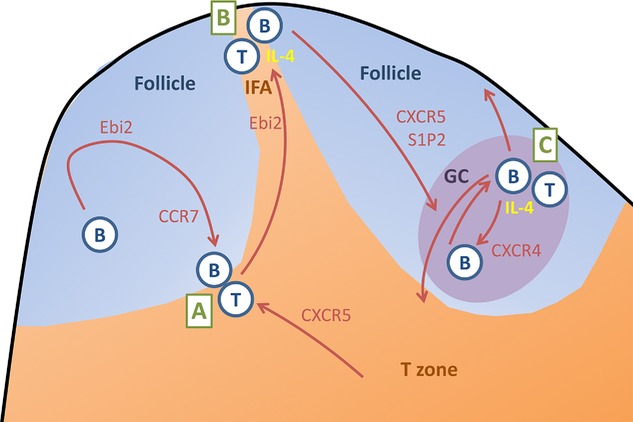
Over the past 25 years it has become clear that B and T lymphocytes go through a range of interactions and migratory events when B cells differentiate to become high-affinity, antibody-secreting cells. This B-cell differentiation is associated with multiple sequential cognate interactions. In this issue of the European Journal of Immunology, Turqueti-Neves et al. [Eur. J. Immunol. 2014. 44: 2130-2138] show that IL-4, a cytokine well known as a regulator of Ig class switch recombination, has another as-yet-unappreciated role. The authors show that IL-4 produced by T-helper cells outside germinal centers has a major effect on the early stages of germinal-center B-cell differentiation. This Commentary will summarize their findings and relate them to what we know on the sequence of cognate interactions and migratory events B cells undergo during T-dependent immune responses.
在过去的 25 年中,人们已经清楚地认识到,B 和 T 淋巴细胞在 B 细胞分化为高亲和力、分泌抗体的细胞时,会经历一系列的相互作用和迁移事件。这种 B 细胞分化与多个连续的同源相互作用有关。在本期的《欧洲免疫学杂志》中,Turqueti-Neves 等人[Eur. J. Immunol. 2014. 44: 2130-2138]表明,白细胞介素 4(IL-4)作为一种调节免疫球蛋白类别转换重组的细胞因子,具有另一个尚未被充分认识的作用。作者表明,生发中心外的辅助性 T 细胞产生的 IL-4 对生发中心 B 细胞分化的早期阶段有重大影响。本评论将总结他们的发现,并将其与我们已知的 B 细胞在 T 细胞依赖性免疫应答中经历的同源相互作用和迁移事件的顺序联系起来。