Bannas Peter, Bakke Joshua, Patrick James L, Pickhardt Perry J
Department of Radiology, University of Wisconsin School of Medicine & Public Health, E3/311 Clinical Science Center, 600 Highland Ave., Madison, WI, 53792-3252, USA,
Abdom Imaging. 2015 Jan;40(1):11-8. doi: 10.1007/s00261-014-0186-x.
To objectively compare residual colonic fluid volume and attenuation of oral sulfate solution (OSS) with four different established cathartic regimens using an automated volumetric software tool at CT colonography (CTC).
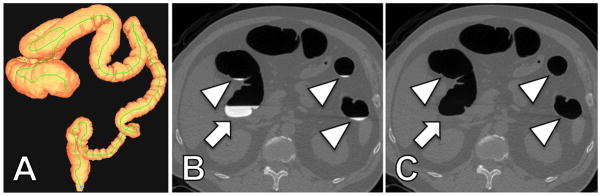
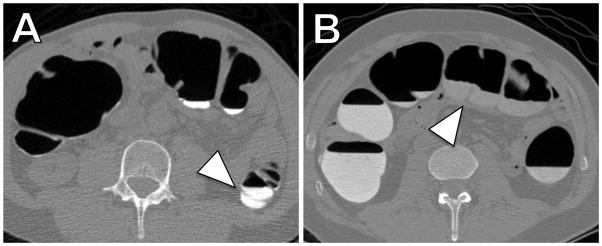
This HIPAA-compliant study had institutional review board approval. Volumetric analysis of residual contrast-tagged colonic fluid was performed on CTC studies in 263 adults (mean age 60.1 years; 137M/126F) using an automated volumetric software tool. Twenty-three patients receiving 177 mL OSS (SUPREP; single-bottle purgation) were compared with 60 patients each receiving 45 mL sodium phosphate (NaP), 90 mL NaP (2× NaP), 592 mL (two bottles) magnesium citrate (MgC), and 4,000 mL polyethylene glycol (PEG). All patients received oral contrast cleansing after catharsis. Data were analyzed with unpaired t test with Welch correction and F test.
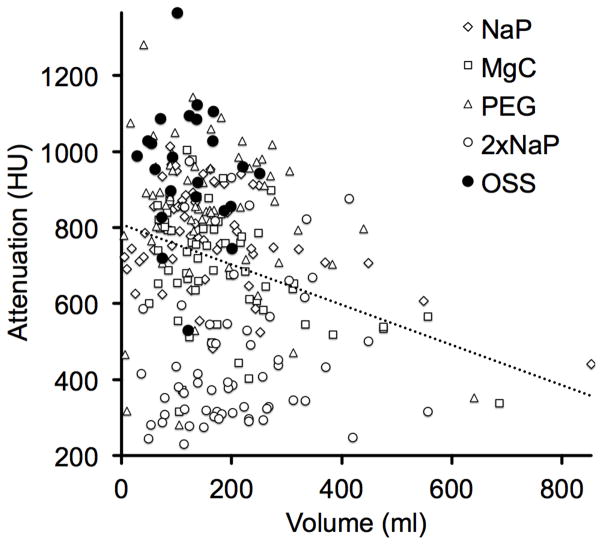
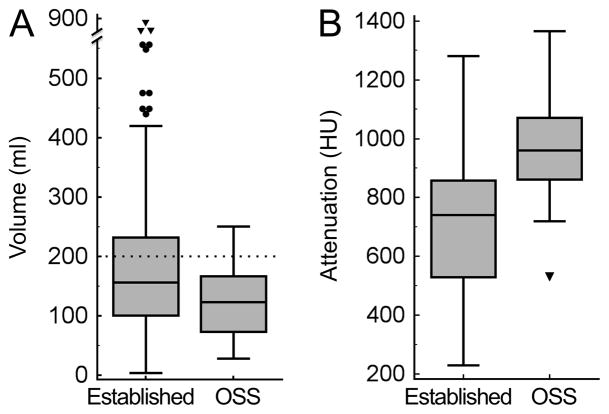
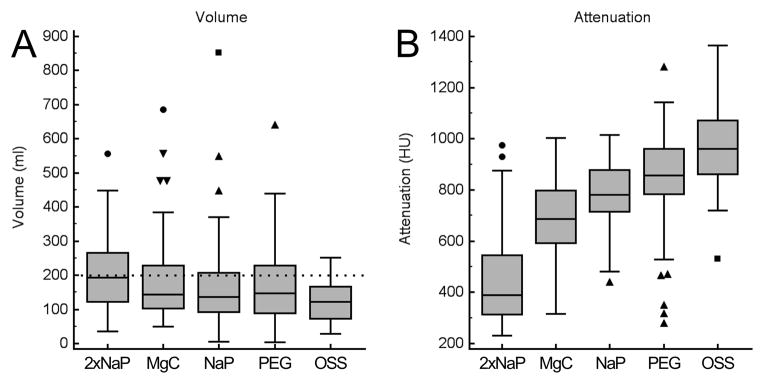
The mean volume of residual colonic fluid was less with OSS (125 ± 60 mL) than for established cathartic agents: 2× NaP (206 ± 125 mL, P < 0.0001), MgC (184 ± 125 mL, P < 0.01), PEG (166 ± 114 mL, P < 0.05), and NaP (165 ± 135 mL, P = 0.067). Variance of volumes was also significantly lower for OSS (range 28-251 mL) than for established agents (range 4-853 mL) (all P < 0.01). Mean fluid attenuation was higher with OSS (956 ± 168 HU) than for established agents (all P < 0.05): 2× NaP (455 ± 191 HU), MgC (691 ± 154 HU), NaP (779 ± 127 HU), and PEG (843 ± 193 HU).
Automated volumetry allows rapid objective assessment of bowel preparation quality at CTC. Purgation with the novel oral sulfate solution (SUPREP) consistently resulted in less residual colonic fluid and higher fluid attenuation compared with established cathartic regimens.
使用CT结肠成像(CTC)的自动容积软件工具,客观比较四种不同既定泻药方案下口服硫酸溶液(OSS)的结肠残留液量和衰减情况。
本符合HIPAA的研究获得了机构审查委员会的批准。使用自动容积软件工具,对263名成年人(平均年龄60.1岁;137名男性/126名女性)的CTC研究进行了残留对比剂标记结肠液的容积分析。将23名接受177 mL OSS(SUPREP;单瓶泻药)的患者与分别接受45 mL磷酸钠(NaP)、90 mL NaP(2×NaP)、592 mL(两瓶)枸橼酸镁(MgC)和4000 mL聚乙二醇(PEG)的60名患者进行比较。所有患者在泻药治疗后均接受口服对比剂清洁。数据采用经韦尔奇校正的非配对t检验和F检验进行分析。
OSS组的结肠残留液平均量(125±60 mL)低于既定泻药:2×NaP(206±125 mL,P<0.0001)、MgC(184±125 mL,P<0.01)、PEG(166±114 mL,P<0.05)和NaP(165±135 mL,P = 0.067)。OSS组的液量方差(范围28 - 251 mL)也显著低于既定泻药(范围4 - 853 mL)(所有P<0.01)。OSS组的平均液体衰减(956±168 HU)高于既定泻药(所有P<0.05):2×NaP(凭经验455±191 HU)、MgC(凭经验691±154 HU)、NaP(凭经验779±127 HU)和PEG(凭经验843±193 HU)。
自动容积测定法可在CTC时快速客观评估肠道准备质量。与既定泻药方案相比,新型口服硫酸溶液(SUPREP)泻药治疗后结肠残留液始终较少,液体衰减较高。