Jung Jin Young, Kim Hyun Sook, Roh Mi Ryung, Roh Hyo Jin, Lee Sang Yoon, Chung Kee Yang
Yeouido Oracle Dermatology and Cosmetic Dermatosurgery Clinic, Seoul, Korea.
Department of Dermatology, Severance Hospital, Cutaneous Biology Research Institute, Brain Korea 21 Project for Medical Science, Yonsei University College of Medicine, Seoul, Korea.
Ann Dermatol. 2014 Jun;26(3):363-73. doi: 10.5021/ad.2014.26.3.363. Epub 2014 Jun 12.
A number of reports have been published regarding the use of imiquimod for the treatment of melanoma in situ and metastatic melanoma. Essential steps in the process of melanoma invasion and metastasis include degradation of basement membranes and remodeling of the extracellular matrix by proteolytic enzymes, including matrix metalloproteinases (MMPs) and tissue inhibitors of metalloproteinases (TIMPs).
To evaluate the antiinvasive effect of imiquimod in human malignant melanoma cell lines, SK-MEL-2 and SK-MEL-24, in vitro, and to investigate imiquimod-induced changes in the expression of MMPs and TIMPs.
Invasiveness of melanoma cell lines following imiquimod treatment was evaluated by invasion assays. In order to investigate the mechanism of the anti-invasive effect of imiquimod, mRNA and protein levels of MMP-2, -9, membrane type 1 (MT1)-MMP, TIMP-1, and -2 were assessed by real-time reverse transcription-polymerase chain reaction, gelatin zymography, and western blotting.
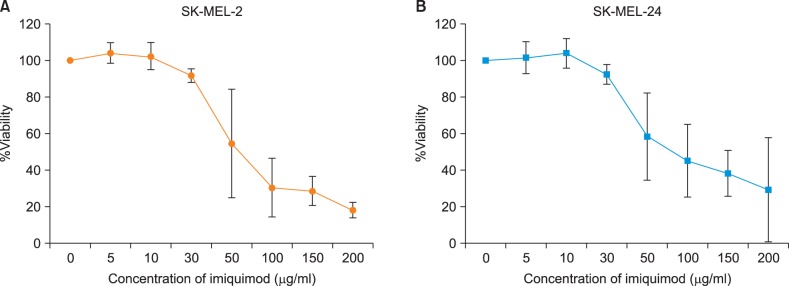
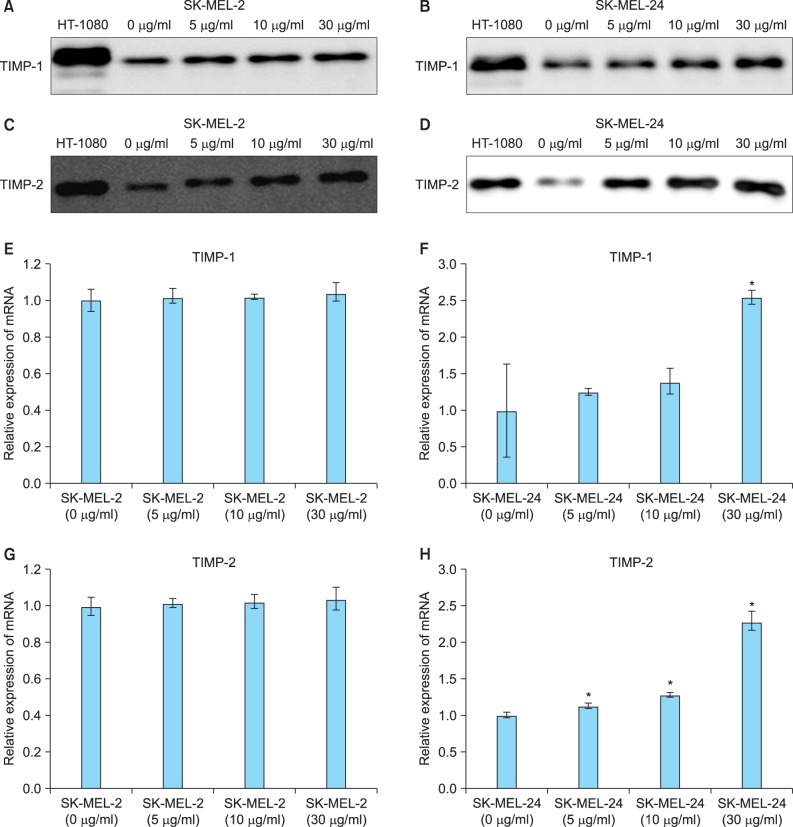
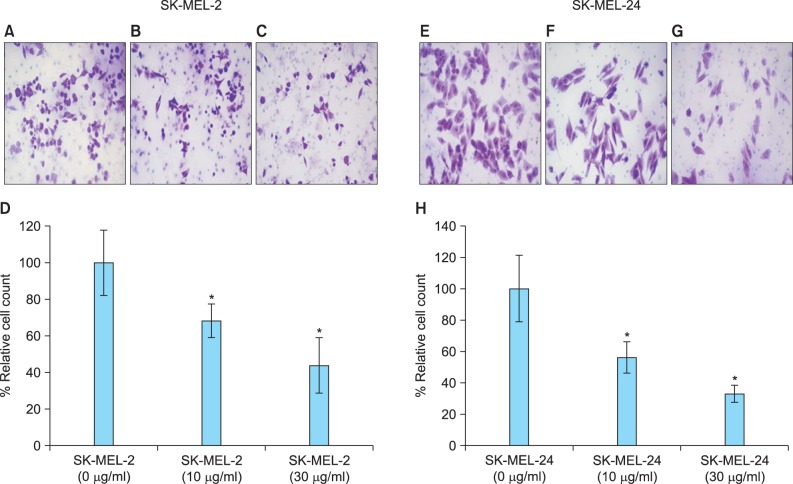
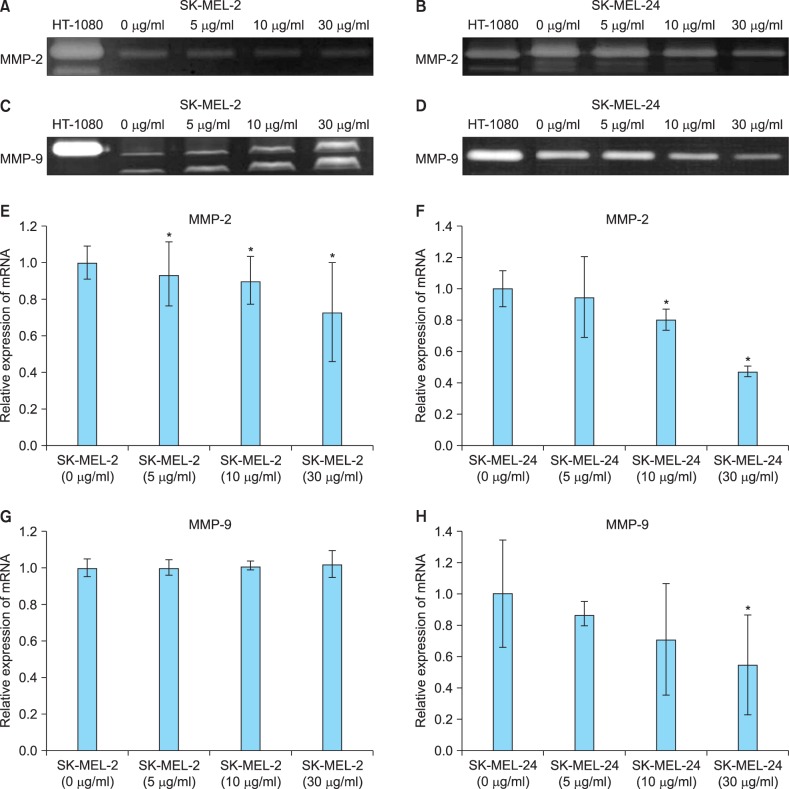
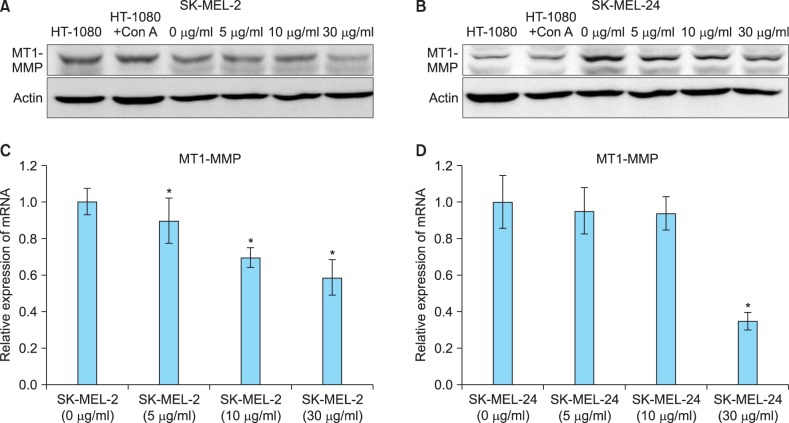
Imiquimod treatment decreased in vitro viability of melanoma cells in a concentration-dependent manner. Imiquimod also elicited a concentration-dependent suppression of invasion in both melanoma cell lines. A concentration-dependent decrease in MMP-2 and MT1-MMP protein levels and a concentration-dependent increase in TIMP-1 and -2 protein levels by imiquimod was observed in both melanoma cell lines. However, expression of MMP-9 protein was increased in SK-MEL-2 but decreased in SK-MEL-24 with increasing imiquimod concentrations. Imiquimod elicited alterations in MMPs and TIMPs mRNA levels that parallel the observed changes in protein levels.
Imiquimod may elicit an anti-invasive effect on human melanoma cells by regulating MMPs and TIMPs.
关于咪喹莫特用于治疗原位黑素瘤和转移性黑素瘤已有多篇报道。黑素瘤侵袭和转移过程中的关键步骤包括基底膜的降解以及基质金属蛋白酶(MMPs)和金属蛋白酶组织抑制剂(TIMPs)等蛋白水解酶对细胞外基质的重塑。
在体外评估咪喹莫特对人恶性黑素瘤细胞系SK-MEL-2和SK-MEL-24的抗侵袭作用,并研究咪喹莫特诱导的MMPs和TIMPs表达变化。
通过侵袭实验评估咪喹莫特处理后黑素瘤细胞系的侵袭能力。为研究咪喹莫特抗侵袭作用的机制,采用实时逆转录-聚合酶链反应、明胶酶谱法和蛋白质印迹法评估MMP-2、-9、膜型1(MT1)-MMP、TIMP-1和-2的mRNA和蛋白水平。
咪喹莫特处理以浓度依赖的方式降低黑素瘤细胞的体外活力。咪喹莫特还对两种黑素瘤细胞系的侵袭产生浓度依赖性抑制。在两种黑素瘤细胞系中均观察到咪喹莫特使MMP-2和MT1-MMP蛋白水平呈浓度依赖性降低,使TIMP-1和-2蛋白水平呈浓度依赖性升高。然而,随着咪喹莫特浓度增加,SK-MEL-2中MMP-9蛋白表达增加,而SK-MEL-24中MMP-9蛋白表达降低。咪喹莫特引起的MMPs和TIMPs mRNA水平变化与观察到的蛋白水平变化一致。
咪喹莫特可能通过调节MMPs和TIMPs对人黑素瘤细胞产生抗侵袭作用。