Bilbao Ainhoa, Rieker Claus, Cannella Nazzareno, Parlato Rosanna, Golda Slawomir, Piechota Marcin, Korostynski Michal, Engblom David, Przewlocki Ryszard, Schütz Günther, Spanagel Rainer, Parkitna Jan R
Institute of Psychopharmacology, Central Institute of Mental Health, Faculty of Medicine Mannheim, University of Heidelberg Heidelberg, Germany.
Department of Molecular Biology of the Cell I, DKFZ-ZMBH Alliance, German Cancer Research Center Heidelberg, Germany.
Front Behav Neurosci. 2014 Jun 11;8:212. doi: 10.3389/fnbeh.2014.00212. eCollection 2014.
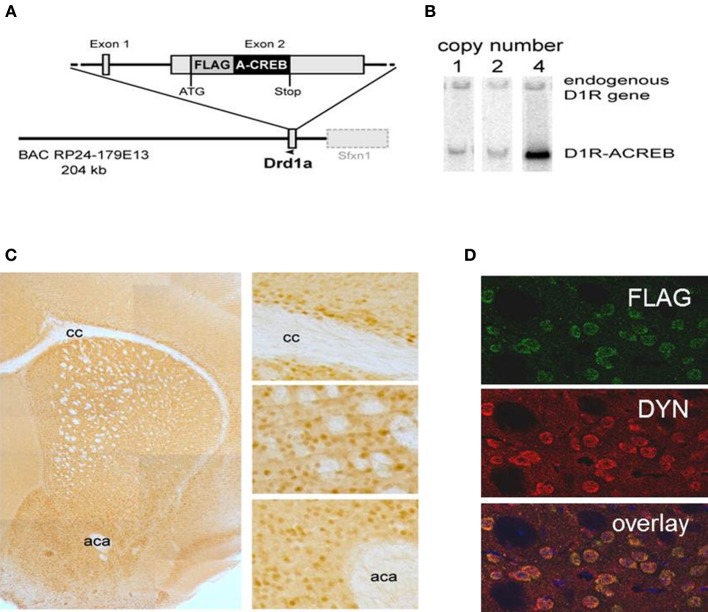
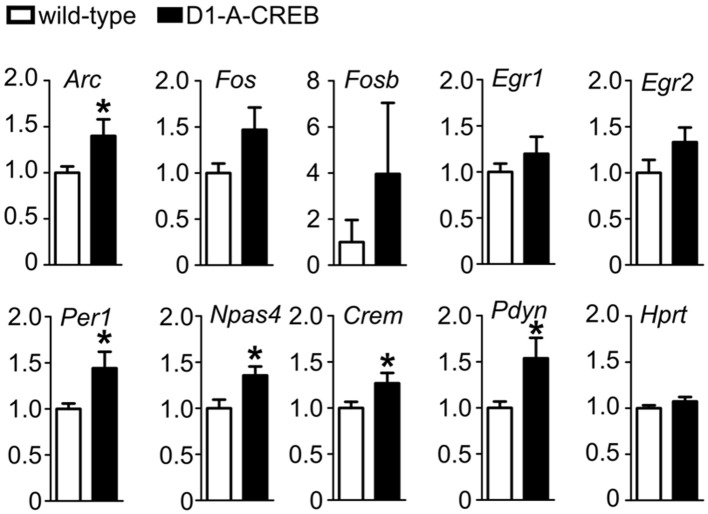
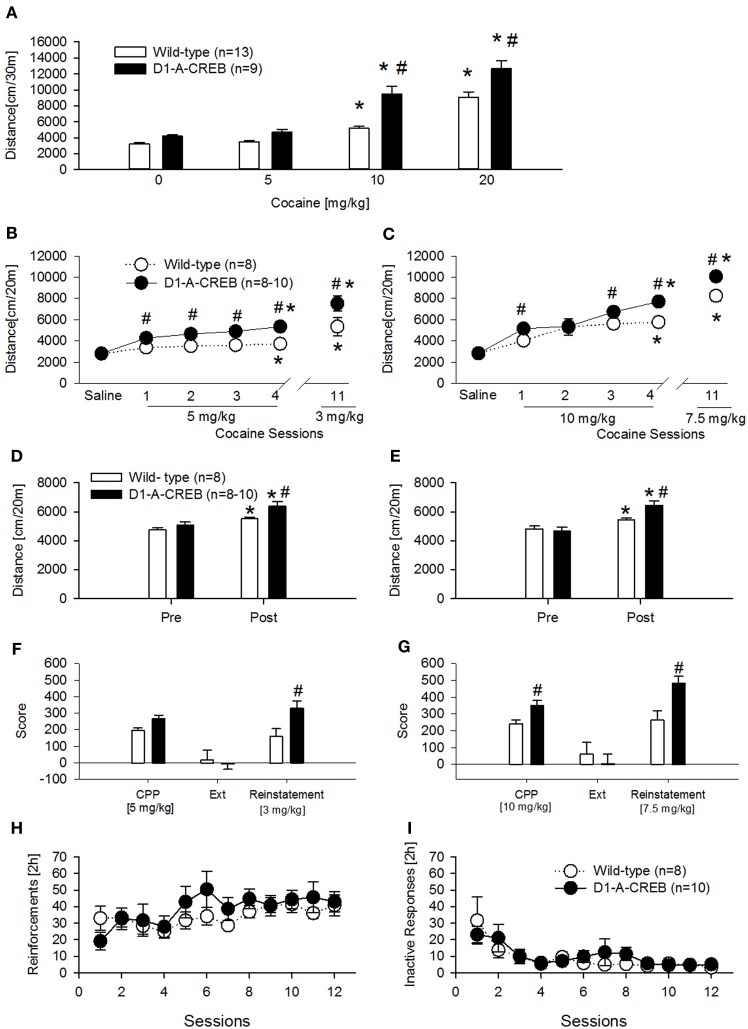
It is suggested that striatal cAMP responsive element binding protein (CREB) regulates sensitivity to psychostimulants. To test the cell-specificity of this hypothesis we examined the effects of a dominant-negative CREB protein variant expressed in dopamine receptor D1 (D1R) neurons on cocaine-induced behaviors. A transgenic mouse strain was generated by pronuclear injection of a BAC-derived transgene harboring the A-CREB sequence under the control of the D1R gene promoter. Compared to wild-type, drug-naïve mutants showed moderate alterations in gene expression, especially a reduction in basal levels of activity-regulated transcripts such as Arc and Egr2. The behavioral responses to cocaine were elevated in mutant mice. Locomotor activity after acute treatment, psychomotor sensitization after intermittent drug injections and the conditioned locomotion after saline treatment were increased compared to wild-type littermates. Transgenic mice had significantly higher cocaine conditioned place preference, displayed normal extinction of the conditioned preference, but showed an augmented cocaine-seeking response following priming-induced reinstatement. This enhanced cocaine-seeking response was associated with increased levels of activity-regulated transcripts and prodynorphin. The primary reinforcing effects of cocaine were not altered in the mutant mice as they did not differ from wild-type in cocaine self-administration under a fixed ratio schedule at the training dose. Collectively, our data indicate that expression of a dominant-negative CREB variant exclusively in neurons expressing D1R is sufficient to recapitulate the previously reported behavioral phenotypes associated with virally expressed dominant-negative CREB.
有人提出纹状体环磷酸腺苷反应元件结合蛋白(CREB)调节对精神兴奋剂的敏感性。为了检验这一假设的细胞特异性,我们研究了在多巴胺受体D1(D1R)神经元中表达的显性负性CREB蛋白变体对可卡因诱导行为的影响。通过原核注射携带在D1R基因启动子控制下的A-CREB序列的BAC衍生转基因,产生了一种转基因小鼠品系。与野生型相比,未接触过药物的突变体在基因表达上有适度改变,特别是活性调节转录本如Arc和Egr2的基础水平降低。突变小鼠对可卡因的行为反应增强。与野生型同窝小鼠相比,急性治疗后的运动活动、间歇性药物注射后的精神运动敏化以及盐水治疗后的条件性运动均增加。转基因小鼠有显著更高的可卡因条件性位置偏爱,表现出条件性偏爱的正常消退,但在启动诱导复燃后表现出增强的可卡因寻求反应。这种增强的可卡因寻求反应与活性调节转录本和前强啡肽水平的增加有关。可卡因的主要强化作用在突变小鼠中未改变,因为在训练剂量下按固定比例给药时,它们与野生型在可卡因自我给药方面没有差异。总体而言,我们的数据表明,仅在表达D1R的神经元中表达显性负性CREB变体足以重现先前报道的与病毒表达的显性负性CREB相关的行为表型。