Verhoest Grégory, Dolley-Hitze Thibault, Jouan Florence, Belaud-Rotureau Marc-Antoine, Oger Emmanuel, Lavenu Audrey, Bensalah Karim, Arlot-Bonnemains Yannick, Collet Nicolas, Rioux-Leclercq Nathalie, Vigneau Cécile
CNRS/UMR 6290/Biosit, Rennes 1 University, 35043 Rennes Cedex, France ; CHU Rennes, Department of Urology, 35033 Rennes, France ; Rennes University Hospital, 2 rue Henri Le Guilloux, 35033 Rennes Cedex, France.
CNRS/UMR 6290/Biosit, Rennes 1 University, 35043 Rennes Cedex, France ; CHU Rennes, Department of Nephrology, 35033 Rennes, France.
Biomed Res Int. 2014;2014:901371. doi: 10.1155/2014/901371. Epub 2014 May 22.
Angiotensin-2 type-1 receptor antagonists not are only antihypertensive drugs but also can inhibit VEGF production. We hypothesised that adding telmisartan to sunitinib could potentiate the antiangiogenic effects.
786-O cell lines were injected in nude mice. After tumor development, mice were divided into 4 groups: the first was the control group (DMSO), the second group was treated with sunitinib alone, the third group was treated with telmisartan alone, and the fourth group was treated with the combination. Drugs were orally administered every day for four weeks. Animals were sacrificed after treatment. Blood and tumor tissues were collected for analysis by immunohistochemistry, Western Blot, and ELISA methods.
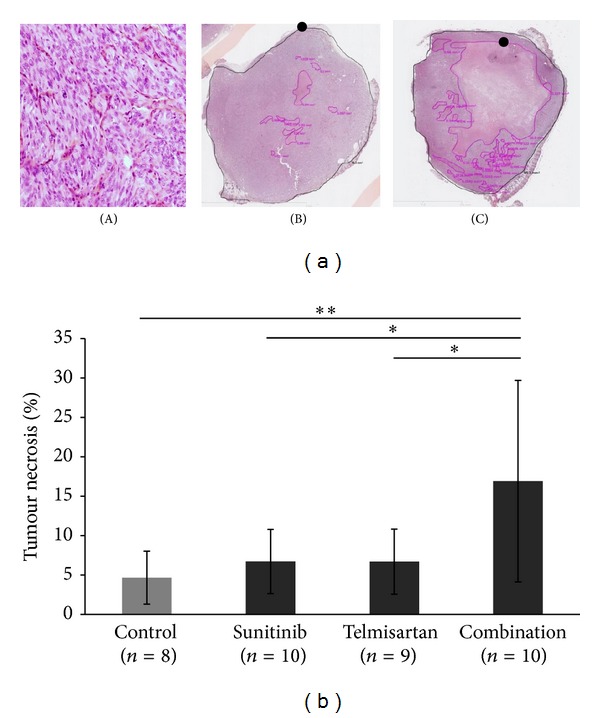
All animals developed a ccRCC and ten in each group were treated. Using a kinetic model, tumors tended to grow slower in the combination group compared to others (P = 0.06). Compared to sunitinib alone, the addition of telmisartan significantly increased tissue necrosis (P = 0.038). Central microvascular density decreased (P = 0.0038) as well as circulating VEGF (P = 0.003). There was no significant variation in proliferation or apoptosis markers.
The combination of sunitinib and telmisartan revealed an enhancement of the blockage of the VEGF pathway on renal tumor resulting in a decrease in neoangiogenesis and an increase in necrosis.
血管紧张素2 1型受体拮抗剂不仅是抗高血压药物,还能抑制血管内皮生长因子(VEGF)的产生。我们假设,在舒尼替尼中加入替米沙坦可增强抗血管生成作用。
将786-O细胞系注射到裸鼠体内。肿瘤形成后,将小鼠分为4组:第一组为对照组(二甲亚砜),第二组单独使用舒尼替尼治疗,第三组单独使用替米沙坦治疗,第四组联合使用两种药物治疗。每天口服给药,持续四周。治疗后处死动物。收集血液和肿瘤组织,采用免疫组织化学、蛋白质免疫印迹和酶联免疫吸附测定法进行分析。
所有动物均发生肾透明细胞癌(ccRCC),每组治疗10只。使用动力学模型,联合治疗组的肿瘤生长速度比其他组慢(P = 0.06)。与单独使用舒尼替尼相比,加入替米沙坦可显著增加组织坏死(P = 0.038)。中心微血管密度降低(P = 0.0038),循环VEGF水平也降低(P = 0.003)。增殖或凋亡标志物无显著变化。
舒尼替尼与替米沙坦联合使用可增强对肾肿瘤VEGF途径的阻断作用,从而减少新生血管生成并增加坏死。