Pishva Ehsan, Drukker Marjan, Viechtbauer Wolfgang, Decoster Jeroen, Collip Dina, van Winkel Ruud, Wichers Marieke, Jacobs Nele, Thiery Evert, Derom Catherine, Geschwind Nicole, van den Hove Daniel, Lataster Tineke, Myin-Germeys Inez, van Os Jim, Rutten Bart P F, Kenis Gunter
School for Mental Health and Neuroscience, Department of Psychiatry and Neuropsychology, Maastricht University Medical Centre, Maastricht, The Netherlands.
School for Mental Health and Neuroscience, Department of Psychiatry and Neuropsychology, Maastricht University Medical Centre, Maastricht, The Netherlands; School of Psychology, Open University of the Netherlands, Heerlen, The Netherlands.
PLoS One. 2014 Jun 26;9(6):e100935. doi: 10.1371/journal.pone.0100935. eCollection 2014.
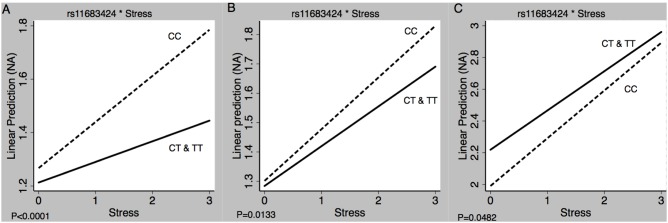
Recent human and animal studies suggest that epigenetic mechanisms mediate the impact of environment on development of mental disorders. Therefore, we hypothesized that polymorphisms in epigenetic-regulatory genes impact stress-induced emotional changes. A multi-step, multi-sample gene-environment interaction analysis was conducted to test whether 31 single nucleotide polymorphisms (SNPs) in epigenetic-regulatory genes, i.e. three DNA methyltransferase genes DNMT1, DNMT3A, DNMT3B, and methylenetetrahydrofolate reductase (MTHFR), moderate emotional responses to stressful and pleasant stimuli in daily life as measured by Experience Sampling Methodology (ESM). In the first step, main and interactive effects were tested in a sample of 112 healthy individuals. Significant associations in this discovery sample were then investigated in a population-based sample of 434 individuals for replication. SNPs showing significant effects in both the discovery and replication samples were subsequently tested in three other samples of: (i) 85 unaffected siblings of patients with psychosis, (ii) 110 patients with psychotic disorders, and iii) 126 patients with a history of major depressive disorder. Multilevel linear regression analyses showed no significant association between SNPs and negative affect or positive affect. No SNPs moderated the effect of pleasant stimuli on positive affect. Three SNPs of DNMT3A (rs11683424, rs1465764, rs1465825) and 1 SNP of MTHFR (rs1801131) moderated the effect of stressful events on negative affect. Only rs11683424 of DNMT3A showed consistent directions of effect in the majority of the 5 samples. These data provide the first evidence that emotional responses to daily life stressors may be moderated by genetic variation in the genes involved in the epigenetic machinery.
近期的人类和动物研究表明,表观遗传机制介导了环境对精神障碍发展的影响。因此,我们推测表观遗传调控基因中的多态性会影响应激诱导的情绪变化。我们进行了一项多步骤、多样本的基因-环境相互作用分析,以检验表观遗传调控基因中的31个单核苷酸多态性(SNP),即三个DNA甲基转移酶基因DNMT1、DNMT3A、DNMT3B以及亚甲基四氢叶酸还原酶(MTHFR),是否会调节通过经验取样法(ESM)测量的日常生活中对压力性和愉悦性刺激的情绪反应。第一步,在112名健康个体的样本中测试主效应和交互效应。然后,在一个基于人群的434名个体的样本中对该发现样本中的显著关联进行重复研究。随后,在另外三个样本中对在发现样本和重复样本中均显示出显著效应的SNP进行测试:(i)85名精神病患者的未患病同胞,(ii)110名精神病性障碍患者,以及(iii)126名有重度抑郁症病史的患者。多级线性回归分析显示,SNP与消极情绪或积极情绪之间无显著关联。没有SNP调节愉悦性刺激对积极情绪的影响。DNMT3A的三个SNP(rs11683424、rs1465764、rs1465825)和MTHFR的一个SNP(rs1801131)调节了应激事件对消极情绪的影响。在这5个样本中的大多数样本中,只有DNMT3A的rs11683424显示出一致的效应方向。这些数据提供了首个证据,表明对日常生活应激源的情绪反应可能受到表观遗传机制相关基因中的遗传变异的调节。