Janssens Lizanne, Stoks Robby
Laboratory of Aquatic Ecology, Evolution and Conservation, University of Leuven, Leuven, Belgium.
PLoS One. 2014 Jun 26;9(6):e101273. doi: 10.1371/journal.pone.0101273. eCollection 2014.
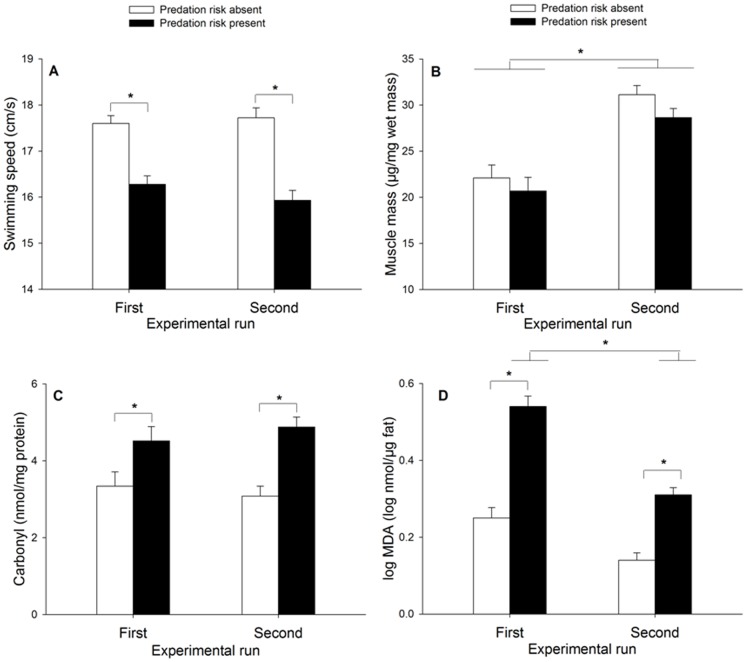
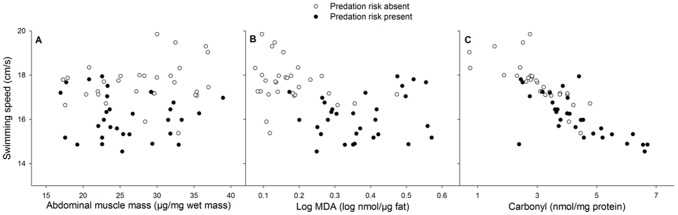
Prey organisms evolved a multitude of plastic responses to avoid being eaten by predators. Besides the evolution of plastic morphological responses to escape predation, prey also evolved a set of physiological stress responses to avoid dying because of chronic predator stress per se due to disruption of cellular homeostasis. As physiological stress theory predicts increased energy consumption and the inhibition of essential nonemergency body functions, we tested whether chronic predation risk may increase oxidative damage thereby generating negative effects on escape performance. Specifically, we evaluated whether predation risk reduces escape swimming speed in damselfly larvae and whether this operates through stress-associated increases in oxidative damage. Counterintuitively and in contrast with many empirical studies, chronic predation risk decreased escape performance. This is however entirely consistent with the expectation of it being a long-term cost of responding to predation risk (e.g. by increasing respiration or upregulating the stress protein levels). The decreased swimming speed could be explained by an increased oxidative damage to proteins, thereby providing one of the poorly studied ecological links between oxidative damage and whole-animal performance. This likely widespread, understudied cost of chronic predation risk may provide an important pathway of non-consumptive predator effects on prey population dynamics. Moreover, it could play an evolutionary role by acting as a selective force causing prey organisms to adjust the magnitude of the physiological stress response and should be considered when evaluating life history trade-offs thought to be mediated by oxidative damage.
猎物进化出了多种适应性反应以避免被捕食者吃掉。除了进化出适应性形态反应来逃避捕食外,猎物还进化出了一系列生理应激反应,以避免因细胞内稳态破坏导致的长期捕食者压力本身而死亡。正如生理应激理论所预测的那样,能量消耗增加且基本的非紧急身体功能受到抑制,我们测试了长期捕食风险是否会增加氧化损伤,从而对逃避性能产生负面影响。具体而言,我们评估了捕食风险是否会降低豆娘幼虫的逃避游泳速度,以及这是否通过与应激相关的氧化损伤增加来起作用。与许多实证研究相反且出人意料的是,长期捕食风险降低了逃避性能。然而,这与它作为应对捕食风险的长期代价(例如通过增加呼吸或上调应激蛋白水平)的预期完全一致。游泳速度降低可以用蛋白质氧化损伤增加来解释,从而提供了氧化损伤与动物整体性能之间研究较少的生态联系之一。这种长期捕食风险可能广泛存在但未被充分研究的代价,可能为捕食者对猎物种群动态的非消耗性影响提供一条重要途径。此外,它可能通过作为一种选择力促使猎物调整生理应激反应的幅度而发挥进化作用,并且在评估被认为由氧化损伤介导的生活史权衡时应予以考虑。