Zhang Hailong, Gu Lubing, Liu Tao, Chiang Kuang-Yueh, Zhou Muxiang
Department of Pediatrics and Aflac Cancer and Blood Disorders Center, Emory University School of Medicine, Atlanta, Georgia, United States of America.
PLoS One. 2014 Jun 26;9(6):e100960. doi: 10.1371/journal.pone.0100960. eCollection 2014.
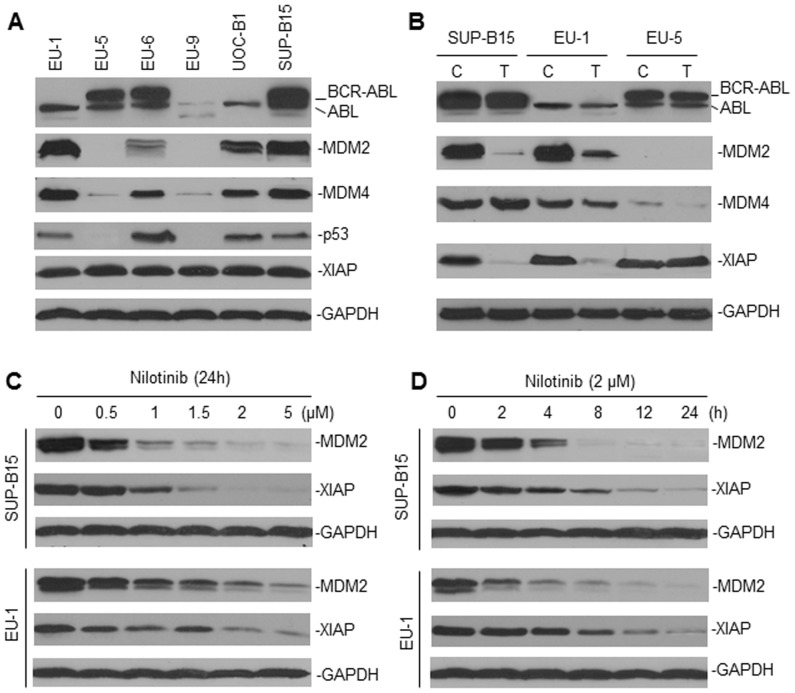
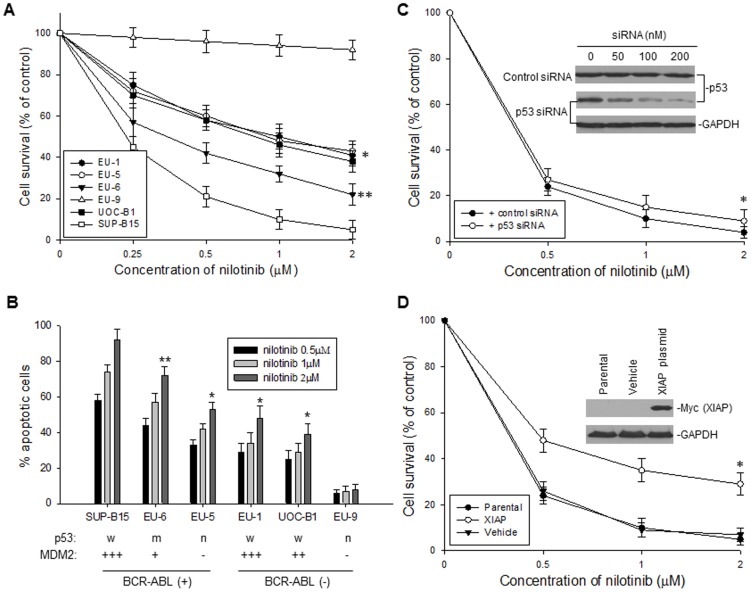
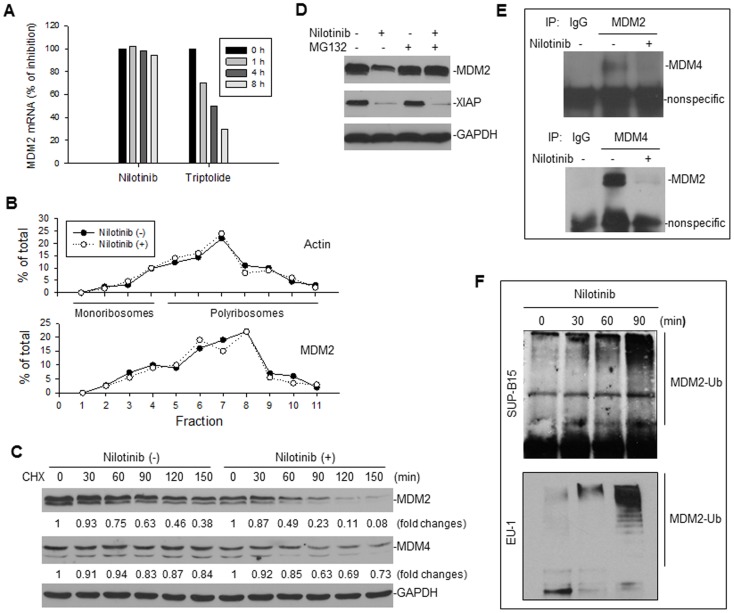
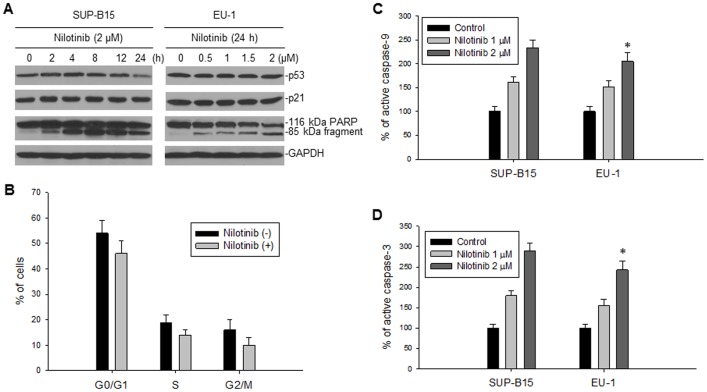
Nilotinib is a selective BCR-ABL tyrosine kinase inhibitor related to imatinib that is more potent than imatinib. Nilotinib is widely used to treat chronic myelogenous leukemia (CML) and Philadelphia-positive (Ph+) acute lymphoblastic leukemia (ALL). The present study identifies Mouse double minute 2 homolog (MDM2) as a target of nilotinib. In studying ALL cell lines, we found that the expression of MDM2 in both Philadelphia positive (Ph+) and Philadelphia negative (Ph-) ALL cells was remarkably inhibited by nilotinib, in a dose- and time-dependent manner. Further studies demonstrated that nilotinib inhibited MDM2 at the post-translational level by inducing MDM2 self-ubiquitination and degradation. Nilotinib-mediated MDM2 downregulation did not result in accumulation and activation of p53. Inhibition of MDM2 in nilotinib-treated ALL cells led to downregulation of the anti-apoptotic protein X-linked inhibitor of apoptosis protein (XIAP), a translational target of MDM2, resulting in activation of caspases. Inhibition of XIAP following nilotinib-mediated downregulation of MDM2 resulted in apoptosis of MDM2-expressing ALL; however, similar nilotinib treatment induced stronger apoptosis in Ph+/MDM2+ ALL than in Ph-/MDM2+ or Ph+/MDM2- ALL. The ALL cells that were Ph-/MDM2- were totally resistant to nilotinib. These results suggested that nilotinib can inhibit MDM2 and induce a p53-independent apoptosis pathway by downregulating XIAP; thus, nilotinib can treat not only Ph+, but also Ph- ALL patients whose cancer cells overexpress MDM2.
尼罗替尼是一种与伊马替尼相关的选择性BCR-ABL酪氨酸激酶抑制剂,其效力比伊马替尼更强。尼罗替尼被广泛用于治疗慢性粒细胞白血病(CML)和费城染色体阳性(Ph+)急性淋巴细胞白血病(ALL)。本研究确定小鼠双微体2同源物(MDM2)为尼罗替尼的一个靶点。在研究ALL细胞系时,我们发现尼罗替尼以剂量和时间依赖性方式显著抑制费城染色体阳性(Ph+)和费城染色体阴性(Ph-)ALL细胞中MDM2的表达。进一步研究表明,尼罗替尼通过诱导MDM2自身泛素化和降解在翻译后水平抑制MDM2。尼罗替尼介导的MDM2下调并未导致p53的积累和激活。在尼罗替尼处理的ALL细胞中抑制MDM2导致抗凋亡蛋白X连锁凋亡抑制蛋白(XIAP)下调,XIAP是MDM2的一个翻译靶点,从而导致半胱天冬酶激活。尼罗替尼介导的MDM2下调后对XIAP的抑制导致表达MDM2的ALL细胞凋亡;然而,类似的尼罗替尼处理在Ph+/MDM2+ ALL中诱导的凋亡比在Ph-/MDM2+或Ph+/MDM2- ALL中更强。Ph-/MDM2-的ALL细胞对尼罗替尼完全耐药。这些结果表明,尼罗替尼可抑制MDM2并通过下调XIAP诱导一条不依赖p53的凋亡途径;因此,尼罗替尼不仅可以治疗Ph+,还可以治疗癌细胞过度表达MDM2的Ph- ALL患者。