Horváth Emese, Farkas Katalin, Herczegfalvi Agnes, Nagy Nikoletta, Széll Márta
Department of Medical Genetics, University of Szeged, Somogyi utca 4, H-6720 Szeged, Hungary.
J Med Case Rep. 2014 Jun 26;8:233. doi: 10.1186/1752-1947-8-233.
Hereditary hyperekplexia is a neurological disorder characterized by excessive startle responses with violent jerking to noise or touch, stiffening of the trunk and limbs, clenching of the fists and attacks of a high-frequency trembling. Hyperekplexia has a heterogeneous genetic background with several identified causative genes and demonstrates both dominant and recessive inheritance. Mutations in the glycine receptor alpha 1 subunit gene occur in about 30 percent of hyperekplexia cases.
In this study, we report the case of a Hungarian boy whose abnormal movements, muscle stiffness and convulsions were first noted when he was 4 days old. Neurological and electrophysiological investigation suggested the clinical diagnosis of hyperekplexia.
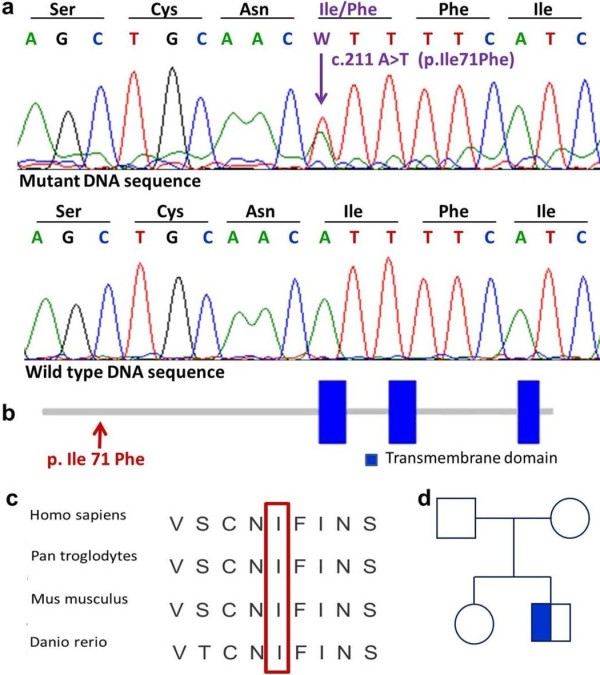
Direct sequencing of the coding regions and the flanking introns of the glycine receptor alpha 1 subunit gene revealed a novel heterozygous missense mutation (c.211A/T, p.Ile71Phe). Genetic screening of our patient's family revealed that the clinically unaffected parents and sister do not carry the mutation, suggesting that the identified sequence change is a de novo mutation. Since hyperekplexia can have severe consequences, including sudden infant death due to laryngospasm and cardiorespiratory failure, identification of the causative genetic alteration(s) of the disease is high priority. Such knowledge is necessary for prenatal diagnosis, which would allow informed family planning and greater parental sensitivity to hyperekplexia 1-associated risks.
遗传性惊吓症是一种神经系统疾病,其特征为对噪音或触摸产生过度惊吓反应,伴有剧烈抽搐、躯干和四肢僵硬、握拳以及高频颤抖发作。惊吓症具有异质性遗传背景,有多个已确定的致病基因,呈现显性和隐性遗传。约30%的惊吓症病例存在甘氨酸受体α1亚基基因突变。
在本研究中,我们报告了一名匈牙利男孩的病例,其异常运动、肌肉僵硬和抽搐在4日龄时首次被注意到。神经学和电生理学检查提示惊吓症的临床诊断。
对甘氨酸受体α1亚基基因的编码区及其侧翼内含子进行直接测序,发现了一个新的杂合错义突变(c.211A/T,p.Ile71Phe)。对患者家族的基因筛查显示,临床未受影响的父母和妹妹不携带该突变,这表明所鉴定的序列变化是一个新发突变。由于惊吓症可能产生严重后果,包括因喉痉挛和心肺衰竭导致的婴儿猝死,确定该疾病的致病基因改变是当务之急。此类知识对于产前诊断是必要的,这将有助于进行明智的计划生育,并使父母对与惊吓症1相关的风险更加敏感。