Bruno Aurélie, Boisselier Blandine, Labreche Karim, Marie Yannick, Polivka Marc, Jouvet Anne, Adam Clovis, Figarella-Branger Dominique, Miquel Catherine, Eimer Sandrine, Houillier Caroline, Soussain Carole, Mokhtari Karima, Daveau Romain, Hoang-Xuan Khê
Sorbonne Universités, UPMC Univ Paris 06, UM 75, ICM, F-75013, Paris, France. Institut National de la Santé et de la Recherche Médicale, U 1127, ICM, F-75013, Paris, France. Centre National de la Recherche Scientifique, UMR 7225, ICM, F-75013, Paris, France. ICM, F-75013, Paris, France.
Sorbonne Universités, UPMC Univ Paris 06, UM 75, ICM, F-75013, Paris, France. Institut National de la Santé et de la Recherche Médicale, U 1127, ICM, F-75013, Paris, France. Centre National de la Recherche Scientifique, UMR 7225, ICM, F-75013, Paris, France. ICM, F-75013, Paris, France. Plateforme de Génotypage Séquençage, ICM, F-75013, Paris, France.
Oncotarget. 2014 Jul 15;5(13):5065-75. doi: 10.18632/oncotarget.2080.
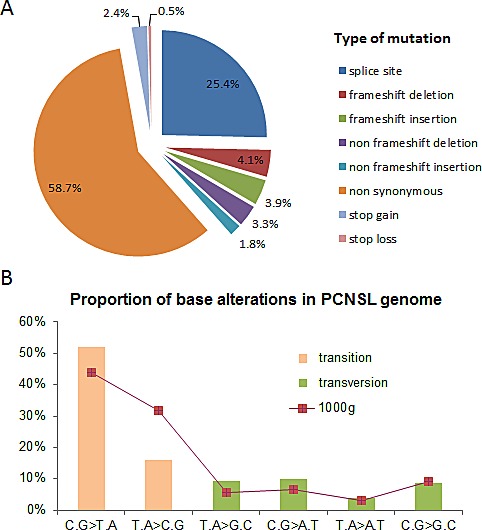
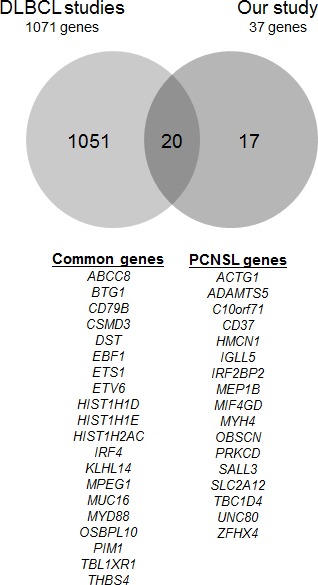
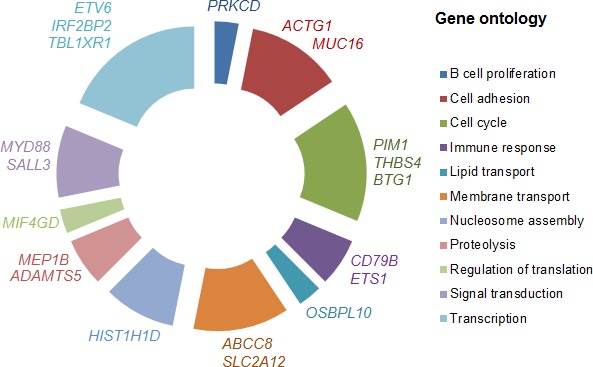
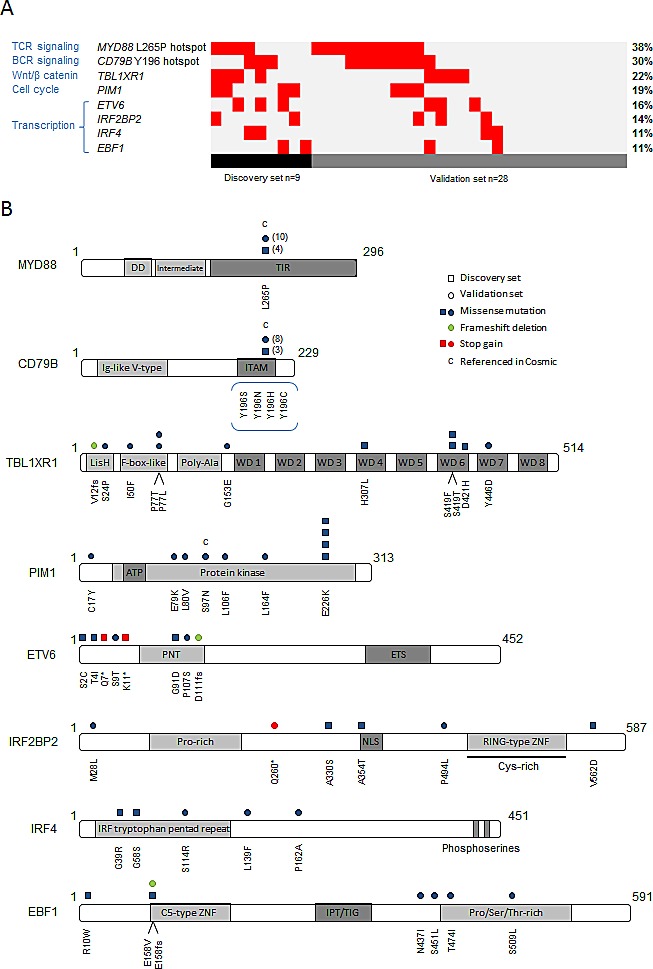
Little is known about the genomic basis of primary central nervous system lymphoma (PCNSL) tumorigenesis. To investigate the mutational profile of PCNSL, we analyzed nine paired tumor and germline DNA samples from PCNSL patients by high throughput exome sequencing. Eight genes of interest have been further investigated by focused resequencing in 28 additional PCNSL tumors to better estimate their incidence. Our study identified recurrent somatic mutations in 37 genes, some involved in key signaling pathways such as NFKB, B cell differentiation and cell cycle control. Focused resequencing in the larger cohort revealed high mutation rates for genes already described as mutated in PCNSL such as MYD88 (38%), CD79B (30%), PIM1 (22%) and TBL1XR1 (19%) and for genes not previously reported to be involved in PCNSL tumorigenesis such as ETV6 (16%), IRF4 (14%), IRF2BP2 (11%) and EBF1 (11%). Of note, only 3 somatically acquired SNVs were annotated in the COSMIC database. Our results demonstrate a high genetic heterogeneity of PCNSL and mutational pattern similarities with extracerebral diffuse large B cell lymphomas, particularly of the activated B-cell (ABC) subtype, suggesting shared underlying biological mechanisms. The present study provides new insights into the mutational profile of PCNSL and potential targets for therapeutic strategies.
关于原发性中枢神经系统淋巴瘤(PCNSL)肿瘤发生的基因组基础,人们了解甚少。为了研究PCNSL的突变谱,我们通过高通量外显子组测序分析了9例PCNSL患者的配对肿瘤和种系DNA样本。通过对另外28例PCNSL肿瘤进行靶向重测序,进一步研究了8个感兴趣的基因,以更好地评估它们的发生率。我们的研究在37个基因中鉴定出复发性体细胞突变,其中一些基因参与关键信号通路,如NFKB、B细胞分化和细胞周期控制。在更大队列中的靶向重测序显示,已被描述在PCNSL中发生突变的基因,如MYD88(38%)、CD79B(30%)、PIM1(22%)和TBL1XR1(19%),以及先前未报道参与PCNSL肿瘤发生的基因,如ETV6(16%)、IRF4(14%)、IRF2BP2(11%)和EBF1(11%),都有较高的突变率。值得注意的是,在COSMIC数据库中仅注释了3个体细胞获得的单核苷酸变异。我们的结果表明PCNSL具有高度的遗传异质性,并且与脑外弥漫性大B细胞淋巴瘤,特别是活化B细胞(ABC)亚型,具有突变模式相似性,提示存在共同的潜在生物学机制。本研究为PCNSL的突变谱和治疗策略的潜在靶点提供了新的见解。