Department of Oncology, Sun Yat-sen Memorial Hospital, Sun Yat-sen University, Guangzhou, Guangdong 510515, China.
Department of Internal Medicine, Nanfang Hospital of Southern Medical University, Luohu District, Guangdong 510515, China.
Gastroenterol Res Pract. 2014;2014:594930. doi: 10.1155/2014/594930. Epub 2014 May 25.
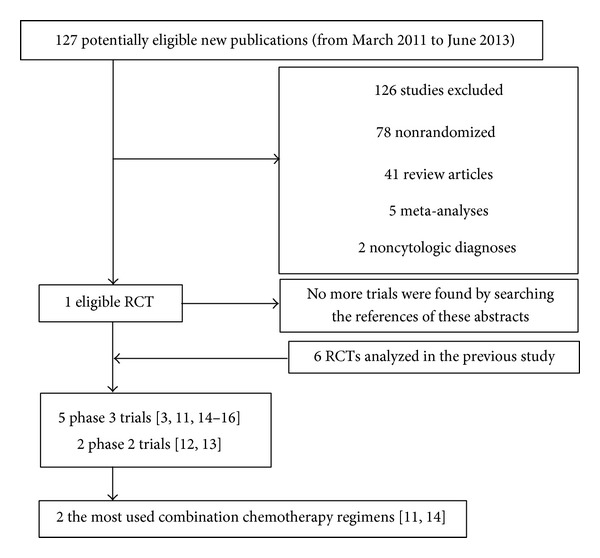
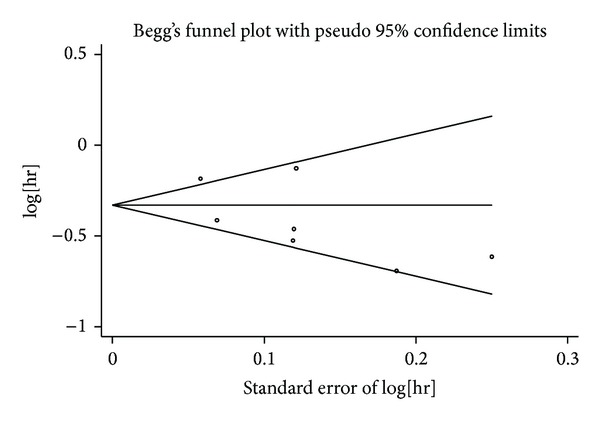
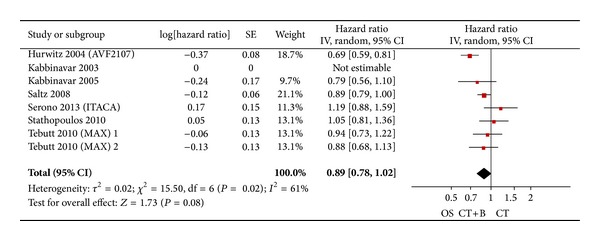
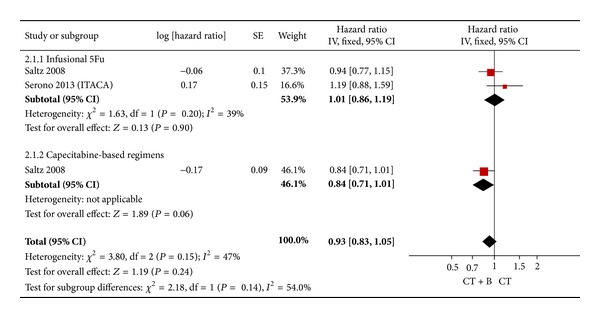
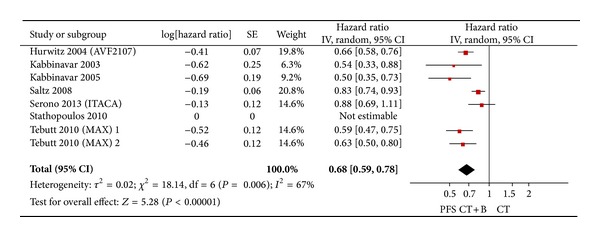
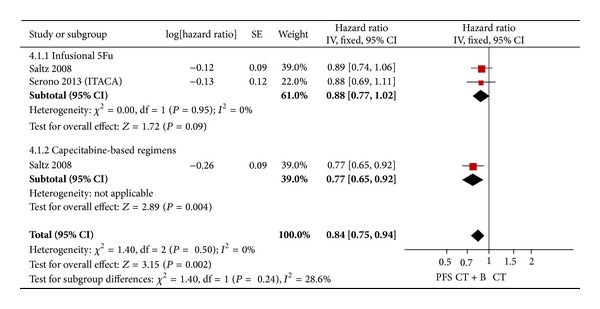
Background. Efficacy of adding bevacizumab in first-line chemotherapy of metastatic colorectal cancer (mCRC) has been controversial. The aim of this study is to gather current data to analyze efficacy of adding bevacizumab to the most used combination first-line chemotherapy in mCRC, based on the 2012 meta-analysis reported by Macedo et al. Methods. Medline, EMBASE and Cochrane library, meeting presentations and abstracts were searched. Eligible studies were randomized controlled trials (RCTs) which evaluated first-line chemotherapy with or without bevacizumab in mCRC. The extracting data were included and examined in the meta-analysis according to the type of chemotherapy regimen. Results. Seven trials, totaling 3436 patients, were analyzed. Compared with first-line chemothery alone, the adding of bevacizumab did not show clinical benefit for OS both in first-line therapy and the most used combination chemotherapy (HR = 0.89; 95% CI = 0.78-1.02; P = 0.08; HR = 0.93; 95% CI = 0.83-1.05; P = 0.24). In contrast with OS, the addition of bevacizumab resulted in significant improvement for PFS (HR = 0.68; 95% CI = 0.59-0.78; P < 0.00001). Moreover, it also demonstrated statistical benefit for PFS in the most used combination first-line chemotherapy (HR = 0.84; 95% CI = 0.75-0.94; P = 0.002). And the subgroup analysis indicated only capacitabine-based regimens were beneficial. Conclusions. This meta-analysis shows that the addition of bevacizumab to FOLFOX/FOLFIRI/XELOX regimens might not be beneficial in terms of OS. Benefit has been seen when PFS has been taken into account. In subgroup analysis, benefit adding bevacizumab has been seen when capecitabine-based regimens are used. Further studies are warranted to explore the combination with bevacizumab.
贝伐珠单抗在转移性结直肠癌(mCRC)一线化疗中的疗效一直存在争议。本研究旨在根据 Macedo 等人 2012 年的荟萃分析,收集当前数据,分析贝伐珠单抗在 mCRC 中最常用的一线化疗联合方案中的疗效。
检索 Medline、EMBASE 和 Cochrane 图书馆、会议演讲和摘要。纳入评估 mCRC 一线化疗中联合或不联合贝伐珠单抗的随机对照试验(RCT)。根据化疗方案的类型,提取数据并进行荟萃分析。
分析了 7 项试验,共 3436 例患者。与单纯一线化疗相比,贝伐珠单抗联合一线治疗和最常用的联合化疗方案均未显示出对 OS 的临床获益(HR=0.89;95%CI=0.78-1.02;P=0.08;HR=0.93;95%CI=0.83-1.05;P=0.24)。与 OS 相反,贝伐珠单抗的加入显著改善了 PFS(HR=0.68;95%CI=0.59-0.78;P<0.00001)。此外,它还显示了在最常用的联合一线化疗中 PFS 的统计学获益(HR=0.84;95%CI=0.75-0.94;P=0.002)。亚组分析表明,只有卡培他滨为基础的方案受益。
本荟萃分析表明,贝伐珠单抗联合 FOLFOX/FOLFIRI/XELOX 方案在 OS 方面可能无益。当考虑 PFS 时,观察到获益。在亚组分析中,当使用卡培他滨为基础的方案时,观察到添加贝伐珠单抗的获益。需要进一步的研究来探索与贝伐珠单抗的联合。