Pinchuk Dmitry Yu, Bekshaev Sergey S, Bumakova Svetlana A, Dudin Mikhail G, Pinchuk Olga D
Human Brain Research Centre, Finlandsky pr. 4-A, Office 901, St. Petersburg 194044, Russia ; Ogonyok Rehabilitation Center of Pediatric Orthopedics and Traumatology, St. Petersburg Highway 101, St. Petersburg 198515, Russia.
Human Brain Research Centre, Finlandsky pr. 4-A, Office 901, St. Petersburg 194044, Russia ; Sechenov Institute of Evolutionary Physiology and Biochemistry, Russian Academy of Sciences, Toreza st., 44, St. Petersburg 194223, Russia.
ISRN Orthop. 2012 Aug 28;2012:987095. doi: 10.5402/2012/987095. eCollection 2012.
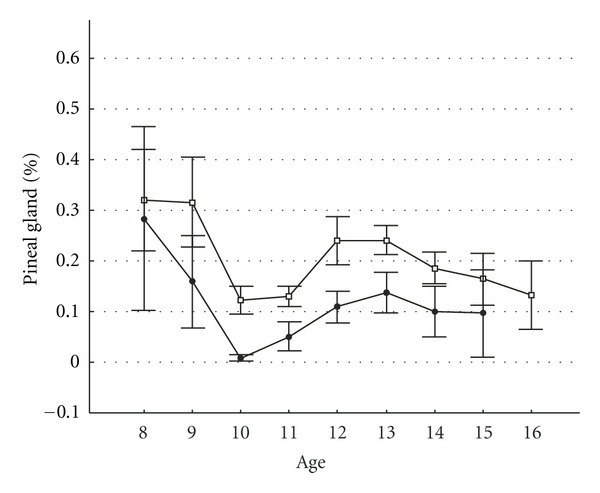
The purpose of this work is to identify a role of the pineal gland/suprachiasmatic nucleus system in adolescent idiopathic scoliosis (AIS) aetiology and pathogenesis. To analyze electroencephalograms of 292 children with AIS and in 46 healthy subjects, a processing method was used to assess three-dimensional coordinates of electric equivalent dipole sources (EEDSs) within the brain. Amounts of EEDSs in the pineal gland and suprachiasmatic nucleus (SCN) area were assessed in different age groups and during the progress of orthopaedic pathology. It was shown that children with AIS, compared with healthy children, were characterized by a higher level of electric activity (as judged by EEDS values) in the pineal gland area. It was also revealed that the number of EEDS in the pineal gland area increases significantly with increased severity of spinal deformation, while their number in the suprachiasmatic nucleus (SCN) area decreases compared with the number in healthy peers. Changes in electric activity and changes in the pineal gland and SCN area suggest that mechanisms of AIS aetiology and pathogenesis involve functional disturbances in brain areas responsible for the formation and maintenance of normal biorhythms, including osteogenesis and bone growth.
这项工作的目的是确定松果体/视交叉上核系统在青少年特发性脊柱侧凸(AIS)病因学和发病机制中的作用。为了分析292例AIS患儿和46例健康受试者的脑电图,采用一种处理方法来评估脑内电等效偶极子源(EEDSs)的三维坐标。在不同年龄组以及骨科病理进展过程中,评估松果体和视交叉上核(SCN)区域的EEDSs数量。结果显示,与健康儿童相比,AIS患儿松果体区域的电活动水平较高(根据EEDS值判断)。还发现,随着脊柱畸形严重程度的增加,松果体区域的EEDs数量显著增加,而与健康同龄人相比,视交叉上核(SCN)区域的EEDs数量减少。电活动的变化以及松果体和SCN区域的变化表明,AIS病因学和发病机制涉及负责正常生物节律形成和维持的脑区功能紊乱,包括骨生成和骨骼生长。