Watkins Deborah J, Eliot Melissa, Sathyanarayana Sheela, Calafat Antonia M, Yolton Kimberly, Lanphear Bruce P, Braun Joseph M
Department of Epidemiology, Brown University , Providence, Rhode Island 02912, United States.
Environ Sci Technol. 2014;48(15):8881-90. doi: 10.1021/es501744v. Epub 2014 Jul 9.
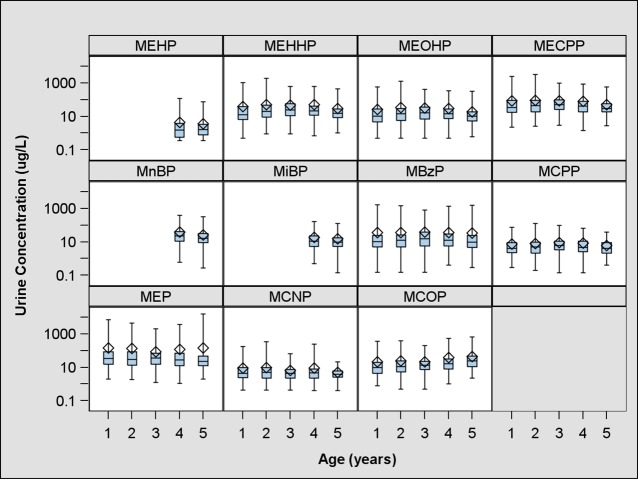
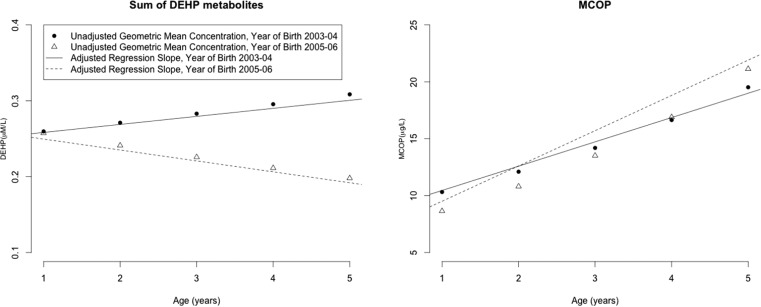
The variability and predictors of urinary concentrations of phthalate metabolites in preschool-aged children have not been thoroughly examined. Additionally, the impact of temporal changes in the use and restriction of phthalates in children's products has not been assessed. Our objective was to identify demographic, behavioral, and temporal predictors of urinary phthalate metabolite concentrations in young children. Between 2004 and 2011, we collected up to five urine samples from each of 296 children participating in a prospective birth cohort during annual study visits at ages 1-5 years. We used linear mixed models to calculate intraclass correlation coefficients (ICCs), a measure of within-individual reproducibility, and identify demographic predictors of urinary phthalate metabolites. We used multivariable linear regression to examine cross-sectional relationships between food packaging or personal care product use and phthalate metabolites measured at age 5 years. Across annual measurements, monoethyl phthalate exhibited the least variation (ICC = 0.38), while di-2-ethylhexyl phthalate (ΣDEHP) metabolites exhibited the most variation (ICC = 0.09). Concentrations changed with age, suggesting age-related changes in phthalate exposure and perhaps metabolism. Our findings suggest that fast food consumption may be a source of butylbenzyl phthalate and di-isononyl phthalate (DiNP) exposure, and some personal care products may be sources of diethyl phthalate exposure. Concentrations of ΣDEHP metabolites decreased over the study period; however, concentrations of DiNP metabolites increased. This finding suggests that manufacturer practices and regulations, like the Consumer Product Safety Improvement Act of 2008, may decrease DEHP exposure, but additional work characterizing the nature and toxicity of replacements is critically needed.
学龄前儿童尿中邻苯二甲酸酯代谢物浓度的变异性及预测因素尚未得到充分研究。此外,儿童产品中邻苯二甲酸酯使用和限制的时间变化所产生的影响也未得到评估。我们的目标是确定幼儿尿中邻苯二甲酸酯代谢物浓度的人口统计学、行为学和时间预测因素。在2004年至2011年期间,我们在1至5岁的年度研究访视中,从参与一项前瞻性出生队列研究的296名儿童中,每人最多收集了5份尿液样本。我们使用线性混合模型来计算组内相关系数(ICC),这是一种个体内再现性的测量方法,并确定尿中邻苯二甲酸酯代谢物的人口统计学预测因素。我们使用多变量线性回归来研究食品包装或个人护理产品的使用与5岁时测量的邻苯二甲酸酯代谢物之间的横断面关系。在年度测量中,邻苯二甲酸单乙酯的变化最小(ICC = 0.38),而邻苯二甲酸二(2-乙基己基)酯(ΣDEHP)代谢物的变化最大(ICC = 0.09)。浓度随年龄变化,表明邻苯二甲酸酯暴露以及可能的代谢存在与年龄相关的变化。我们的研究结果表明,食用快餐可能是邻苯二甲酸丁苄酯和邻苯二甲酸二异壬酯(DiNP)暴露的一个来源,一些个人护理产品可能是邻苯二甲酸二乙酯暴露的来源。在研究期间,ΣDEHP代谢物的浓度下降;然而,DiNP代谢物的浓度上升。这一发现表明,制造商的做法和法规,如2008年的《消费品安全改进法案》,可能会减少DEHP暴露,但迫切需要开展更多工作来表征替代品的性质和毒性。