Fuller Joanne M, Wong Keith K, Grunstein Ronald, Krass Ines, Patel Jayshree, Saini Bandana
Faculty of Pharmacy, The University of Sydney, Sydney, NSW, Australia; The Centre for Integrated Research and Understanding of Sleep (CIRUS), The University of Sydney, Sydney, NSW, Australia.
Royal Prince Alfred Hospital, Sydney, NSW, Australia; The Centre for Integrated Research and Understanding of Sleep (CIRUS), The University of Sydney, Sydney, NSW, Australia; The Woolcock Institute of Medical Research, The University of Sydney, Sydney, NSW, Australia.
PLoS One. 2014 Jun 30;9(6):e101003. doi: 10.1371/journal.pone.0101003. eCollection 2014.
Community pharmacies may potentially assist in screening for chronic conditions such as sleep disorders, which remain both under-diagnosed and untreated. We aimed to compare a subjective risk-assessment-only questionnaire (RAO) for common sleep disorder screening against the same risk-assessment questionnaire plus a nasal flow monitor as an objective marker of possible underlying obstructive sleep apnea (OSA) (RA+) in a community pharmacy setting. The primary outcome was the number of participants identified in RAO or RA+ group who were likely to have and consequently be diagnosed with OSA. Further outcomes included the number of participants identified as being at risk for, referred for, taking-up referral for, and then diagnosed with OSA, insomnia, and/or restless legs syndrome (RLS) in either group.
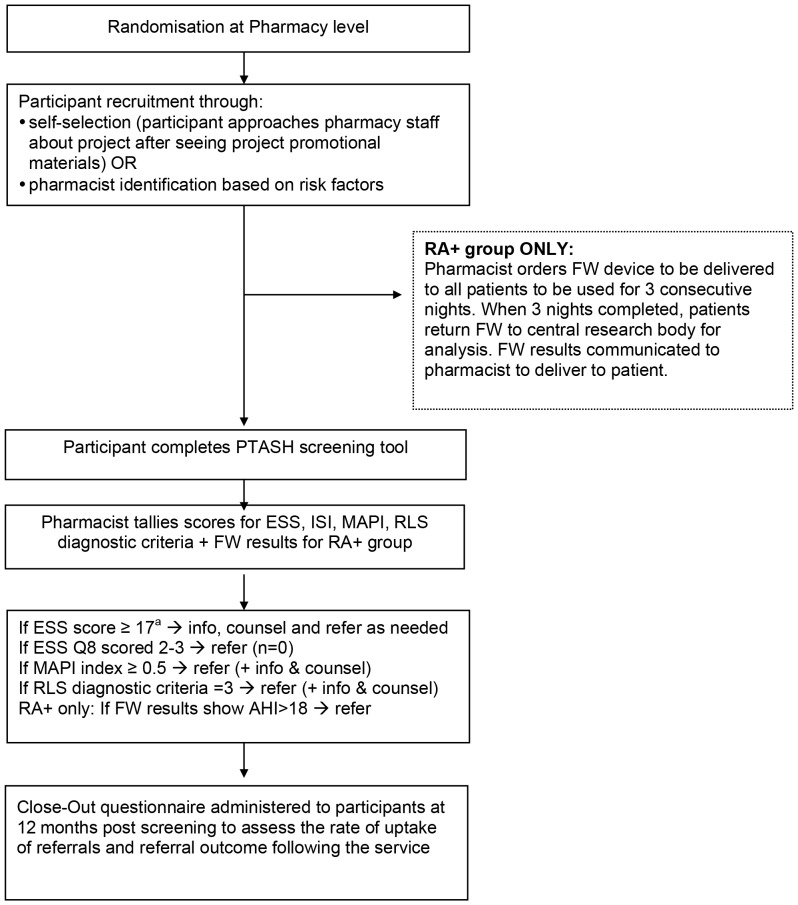
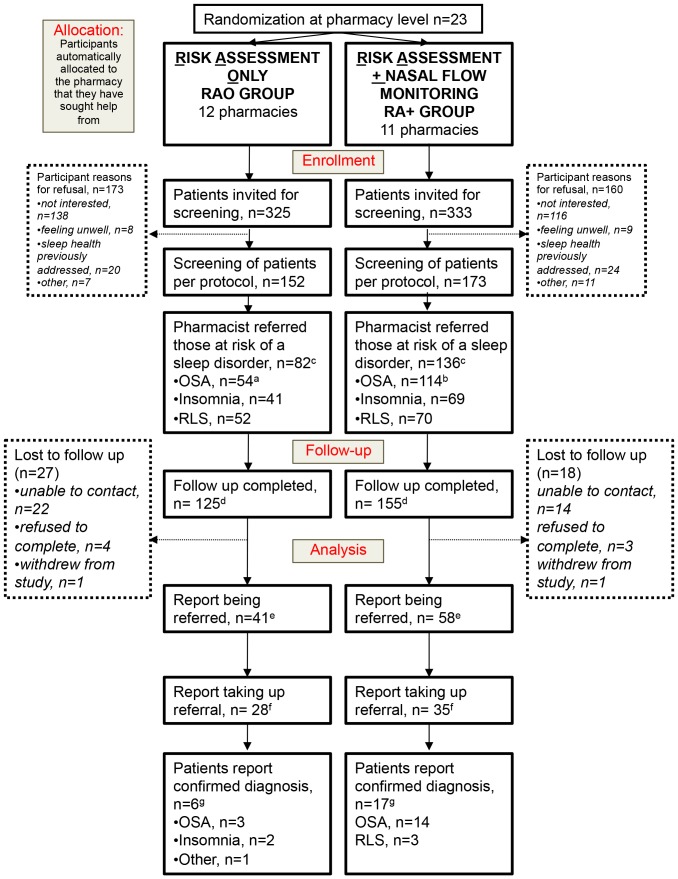
In a cluster-randomized trial, participants were recruited through 23 community pharmacies. Using validated instruments, 325 (RAO = 152, RA+ = 173) participants were screened for OSA, insomnia, and RLS.
218 (67%) participants were at risk of OSA, insomnia or RLS and these participants were referred to their primary physician. The proportion of screened participants identified as being at risk of OSA was significantly higher in the RA+ group (36% in RAO vs. 66% in RA+, OR 3.4, 95% CI (1.8-6.5), p<0.001). A 12-month follow-up was completed in 125 RAO and 155 RA+ participants. Actual referral uptake was 34% RAO, 26% RA+, OR 4.4, 95% CI (1.4-19.2), p = 0.31. The OSA diagnosis rate was higher in the RA+ arm (p = 0.01). To yield a single additional confirmed OSA diagnosis, 16 people would need to be screened using the RA+ protocol.
These results demonstrate that utilising either screening method is feasible in identifying individuals in the community pharmacy setting who are likely to have OSA, insomnia and/or RLS. Secondly, adding an objective marker of OSA to a questionnaire-based prediction tool resulted in more confirmed OSA diagnoses.
ACTR.org.au ACTRN12608000628347.
社区药房可能有助于筛查睡眠障碍等慢性病,这类疾病目前仍诊断不足且治疗不充分。我们旨在比较在社区药房环境中,仅使用主观风险评估问卷(RAO)进行常见睡眠障碍筛查与使用相同风险评估问卷并加上鼻气流监测仪作为潜在阻塞性睡眠呼吸暂停(OSA)客观标志物(RA+)的效果。主要结局是RAO组或RA+组中被认定可能患有并最终被诊断为OSA的参与者数量。进一步的结局包括两组中被认定有OSA、失眠和/或不宁腿综合征(RLS)风险、被转诊、接受转诊并最终被诊断为上述疾病的参与者数量。
在一项整群随机试验中,通过23家社区药房招募参与者。使用经过验证的工具,对325名参与者(RAO组 = 152人,RA+组 = 173人)进行OSA、失眠和RLS筛查。
218名(67%)参与者有OSA、失眠或RLS风险,这些参与者被转诊至他们的初级医生处。RA+组中被认定有OSA风险的筛查参与者比例显著更高(RAO组为36%,RA+组为66%,比值比3.4,95%置信区间(1.8 - 6.5),p<0.001)。125名RAO组参与者和155名RA+组参与者完成了为期12个月的随访。实际接受转诊的比例RAO组为34%,RA+组为26%,比值比4.4,95%置信区间(1.4 - 19.2),p = 0.31。RA+组的OSA诊断率更高(p = 0.01)。要多确诊一例OSA,使用RA+方案需要筛查16人。
这些结果表明,在社区药房环境中,使用任何一种筛查方法来识别可能患有OSA、失眠和/或RLS的个体都是可行的。其次,在基于问卷的预测工具中添加OSA的客观标志物可使更多OSA诊断得到确认。
ACTR.org.au ACTRN12608000628347。