
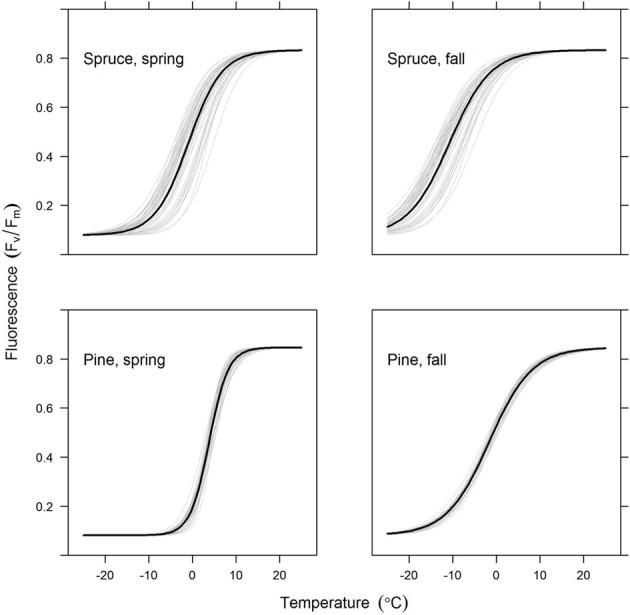
荧光测量显示,与挪威云杉相比,欧洲赤松的光合作用光反应在冬季受到更强的冷抑制,而与秋季相比,春季的光反应受到更强的冷抑制。
Fluorescence measurements show stronger cold inhibition of photosynthetic light reactions in Scots pine compared to Norway spruce as well as during spring compared to autumn.
机构信息
Vantaa Unit, Finnish Forest Research Institute Vantaa, Finland.
出版信息
Front Plant Sci. 2014 Jun 13;5:264. doi: 10.3389/fpls.2014.00264. eCollection 2014.
We studied the photosynthetic activity of Scots pine (Pinus sylvestris L.) and Norway spruce (Picea abies [L.] Karst) in relation to air temperature changes from March 2013 to February 2014. We measured the chlorophyll fluorescence of approximately 50 trees of each species growing in southern Finland. Fluorescence was measured 1-3 times per week. We began by measuring shoots present in late winter (i.e., March 2013) before including new shoots once they started to elongate in spring. By July, when the spring shoots had achieved similar fluorescence levels to the older ones, we proceeded to measure the new shoots only. We analyzed the data by fitting a sigmoidal model containing four parameters to link sliding averages of temperature and fluorescence. A parameter defining the temperature range over which predicted fluorescence increased most rapidly was the most informative with in describing temperature dependence of fluorescence. The model generated similar fluorescence patterns for both species, but differences were observed for critical temperature and needle age. Down regulation of the light reaction was stronger in spring than in autumn. Pine showed more conservative control of the photosynthetic light reactions, which were activated later in spring and more readily attenuated in autumn. Under the assumption of a close correlation of fluorescence and photosynthesis, spruce should therefore benefit more than pine from the increased photosynthetic potential during warmer springs, but be more likely to suffer frost damage with a sudden cooling following a warm period. The winter of 2013-2014 was unusually mild and similar to future conditions predicted by global climate models. During the mild winter, the activity of photosynthetic light reactions of both conifers, especially spruce, remained high. Because light levels during winter are too low for photosynthesis, this activity may translate to a net carbon loss due to respiration.
我们研究了从 2013 年 3 月至 2014 年 2 月期间,空气温度变化对欧洲赤松(Pinus sylvestris L.)和挪威云杉(Picea abies [L.] Karst)光合作用的影响。我们测量了生长在芬兰南部的约 50 棵每种树木的叶绿素荧光。荧光每周测量 1-3 次。我们从冬末(即 2013 年 3 月)开始测量现有枝条,然后在春季新枝条开始伸长时测量新枝条。到 7 月,当春季枝条的荧光水平与老枝条相同时,我们只测量新枝条。我们通过拟合包含四个参数的 S 型模型来分析数据,该模型将温度和荧光的滑动平均值联系起来。预测荧光增长最快的温度范围的参数是描述荧光对温度依赖性最有信息的参数。该模型为两种物种生成了相似的荧光模式,但在临界温度和针叶年龄方面存在差异。春季的光反应下调比秋季更强。与秋季相比,松树对光合作用光反应的控制更为保守,春季光反应的激活时间较晚,秋季更容易衰减。在荧光与光合作用密切相关的假设下,因此,在温暖的春季,云杉比松树更能受益于光合作用潜力的增加,但在温暖期后突然降温时,云杉更有可能遭受霜害。2013-2014 年的冬季异常温和,与全球气候模型预测的未来条件相似。在温和的冬季,两种针叶树的光合作用光反应活性都很高,尤其是云杉。由于冬季的光照水平太低,无法进行光合作用,这种活性可能会因呼吸作用而导致净碳损失。



 Zotero 插件