Goos J A C M, Hiemstra A C, Coupé V M H, Diosdado B, Kooijman W, Delis-Van Diemen P M, Karga C, Beliën J A M, Menke-van der Houven van Oordt C W, Geldof A A, Meijer G A, Hoekstra O S, Fijneman R J A
1] Department of Pathology, VU University Medical Center, CCA 1.08, De Boelelaan 1117, 1081HV Amsterdam, The Netherlands [2] Department of Radiology & Nuclear Medicine, VU University Medical Center, CCA 1.08, De Boelelaan 1117, 1081HV Amsterdam, The Netherlands.
Department of Pathology, VU University Medical Center, CCA 1.08, De Boelelaan 1117, 1081HV Amsterdam, The Netherlands.
Br J Cancer. 2014 Aug 12;111(4):749-55. doi: 10.1038/bjc.2014.354. Epub 2014 Jul 1.
Resection of colorectal cancer liver metastasis (CRCLM) with curative intent has long-term benefit in ~40% of cases. Prognostic biomarkers are needed to improve clinical management and reduce futile surgeries. Expression of epidermal growth factor receptor (EGFR) and prostaglandin-endoperoxide synthase 2 (PTGS2; also known as cyclooxygenase-2) has been associated with carcinogenesis and survival. We investigated the prognostic value of EGFR and PTGS2 expression in patients with resected CRCLM.
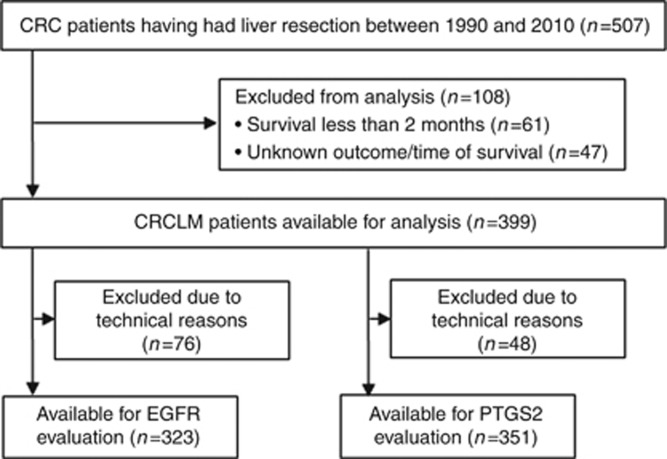
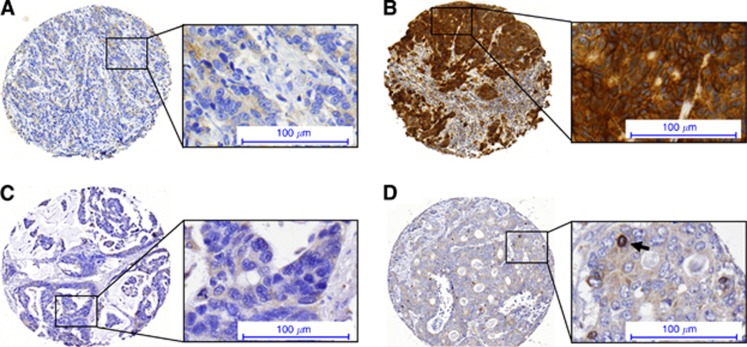
Formalin-fixed paraffin-embedded CRCLM tissue and corresponding primary tumour specimens from a multi-institutional cohort of patients who underwent liver resection between 1990 and 2010 were incorporated into tissue microarrays (TMAs). TMAs were stained for EGFR and PTGS2 by immunohistochemistry. The hazard rate ratio (HRR) for the association between expression in CRCLM and overall survival was calculated using a 500-fold cross-validation procedure.
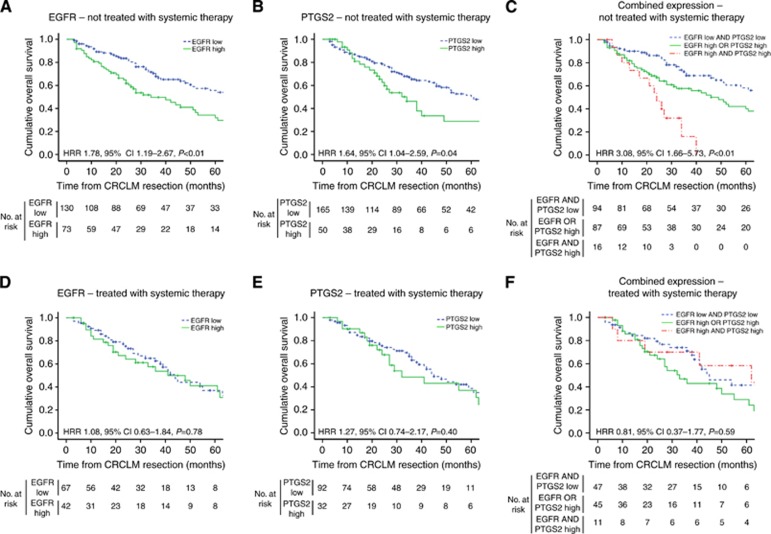
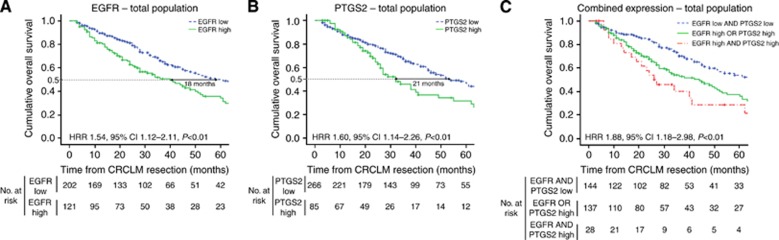
EGFR and PTGS2 expression could be evaluated in 323 and 351 patients, respectively. EGFR expression in CRCLM was associated with poor prognosis (HRR 1.54; P<0.01) with a cross-validated HRR of 1.47 (P=0.03). PTGS2 expression was also associated with poor prognosis (HRR 1.60; P<0.01) with a cross-validated HRR of 1.63 (P<0.01). Expression of EGFR and PTGS2 remained prognostic after multivariate analysis with standard clinicopathological variables (cross-validated HRR 1.51; P=0.02 and cross-validated HRR 1.59; P=0.01, respectively). Stratification for the commonly applied systemic therapy regimens demonstrated prognostic value for EGFR and PTGS2 only in the subgroup of patients who were not treated with systemic therapy (HRR 1.78; P<0.01 and HRR 1.64; P=0.04, respectively), with worst prognosis when both EGFR and PTGS2 were highly expressed (HRR 3.08; P<0.01). Expression of PTGS2 in CRCLM was correlated to expression in patient-matched primary tumours (P=0.02, 69.2% concordance).
EGFR and PTGS2 expressions are prognostic molecular biomarkers with added value to standard clinicopathological variables for patients with resectable CRCLM.
根治性切除结直肠癌肝转移灶(CRCLM)对约40%的病例有长期益处。需要预后生物标志物来改善临床管理并减少无效手术。表皮生长因子受体(EGFR)和前列腺素内过氧化物合酶2(PTGS2;也称为环氧化酶-2)的表达与致癌作用和生存相关。我们研究了EGFR和PTGS2表达在接受CRCLM切除患者中的预后价值。
将1990年至2010年间接受肝切除的多机构队列患者的福尔马林固定石蜡包埋的CRCLM组织及相应的原发性肿瘤标本制成组织微阵列(TMA)。通过免疫组织化学对TMA进行EGFR和PTGS2染色。使用500倍交叉验证程序计算CRCLM中表达与总生存之间关联的风险率比(HRR)。
分别可对323例和351例患者评估EGFR和PTGS2表达。CRCLM中EGFR表达与预后不良相关(HRR 1.54;P<0.01),交叉验证的HRR为1.47(P=0.03)。PTGS2表达也与预后不良相关(HRR 1.60;P<0.01),交叉验证的HRR为1.63(P<0.01)。在与标准临床病理变量进行多因素分析后,EGFR和PTGS2的表达仍具有预后意义(交叉验证的HRR分别为1.51;P=0.02和交叉验证的HRR为1.59;P=0.01)。对常用的全身治疗方案进行分层分析显示,EGFR和PTGS2仅在未接受全身治疗的患者亚组中具有预后价值(HRR分别为1.78;P<0.01和HRR为1.64;P=0.04),当EGFR和PTGS2均高表达时预后最差(HRR 3.08;P<0.01)。CRCLM中PTGS2的表达与患者匹配的原发性肿瘤中的表达相关(P=0.02,一致性为69.2%)。
对于可切除的CRCLM患者,EGFR和PTGS2表达是预后分子生物标志物,对标准临床病理变量具有附加价值。