Mangieri Regina A, Cofresí Roberto U, Gonzales Rueben A
Division of Pharmacology and Toxicology, College of Pharmacy, The University of Texas at Austin Austin, TX, USA.
Front Behav Neurosci. 2014 Jun 17;8:220. doi: 10.3389/fnbeh.2014.00220. eCollection 2014.
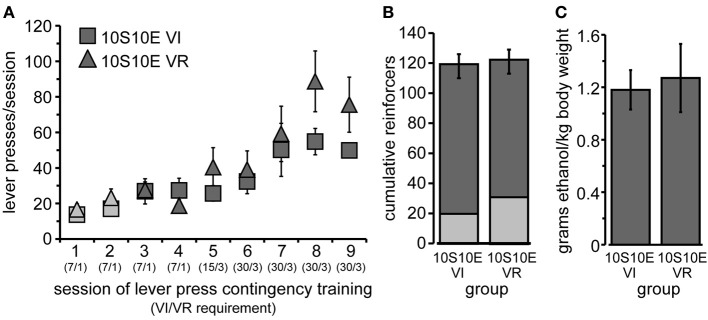
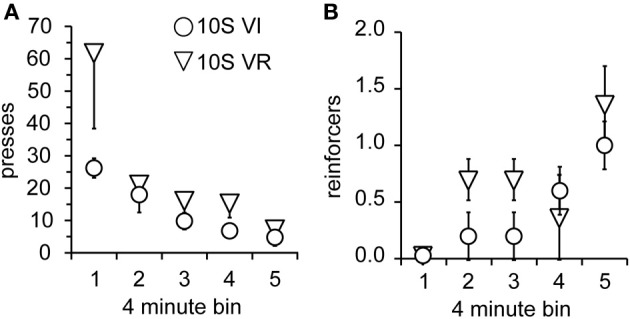
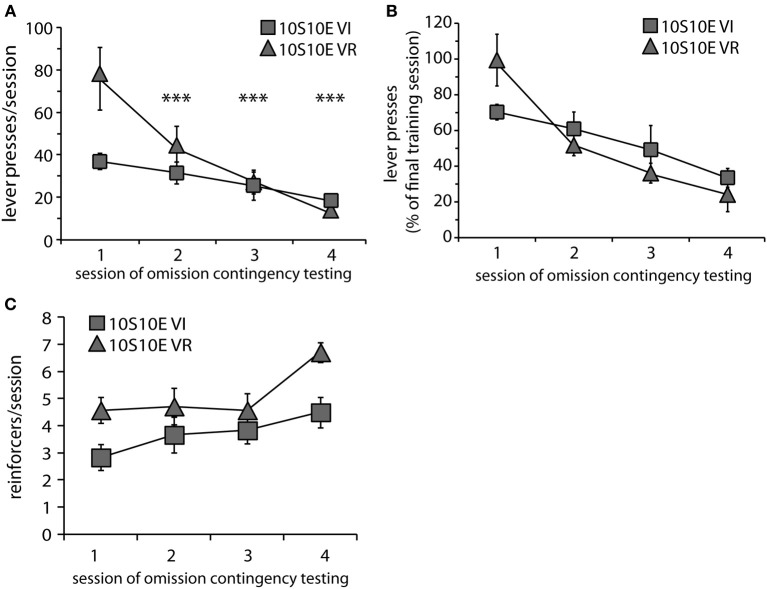
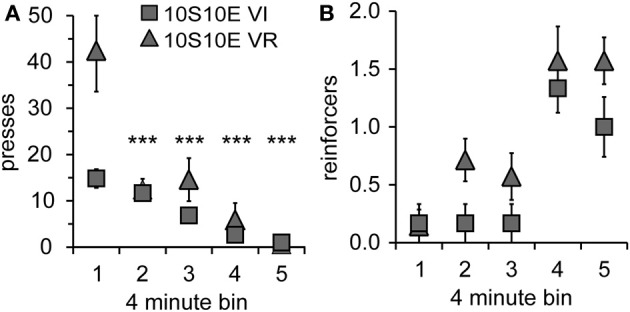
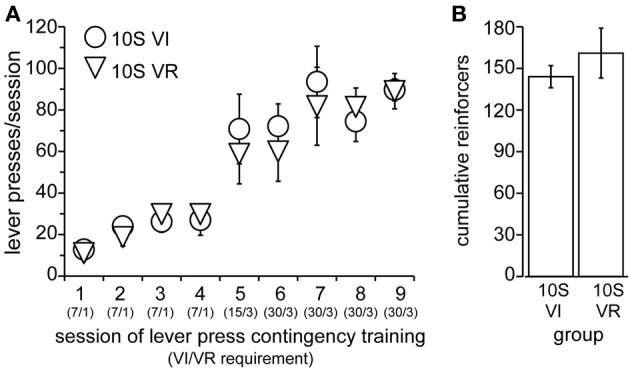
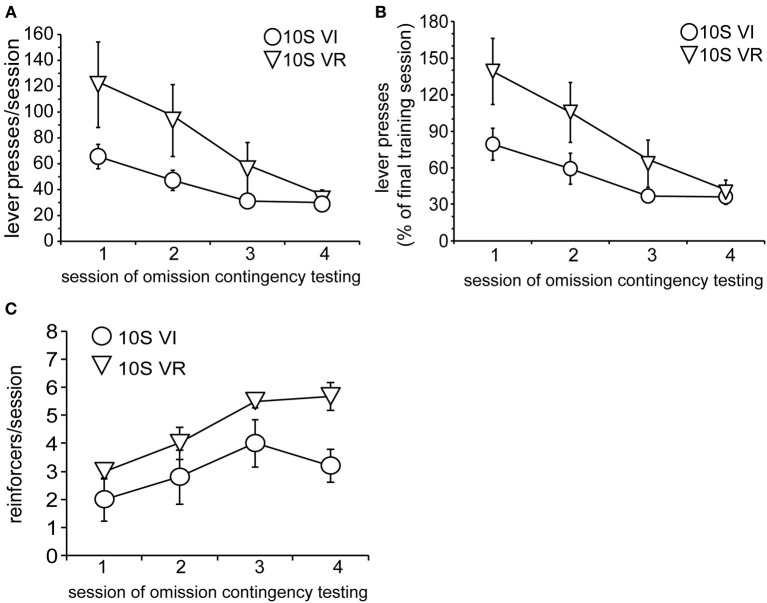
We previously reported that, in male, Long Evans rats, instrumental lever pressing that had been reinforced during limited training under a variable interval (VI) schedule by oral self-administration of a 10% sucrose/10% ethanol (10S10E) solution was insensitive to devaluation of 10S10E. In contrast, lever pressing that had been reinforced under a variable ratio (VR) schedule, or by self-administration of 10% sucrose (10S) alone, was sensitive to outcome devaluation. The relative insensitivity to outcome devaluation indicated that seeking of 10S10E by the VI-trained rats had become an instrumental habit. In the present study we employed an alternative operational definition of an instrumental habit and compared the effect of reversing the action-outcome contingency on lever press performance by rats trained under the same experimental conditions. Male Long Evans rats received daily operant training, in which lever presses were reinforced by 10S10E or 10S, under VI or VR schedules. After nine sessions of VI or VR training, rats were tested over four sessions in which the instrumental contingency was changed so that a lever press would prevent reinforcer delivery for 120 s. We found that rats that had been trained to lever press for 10S10E under the VR schedule showed a greater change in lever pressing across testing sessions than those that had received 10S10E reinforcement under the VI schedule. There was no such interaction with reinforcement schedule for rats that had received only 10S reinforcement during training. These findings are consistent with those of our previous study, and provide further evidence that addition of ethanol to sucrose may promote habitual responding in an instrumental task.
我们之前报道过,在雄性朗·埃文斯大鼠中,在可变间隔(VI)强化程序下进行有限训练期间,通过口服自行摄入10%蔗糖/10%乙醇(10S10E)溶液强化的操作性杠杆按压行为,对10S10E的贬值不敏感。相比之下,在可变比率(VR)强化程序下强化的杠杆按压行为,或仅通过自行摄入10%蔗糖(10S)强化的杠杆按压行为,对结果贬值敏感。对结果贬值的相对不敏感表明,VI训练的大鼠对10S10E的寻求已成为一种操作性习惯。在本研究中,我们采用了操作性习惯的另一种操作性定义,并比较了在相同实验条件下训练的大鼠,逆转动作-结果偶联对杠杆按压表现的影响。雄性朗·埃文斯大鼠接受每日操作性训练,在VI或VR强化程序下,杠杆按压行为通过10S10E或10S进行强化。在进行九次VI或VR训练后,对大鼠进行四次测试,在此期间改变操作性偶联,使杠杆按压会在120秒内阻止强化物的给予。我们发现,在VR强化程序下训练以杠杆按压获取10S10E的大鼠,在测试过程中杠杆按压的变化比在VI强化程序下接受10S10E强化的大鼠更大。在训练期间仅接受10S强化的大鼠,其强化程序与上述情况不存在这种相互作用。这些发现与我们之前的研究结果一致,并进一步证明在蔗糖中添加乙醇可能会促进在一项操作性任务中的习惯性反应。