Xavier Fabiano E, Blanco-Rivero Javier, Sastre Esther, Caracuel Laura, Callejo María, Balfagón Gloria
Departamento de Fisiologia e Farmacologia, Centro de Ciências Biológicas, Universidade Federal de Pernambuco, Recife, Brazil.
Departamento de Fisiología, Facultad de Medicina, Universidad Autónoma de Madrid, Madrid, Spain; Instituto de Investigación Sanitaria IdIPaz, Madrid, Spain.
PLoS One. 2014 Jul 3;9(7):e100356. doi: 10.1371/journal.pone.0100356. eCollection 2014.
Tranilast, in addition to its capacity to inhibit mast cell degranulation, has other biological effects, including inhibition of reactive oxygen species, cytokines, leukotrienes and prostaglandin release. In the current study, we analyzed whether tranilast could alter endothelial function in rat mesenteric resistance arteries (MRA).
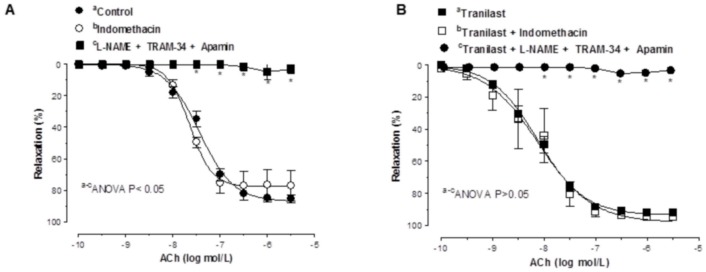
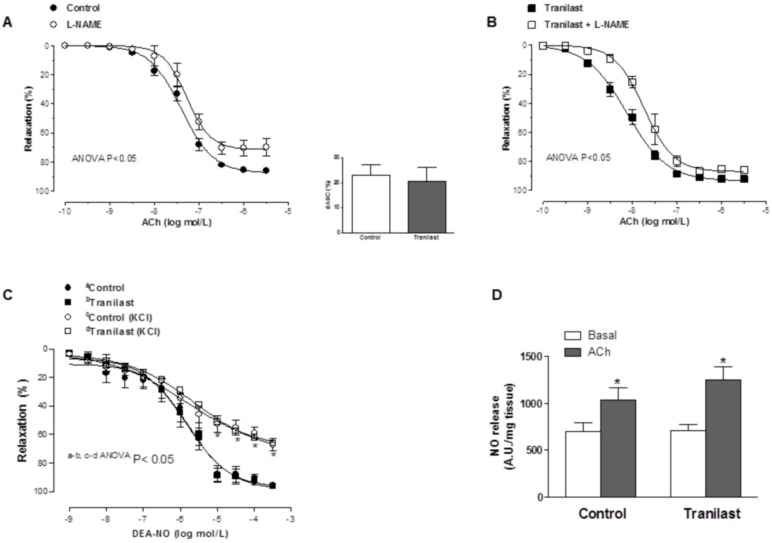
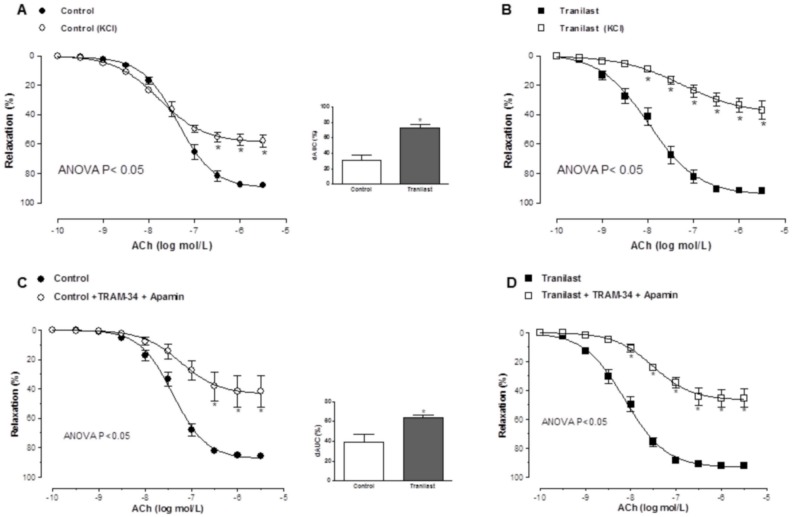
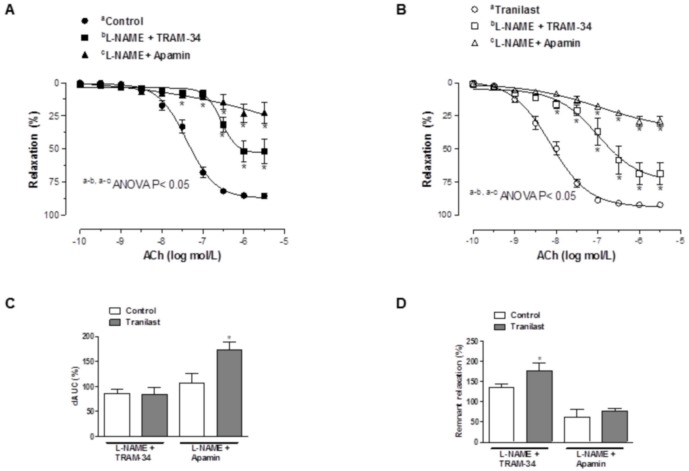
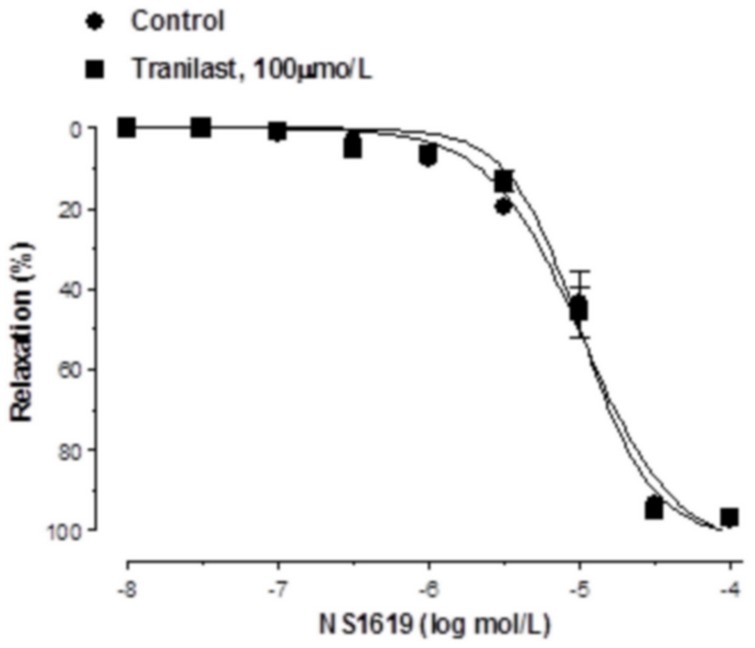
Acetylcholine-induced relaxation was analyzed in MRA (untreated and 1-hour tranilast treatment) from 6 month-old Wistar rats. To assess the possible participation of endothelial nitric oxide or prostanoids, acetylcholine-induced relaxation was analyzed in the presence of L-NAME or indomethacin. The participation of endothelium-derived hyperpolarizing factor (EDHF) in acetylcholine-induced response was analyzed by preincubation with TRAM-34 plus apamin or by precontraction with a high K+ solution. Nitric oxide (NO) and superoxide anion levels were measured, as well as vasomotor responses to NO donor DEA-NO and to large conductance calcium-activated potassium channel opener NS1619.
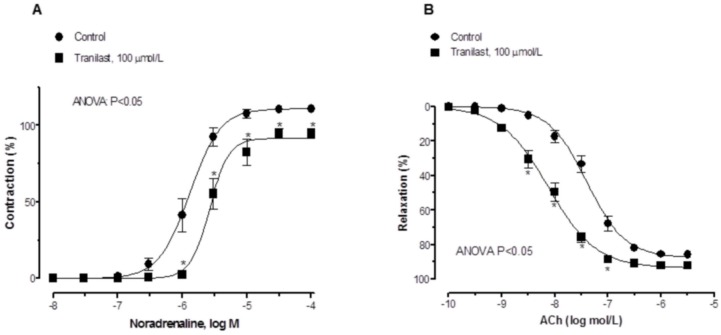
Acetylcholine-induced relaxation was greater in tranilast-incubated MRA. Acetylcholine-induced vasodilation was decreased by L-NAME in a similar manner in both experimental groups. Indomethacin did not modify vasodilation. Preincubation with a high K+ solution or TRAM-34 plus apamin reduced the vasodilation to ACh more markedly in tranilast-incubated segments. NO and superoxide anion production, and vasodilator responses to DEA-NO or NS1619 remained unmodified in the presence of tranilast.
Tranilast increased the endothelium-dependent relaxation to acetylcholine in rat MRA. This effect is independent of the nitric oxide and cyclooxygenase pathways but involves EDHF, and is mediated by an increased role of small conductance calcium-activated K+ channels.
曲尼司特除了具有抑制肥大细胞脱颗粒的能力外,还具有其他生物学效应,包括抑制活性氧、细胞因子、白三烯和前列腺素的释放。在本研究中,我们分析了曲尼司特是否能改变大鼠肠系膜阻力动脉(MRA)的内皮功能。
对6月龄Wistar大鼠的MRA(未处理和经曲尼司特处理1小时)进行乙酰胆碱诱导的舒张分析。为了评估内皮一氧化氮或前列腺素的可能参与,在L-NAME或吲哚美辛存在的情况下分析乙酰胆碱诱导的舒张。通过与TRAM-34加蜂毒明肽预孵育或用高钾溶液预收缩来分析内皮衍生超极化因子(EDHF)在乙酰胆碱诱导反应中的参与。测量一氧化氮(NO)和超氧阴离子水平,以及对NO供体DEA-NO和大电导钙激活钾通道开放剂NS1619的血管舒缩反应。
在经曲尼司特孵育的MRA中,乙酰胆碱诱导的舒张作用更强。在两个实验组中,L-NAME以相似的方式降低了乙酰胆碱诱导的血管舒张。吲哚美辛未改变血管舒张。用高钾溶液或TRAM-34加蜂毒明肽预孵育,在经曲尼司特孵育的节段中,对乙酰胆碱的血管舒张作用降低更为明显。在曲尼司特存在的情况下,NO和超氧阴离子的产生以及对DEA-NO或NS1619的血管舒张反应未发生改变。
曲尼司特增加了大鼠MRA中对乙酰胆碱的内皮依赖性舒张。这种作用独立于一氧化氮和环氧化酶途径,但涉及EDHF,并且由小电导钙激活钾通道作用增强介导。