Sastre Esther, Caracuel Laura, Xavier Fabiano E, Balfagón Gloria, Blanco-Rivero Javier
Departamento de Fisiología, Facultad de Medicina, Universidad Autónoma de Madrid, Madrid, Spain.
PLoS One. 2013 Aug 20;8(8):e73232. doi: 10.1371/journal.pone.0073232. eCollection 2013.
We analyzed whether mast cell stabilization by either ketotifen or tranilast could alter either sympathetic or nitrergic innervation function in rat mesenteric arteries.
Electrical field stimulation (EFS)-induced contraction was analyzed in mesenteric segments from 6-month-old Wistar rats in three experimental groups: control, 3-hour ketotifen incubated (0.1 αmol/L), and 3-hour tranilast incubated (0.1 mmol/L). To assess the possible participation of nitrergic or sympathetic innervation, EFS contraction was analyzed in the presence of non-selective nitric oxide synthase (NOS) inhibitor L-NAME (0.1 mmol/L), α-adrenergic receptor antagonist phentolamine (0.1 µmol/L), or the neurotoxin 6-hydroxydopamine (6-OHDA, 1.46 mmol/L). Nitric oxide (NO) and superoxide anion (O2.(-) levels were measured, as were vasomotor responses to noradrenaline (NA) and to NO donor DEA-NO, in the presence and absence of 0.1 mmol/L tempol. Phosphorylated neuronal NOS (P-nNOS) expression was also analyzed.
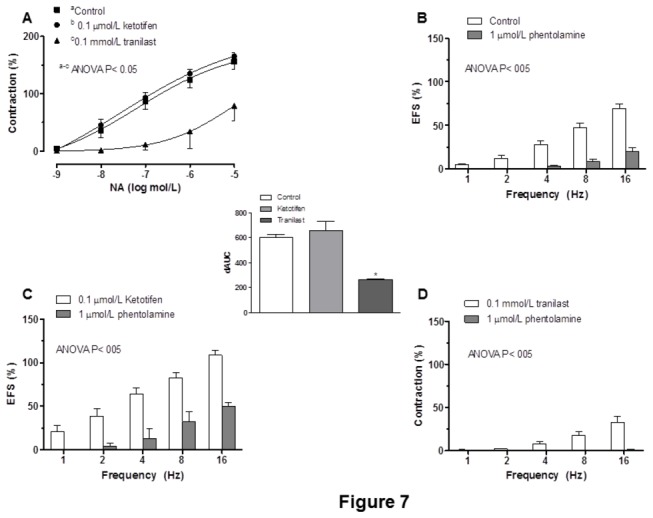
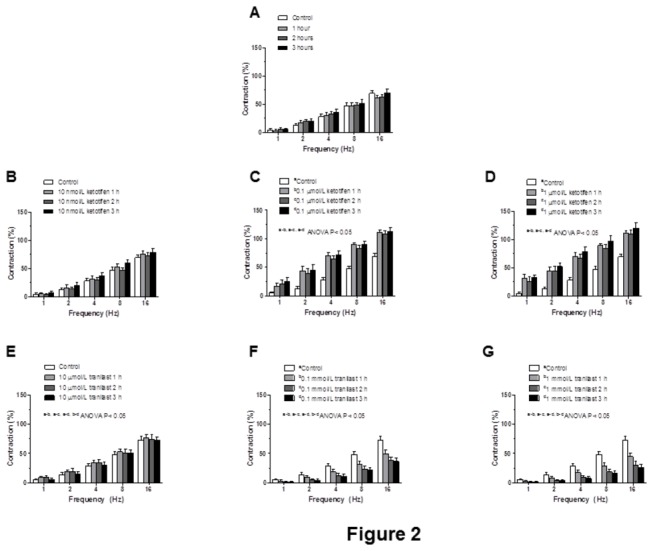
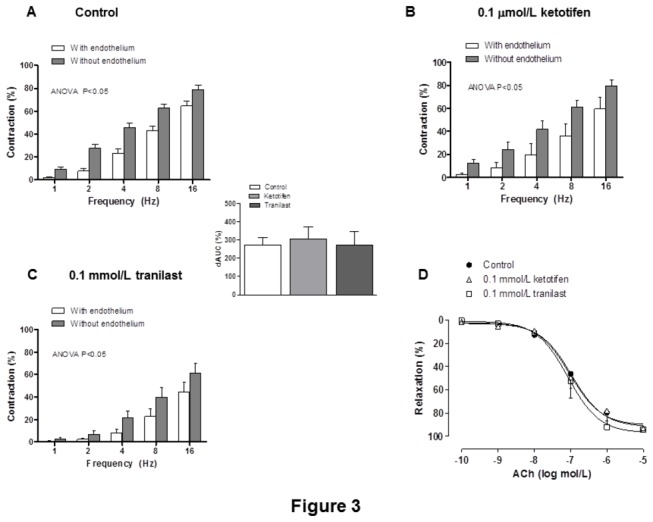
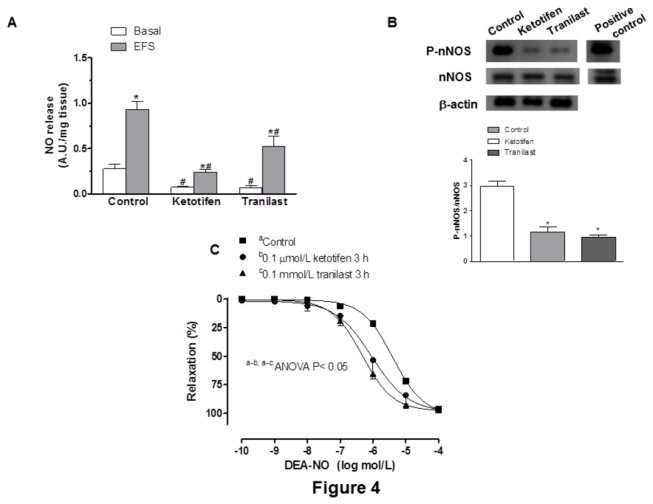
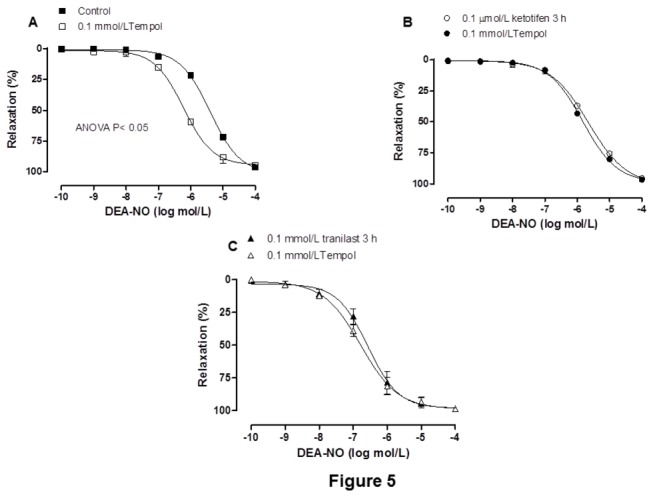
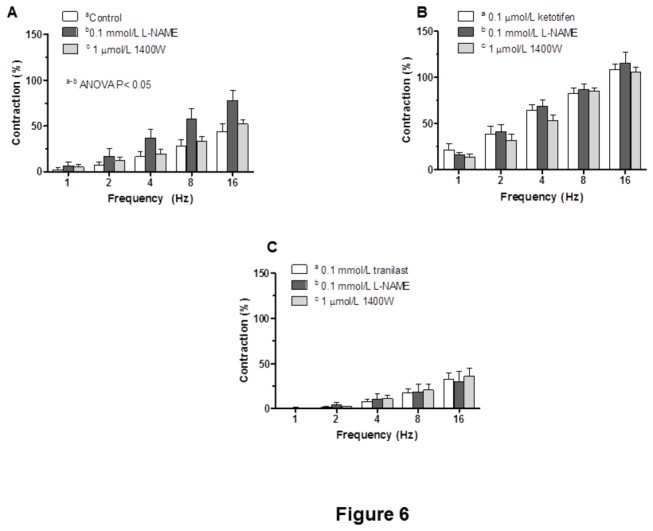
EFS-induced contraction was increased by ketotifen and decreased by tranilast. L-NAME increased the vasoconstrictor response to EFS only in control segments. The vasodilator response to DEA-NO was higher in ketotifen- and tranilast-incubated segments, while tempol increased vasodilator response to DEA-NO only in control segments. Both NO and O2(-) release, and P-nNOS expression were diminished by ketotifen and by tranilast treatment. The decrease in EFS-induced contraction produced by phentolamine was lower in tranilast-incubated segments. NA vasomotor response was decreased only by tranilast. The remnant vasoconstriction observed in control and ketotifen-incubated segments was abolished by 6-OHDA.
While both ketotifen and tranilast diminish nitrergic innervation function, only tranilast diminishes sympathetic innnervation function, thus they alter the vasoconstrictor response to EFS in opposing manners.
我们分析了酮替芬或曲尼司特对肥大细胞的稳定作用是否会改变大鼠肠系膜动脉的交感神经或一氧化氮能神经支配功能。
在三个实验组中,对6月龄Wistar大鼠的肠系膜节段进行电场刺激(EFS)诱导的收缩分析:对照组、酮替芬孵育3小时(0.1αmol/L)组和曲尼司特孵育3小时(0.1mmol/L)组。为评估一氧化氮能或交感神经支配的可能参与情况,在非选择性一氧化氮合酶(NOS)抑制剂L-NAME(0.1mmol/L)、α-肾上腺素能受体拮抗剂酚妥拉明(0.1μmol/L)或神经毒素6-羟基多巴胺(6-OHDA,1.46mmol/L)存在的情况下分析EFS收缩。测量一氧化氮(NO)和超氧阴离子(O2·-)水平,以及在存在和不存在0.1mmol/L Tempol的情况下对去甲肾上腺素(NA)和NO供体DEA-NO的血管运动反应。还分析了磷酸化神经元NOS(P-nNOS)的表达。
酮替芬增加EFS诱导的收缩,曲尼司特则使其降低。L-NAME仅在对照组节段中增加了对EFS的血管收缩反应。在酮替芬和曲尼司特孵育的节段中,对DEA-NO的血管舒张反应更高,而Tempol仅在对照组节段中增加了对DEA-NO的血管舒张反应。酮替芬和曲尼司特处理均降低了NO和O2(-)的释放以及P-nNOS的表达。酚妥拉明在曲尼司特孵育的节段中产生的EFS诱导收缩的降低幅度较小NA血管运动反应仅被曲尼司特降低。6-OHDA消除了在对照组和酮替芬孵育节段中观察到的残余血管收缩。
虽然酮替芬和曲尼司特均降低一氧化氮能神经支配功能,但只有曲尼司特降低交感神经支配功能,因此它们以相反的方式改变对EFS的血管收缩反应。