Vafaei Afshin, Pickett William, Alvarado Beatriz E
Department of Public Health Sciences, Queen's University, Kingston, Ontario, Canada.
BMJ Open. 2014 Jul 3;4(7):e004919. doi: 10.1136/bmjopen-2014-004919.
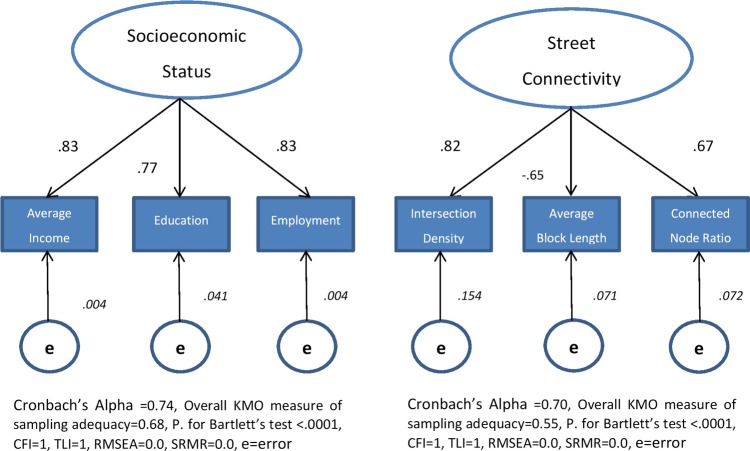
Social sorting mechanisms or analogous selection processes may impose confounding effects in the study of aetiological relationships. Such processes are referred to as structural confounding. If present, certain strata of social factors could hypothetically never be exposed to specific risk factors. This prohibits exchangeability across groups that is needed for meaningful causal inference. The objectives of this study were to: (1) develop and test the reliability and validity of composite scales for the measurement of social capital (SC), socioeconomic status (SES) and built environment (BE) and (2) to explore the possible roles of community level SC, SES and BE factors in studies of the aetiology of youth injury.
SETTING/PARTICIPANTS: A nationally representative sample of over 26 000 Canadian students aged 11-15 years.
MEASURES/ANALYSIS: Scales describing these key factors were developed and validated via exploratory and confirmatory factor analyses. We then used tabular analyses to explore structural confounding in our population.
The proposed scales all demonstrated good psychometric properties. Despite variations in the number of adolescents across social and environmental strata, no evidence for the presence of structural confounding was detected in our data.
Relationships between social capital and the occurrence of injuries in Canadian youth aged 11-16 can potentially be studied without consideration of structural confounding biases. Canada is a suitable place to disentangle the effects of different neighbourhood social and environmental exposures on occurrence of injuries and other outcomes in adolescent populations. Exchangeability is possible across exposure strata and therefore a meaningful multilevel regression analysis is feasible. However, more studies are needed to test the consistency of our findings in other populations and for different outcomes.
社会分类机制或类似的选择过程可能会在病因关系研究中产生混杂效应。此类过程被称为结构混杂。如果存在结构混杂,某些社会因素阶层可能理论上永远不会接触到特定风险因素。这阻碍了有意义的因果推断所需的组间可交换性。本研究的目的是:(1)开发并测试用于测量社会资本(SC)、社会经济地位(SES)和建成环境(BE)的综合量表的信度和效度;(2)探讨社区层面的SC、SES和BE因素在青少年伤害病因学研究中的可能作用。
设置/参与者:对26000多名年龄在11 - 15岁的加拿大学生进行全国代表性抽样。
测量/分析:通过探索性和验证性因素分析开发并验证了描述这些关键因素的量表。然后我们使用表格分析来探索总体中的结构混杂情况。
所提出的量表均显示出良好的心理测量特性。尽管不同社会和环境阶层的青少年数量存在差异,但在我们的数据中未检测到结构混杂存在的证据。
在研究11 - 16岁加拿大青少年的社会资本与伤害发生之间的关系时,可能无需考虑结构混杂偏差。加拿大是一个适合理清不同邻里社会和环境暴露对青少年人群伤害及其他结果发生影响的地方。暴露阶层之间具有可交换性,因此进行有意义的多水平回归分析是可行的。然而,需要更多研究来检验我们的发现在其他人群和不同结果中的一致性。