Department of Geriatrics, Centre for the Medicine of the Ageing, Neurosciences and Orthopedics, Catholic University, Rome, Italy ; Dementia Center, Italian Hospital Group, Via Tiburtina 188, Guidonia, 00012 Rome, Italy.
Department of Geriatrics, Centre for the Medicine of the Ageing, Neurosciences and Orthopedics, Catholic University, Rome, Italy ; Institute of Clinical Infectious Diseases, Catholic University, 00168 Rome, Italy.
Behav Neurol. 2014;2014:259358. doi: 10.1155/2014/259358. Epub 2014 Jun 5.
"Posterior shift" of the neuropathological changes of Alzheimer's disease (AD) produces a syndrome (posterior cortical atrophy) (PCA) dominated by high-level visual deficits.
To explore in patients with AD-type pathology whether a data-driven analysis (cluster analysis) based on neuropsychological findings resulted in the emergence of different subgroups of patients; in particular to find out whether it was possible to identify patients with visuospatial deficits consistent with the hypothesis that PCA is a "dorsal stream" syndrome or, rather, whether there were subgroups of patients with different types of impairment within the high-level visual domain.
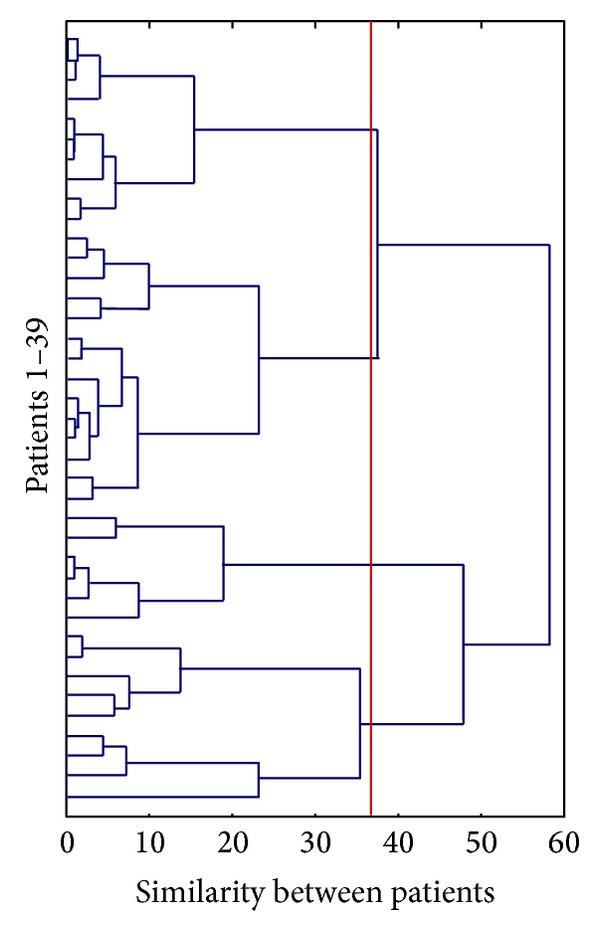
23 PCA and 16 DAT patients were studied. By a principal component analysis performed on a wide range of neuropsychological tasks, 15 variables were obtained that loaded onto five main factors (memory, language, perceptual, visuospatial, and calculation) which entered a hierarchical cluster analysis.
Four clusters of cognitive impairment emerged: visuospatial/perceptual, memory, perceptual/calculation, and language. Only in the first cluster a visuospatial deficit clearly emerged. conclusions: AD pathology produces not only variants dominated by memory (DAT) and, to a lesser extent, visuospatial deficit (PCA), but also other distinct syndromic subtypes with disorders in visual perception and language which reflect a different vulnerability of specific functional networks.
阿尔茨海默病(AD)的神经病理学变化的“后移”产生了一种以高级视觉缺陷为主要表现的综合征(后部皮质萎缩症,PCA)。
在 AD 型病理学患者中,是否基于神经心理学发现的数据分析(聚类分析)会导致患者出现不同的亚组;特别是要确定是否有可能识别出符合 PCA 是“背侧流”综合征假说的视觉空间缺陷患者,或者是否存在具有不同高级视觉领域损伤类型的亚组患者。
研究了 23 例 PCA 和 16 例 DAT 患者。通过对广泛的神经心理学任务进行主成分分析,获得了 15 个可加载到五个主要因素(记忆、语言、知觉、视觉空间和计算)的变量,这些变量进入了层次聚类分析。
出现了四个认知障碍聚类:视觉空间/知觉、记忆、知觉/计算和语言。只有在第一个聚类中,明显出现了视觉空间缺陷。
AD 病理学不仅产生了以记忆为主的变体(DAT)和,在较小程度上,以视觉空间缺陷为主的变体(PCA),还产生了其他具有视觉感知和语言障碍的不同综合征亚型,这反映了特定功能网络的不同脆弱性。