Sherkat Roya, Yaran Majid, Shoaie Parisa, Mortazavi Mojgan, Shahidi Shahrzad, Hamidi Hossein, Seirafian Shiva, Taheri Shahram, Farajzadegan Ziba, Rostami Soodabeh
Acquired Immunodeficiency Research Center, Isfahan University of Medical Sciences, Isfahan, Iran.
Nosocomial Infections Research Center, Isfahan University of Medical Sciences, Isfahan, Iran.
J Res Med Sci. 2014 Mar;19(Suppl 1):S26-9.
Detection of latent tuberculosis infection (LTBI) in transplant candidates is very important. The tuberculin skin test (TST) and interferon-gamma release assays (IGRAs) are standard immunologic tools for LTBI detection. The aim of this study was to compare the TST results and T-SPOT(®).TB test (a type of IGRAs) in kidney transplant candidates for the screening of LTBI and follow the patients with positive test for an activation of tuberculosis (TB) after transplantation and using anti-TB prophylaxis.
This study was a prospective study and carried out in 44 renal transplant candidates from March 2010 to February 2011 in the teaching hospitals of Isfahan University of Medical Sciences, Iran. TST and T-SPOT(®).TB test were performed and their results evaluated. Patients with a positive skin test and/or T-SPOT(®).TB test were started on anti-TB prophylaxis and followed after transplantation for an activation of their LTBI for 1 year.
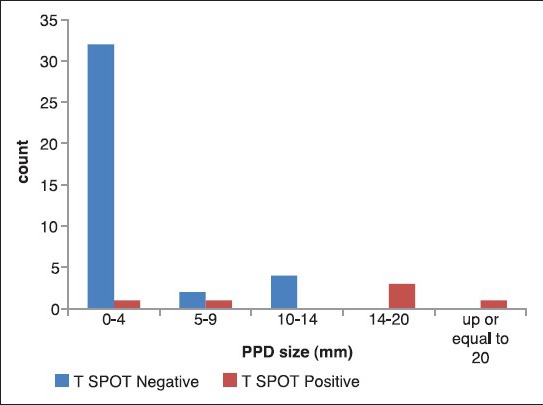
Overall, 8 (18.2%) patients were positive for TST and 6 (13.6%) patients for T-SPOT(®).TB test. The agreement between TST and T-SPOT(®).TB test was moderate (κ = 0.49, 95% confidence interval 0.145-0.839). The overall agreement between TST and T-SPOT(®).TB test was 86%. No relation was found between the underlying diseases and TST or T-SPOT(®).TB test positivity. Although isoniazid prophylaxis was used for patients with positive TST and/or T-SPOT(®).TB test, one patient had reactivation of TB.
In kidney transplant candidates both TST and T-SPOT(®).TB test were comparable for the diagnosis of LTBI with reasonable agreement between the tests. However, further studies are needed to determine the ability of T-SPOT(®).TB test to detect LTBI and to evaluate the need for prophylaxis in these patients.
检测移植候选者中的潜伏性结核感染(LTBI)非常重要。结核菌素皮肤试验(TST)和干扰素-γ释放试验(IGRAs)是检测LTBI的标准免疫学工具。本研究的目的是比较肾移植候选者中TST结果和T-SPOT(®).TB检测(一种IGRAs)用于筛查LTBI,并对检测呈阳性的患者在移植后进行结核病(TB)激活情况的随访以及使用抗结核预防措施。
本研究为前瞻性研究,于2010年3月至2011年2月在伊朗伊斯法罕医科大学教学医院对44例肾移植候选者进行。进行TST和T-SPOT(®).TB检测并评估其结果。皮肤试验和/或T-SPOT(®).TB检测呈阳性的患者开始接受抗结核预防治疗,并在移植后随访1年,观察其LTBI是否激活。
总体而言,8例(18.2%)患者TST呈阳性,6例(13.6%)患者T-SPOT(®).TB检测呈阳性。TST和T-SPOT(®).TB检测之间的一致性为中等(κ = 0.49,95%置信区间0.145 - 0.839)。TST和T-SPOT(®).TB检测之间的总体一致性为86%。未发现基础疾病与TST或T-SPOT(®).TB检测阳性之间存在关联。尽管对TST和/或T-SPOT(®).TB检测呈阳性的患者使用了异烟肼预防治疗,但仍有1例患者发生了TB复发。
在肾移植候选者中,TST和T-SPOT(®).TB检测在诊断LTBI方面具有可比性,检测之间具有合理的一致性。然而,需要进一步研究以确定T-SPOT(®).TB检测检测LTBI的能力,并评估这些患者预防治疗的必要性。