Vopat Bryan G, Murali Jothi, Gowda Ashok L, Kaback Lee, Blaine Theodore
Orthopedic Department, Warren Alpert School of Medicine at Brown University, Rhode Island Hospital , Providence, RI, USA.
Orthopedic Department, Yale School of Medicine , New Haven, CT, USA.
Orthop Rev (Pavia). 2014 May 13;6(2):5279. doi: 10.4081/or.2014.5279. eCollection 2014 Apr 22.
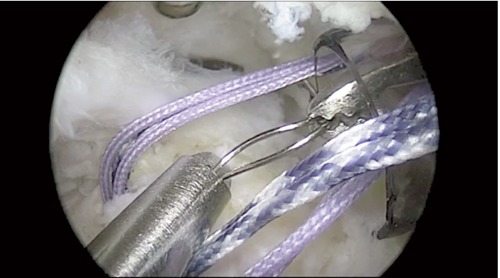
Most arthroscopic rotator cuff repairs utilize suture passing devices placed through arthroscopic cannulas. These devices are limited by the size of the passing device where the suture is passed through the tendon. An alternative technique has been used in the senior author's practice for the past ten years, where sutures are placed through the rotator cuff tendon using percutaneous passing devices. This technique, dubbed the global percutaneous shuttling technique of rotator cuff repair, affords the placement of sutures from nearly any angle and location in the shoulder, and has the potential advantage of larger suture bites through the tendon edge. These advantages may increase the area of tendon available to compress to the rotator cuff footprint and improve tendon healing and outcomes. The aim of this study is to describe the global percutaneous shuttling (GPS) technique and report our results using this method. The GPS technique can be used for any full thickness rotator cuff tear and is particularly useful for massive cuff tears with poor tissue quality. We recently followed up 22 patients with an average follow up of 32 months to validate its usefulness. American Shoulder and Elbow Surgeons scores improved significantly from 37 preoperatively to 90 postoperatively (P<0.0001). This data supports the use of the GPS technique for arthroscopic rotator cuff repair. Further biomechanical studies are currently being performed to assess the improvements in tendon footprint area with this technique.
大多数关节镜下肩袖修补术采用通过关节镜套管置入的缝线传递装置。这些装置受缝线穿过肌腱处传递装置尺寸的限制。在资深作者的临床实践中,过去十年一直采用另一种技术,即使用经皮传递装置将缝线穿过肩袖肌腱。这种技术被称为肩袖修补的全经皮穿梭技术,可从肩部几乎任何角度和位置置入缝线,并且具有在肌腱边缘咬取更大缝线的潜在优势。这些优势可能会增加可压缩至肩袖足迹的肌腱面积,并改善肌腱愈合及治疗效果。本研究的目的是描述全经皮穿梭(GPS)技术,并报告我们使用该方法的结果。GPS技术可用于任何全层肩袖撕裂,尤其适用于组织质量差的巨大肩袖撕裂。我们最近对22例患者进行了随访,平均随访32个月以验证其有效性。美国肩肘外科医师协会评分从术前的37分显著提高到术后的90分(P<0.0001)。该数据支持在关节镜下肩袖修补术中使用GPS技术。目前正在进行进一步的生物力学研究,以评估该技术对肌腱足迹面积的改善情况。