Minter Lisa M
Department of Veterinary and Animal Sciences; University of Massachusetts Amherst; Amherst, MA USA.
Rare Dis. 2013 Nov 6;1:e26764. doi: 10.4161/rdis.26764. eCollection 2013.
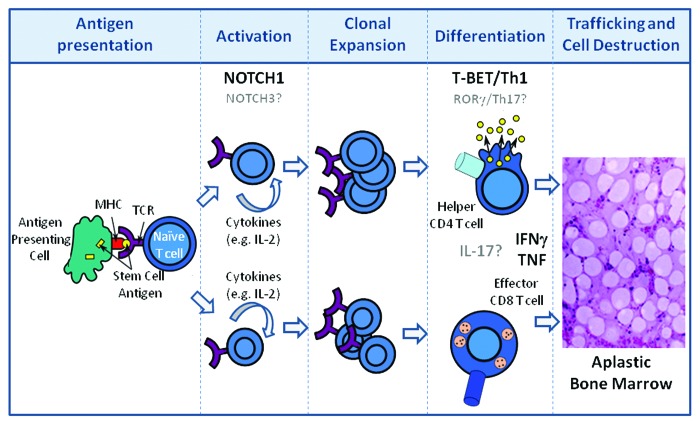
Severe aplastic anemia is a rare bone marrow failure disease with the majority of cases caused by aberrant immune destruction of blood progenitors. Although the Th1-mediated pathology of aplastic anemia is well-described, the molecular mechanisms that drive disease progression remain ill-defined. The NOTCH signaling pathway mediates Th1 differentiation in the presence of polarizing cytokines, an action requiring enzymatic processing of NOTCH receptors by γ- secretase. We used a mouse model of aplastic anemia to demonstrate that expression both of intracellular NOTCH1 (NOTCH1(IC)) and T-BET, a key transcription factor regulating Th1 differentiation, were increased in T cells in the spleen and bone marrow during active disease. Conditionally deleting NOTCH1 or administering γ-secretase inhibitors (GSI) in vivo, attenuated disease and rescued mice from lethal bone marrow failure. In peripheral T cells from patients with untreated aplastic anemia, NOTCH1(IC) was significantly elevated and was detected at the TBX21 promoter, showing NOTCH1 directly regulates the gene encoding T-BET. Treating patients' cells ex vivo with GSI lowered NOTCH1(IC) levels, decreased the level of NOTCH1 detectable at the TBX21 promoter, and also decreased T-BET expression, indicating NOTCH1 signaling is responsive to GSI during active disease. Collectively, these results identify NOTCH1 signaling as a primary driver of Th1-mediated pathogenesis in aplastic anemia and may represent a novel target for therapeutic intervention.
重型再生障碍性贫血是一种罕见的骨髓衰竭疾病,大多数病例是由血液祖细胞的异常免疫破坏引起的。虽然再生障碍性贫血的Th1介导的病理机制已得到充分描述,但驱动疾病进展的分子机制仍不明确。NOTCH信号通路在极化细胞因子存在的情况下介导Th1分化,这一作用需要γ-分泌酶对NOTCH受体进行酶促加工。我们使用再生障碍性贫血小鼠模型证明,在疾病活动期,脾脏和骨髓中的T细胞内NOTCH1(NOTCH1(IC))和T-BET(一种调节Th1分化的关键转录因子)的表达均增加。在体内条件性删除NOTCH1或给予γ-分泌酶抑制剂(GSI)可减轻疾病,并使小鼠免于致命的骨髓衰竭。在未经治疗的再生障碍性贫血患者的外周T细胞中,NOTCH1(IC)显著升高,并在TBX21启动子处检测到,表明NOTCH1直接调节编码T-BET的基因。用GSI离体处理患者细胞可降低NOTCH1(IC)水平,降低在TBX21启动子处可检测到的NOTCH1水平,并降低T-BET表达,表明在疾病活动期NOTCH1信号对GSI有反应。总的来说,这些结果确定NOTCH1信号是再生障碍性贫血中Th1介导的发病机制的主要驱动因素,可能代表一种新的治疗干预靶点。