Department of Pathology, University of Alabama at Birmingham, Birmingham, AL 35294, USA.
Immunol Rev. 2013 Mar;252(1):89-103. doi: 10.1111/imr.12035.
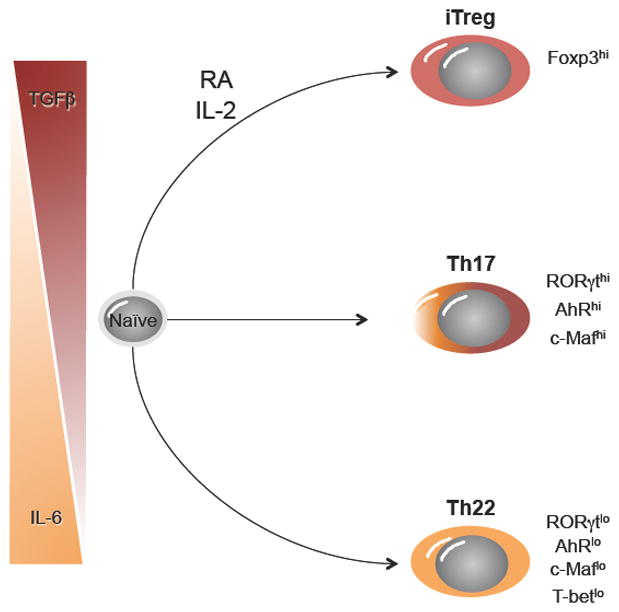
Discovery of the T-helper 17 (Th17) subset heralded a major shift in T-cell biology and immune regulation. In addition to defining a new arm of the adaptive immune response, studies of the Th17 pathway have led to a greater appreciation of the developmental flexibility, or plasticity, that is a feature of T-cell developmental programs. Since the initial finding that differentiation of Th17 cells is promoted by transforming growth factor-β (TGFβ), it became clear that Th17 cell development overlapped that of induced regulatory T (iTreg) cells. Subsequent findings established that Th17 cells are also unusually flexible in their late developmental programming, demonstrating substantial overlap with conventional Th1 cells through mechanisms that are just beginning to be understood but would appear to have important implications for immunoregulation at homeostasis and in immune-mediated diseases. Herein we examine the developmental and functional features of Th17 cells in relation to iTreg cells, Th1 cells, and Th22 cells, as a basis for understanding the contributions of this pathway to host defense, immune homeostasis, and immune-mediated disease.
辅助性 T 细胞 17(Th17)亚群的发现标志着 T 细胞生物学和免疫调节的重大转变。除了定义适应性免疫反应的新分支外,对 Th17 途径的研究还使人们更加认识到 T 细胞发育程序的发育灵活性或可塑性。自最初发现 Th17 细胞的分化受转化生长因子-β(TGFβ)促进以来,人们已经清楚 Th17 细胞的发育与诱导性调节性 T(iTreg)细胞重叠。随后的发现确立了 Th17 细胞在其晚期发育编程中也具有异常的灵活性,通过刚刚开始理解的机制与传统的 Th1 细胞有很大的重叠,但似乎对免疫稳态和免疫介导的疾病中的免疫调节有重要影响。在此,我们研究了 Th17 细胞与 iTreg 细胞、Th1 细胞和 Th22 细胞在发育和功能方面的特征,以此作为理解该途径对宿主防御、免疫稳态和免疫介导疾病的贡献的基础。