Khalaf Abedawn I, Huggan Judith K, Suckling Colin J, Gibson Colin L, Stewart Kirsten, Giordani Federica, Barrett Michael P, Wong Pui Ee, Barrack Keri L, Hunter William N
WestCHEM Department of Pure and Applied Chemistry, University of Strathclyde , 295 Cathedral Street, Glasgow G1 1XL, United Kingdom.
J Med Chem. 2014 Aug 14;57(15):6479-94. doi: 10.1021/jm500483b. Epub 2014 Jul 29.
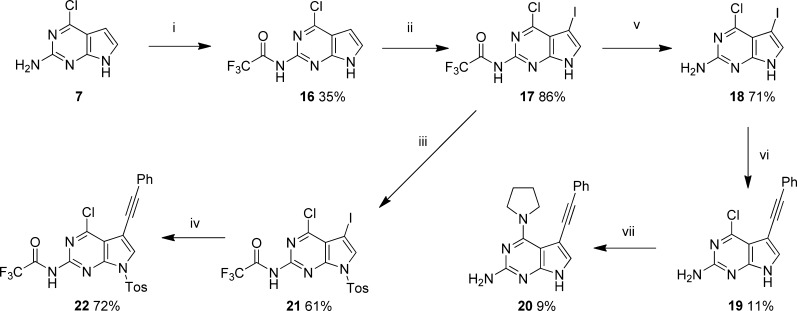
The treatment of Human African trypanosomiasis remains a major unmet health need in sub-Saharan Africa. Approaches involving new molecular targets are important; pteridine reductase 1 (PTR1), an enzyme that reduces dihydrobiopterin in Trypanosoma spp., has been identified as a candidate target, and it has been shown previously that substituted pyrrolo[2,3-d]pyrimidines are inhibitors of PTR1 from Trypanosoma brucei (J. Med. Chem. 2010, 53, 221-229). In this study, 61 new pyrrolo[2,3-d]pyrimidines have been prepared, designed with input from new crystal structures of 23 of these compounds complexed with PTR1, and evaluated in screens for enzyme inhibitory activity against PTR1 and in vitro antitrypanosomal activity. Eight compounds were sufficiently active in both screens to take forward to in vivo evaluation. Thus, although evidence for trypanocidal activity in a stage I disease model in mice was obtained, the compounds were too toxic to mice for further development.
在撒哈拉以南非洲地区,人类非洲锥虫病的治疗仍是一项尚未满足的重大健康需求。涉及新分子靶点的方法很重要;蝶啶还原酶1(PTR1)是一种能还原锥虫属中二氢生物蝶呤的酶,已被确定为候选靶点,并且先前已表明,取代的吡咯并[2,3 - d]嘧啶是布氏锥虫PTR1的抑制剂(《药物化学杂志》,2010年,第53卷,221 - 229页)。在本研究中,已制备了61种新的吡咯并[2,3 - d]嘧啶,这些化合物的设计参考了其中23种与PTR1复合的新晶体结构,并在针对PTR1的酶抑制活性筛选和体外抗锥虫活性筛选中进行了评估。有8种化合物在这两种筛选中均具有足够的活性,可推进到体内评估。因此,尽管在小鼠的I期疾病模型中获得了杀锥虫活性的证据,但这些化合物对小鼠毒性太大,无法进一步开发。