Control of Neglected Tropical Diseases, Innovative and Intensified Disease Management, World Health Organization, Geneva, Switzerland.
PLoS Negl Trop Dis. 2012;6(10):e1859. doi: 10.1371/journal.pntd.0001859. Epub 2012 Oct 25.
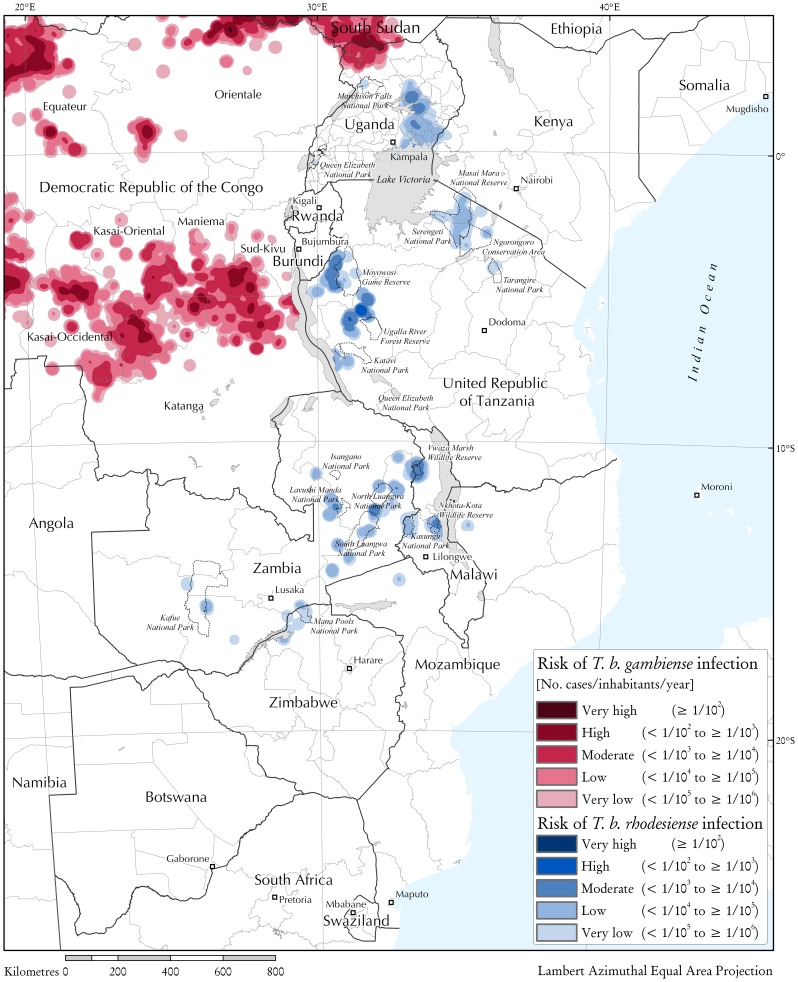
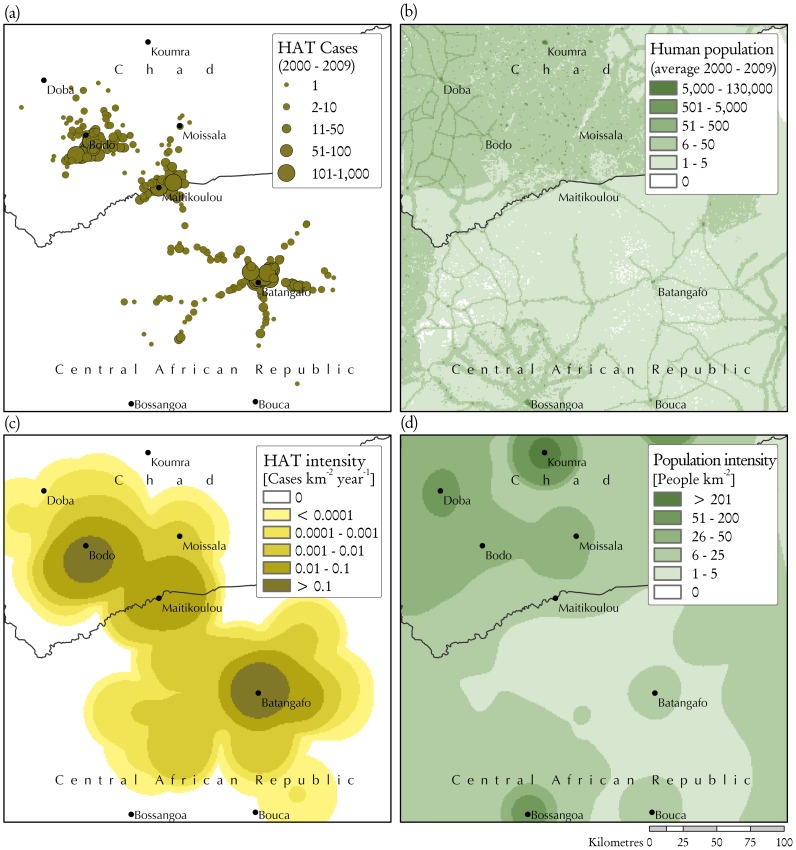
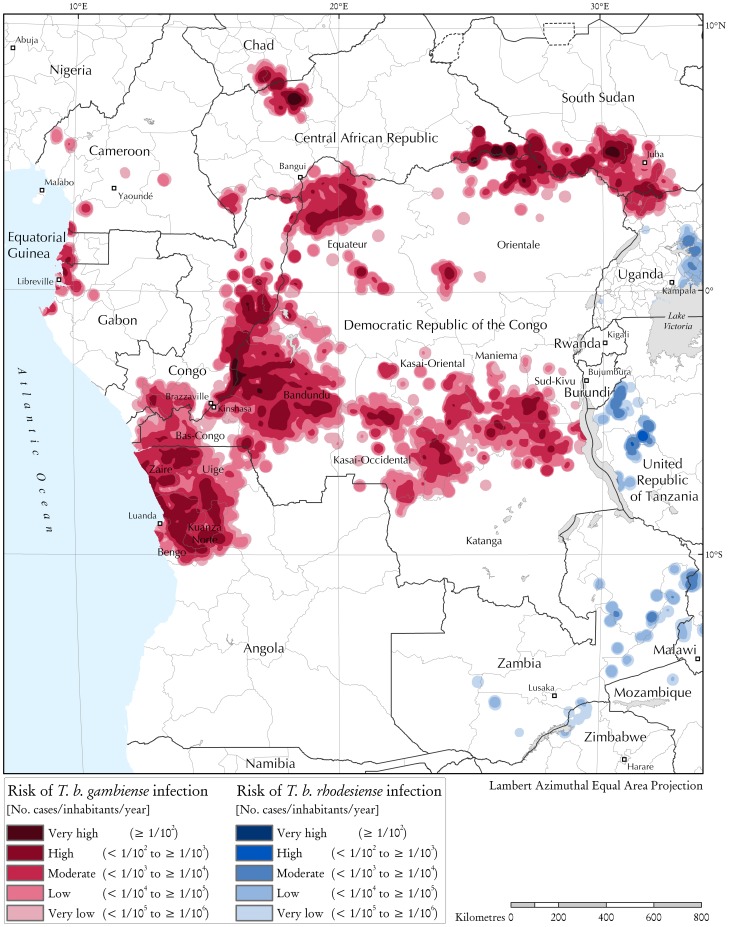
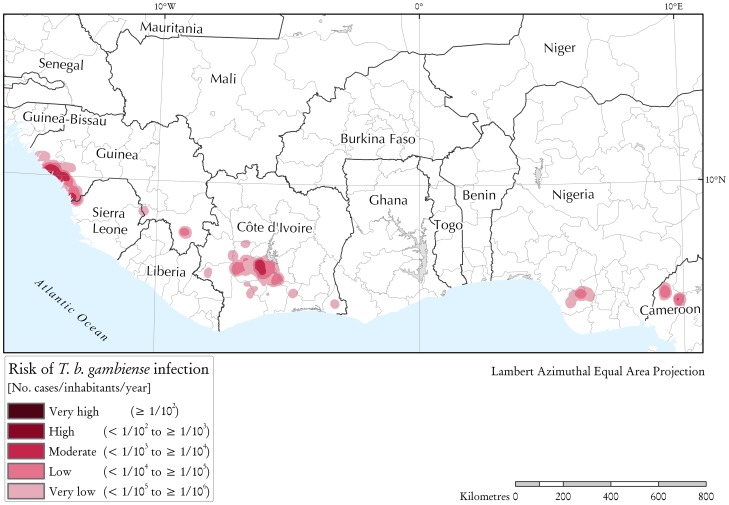
Human African trypanosomiasis (HAT), also known as sleeping sickness, persists as a public health problem in several sub-Saharan countries. Evidence-based, spatially explicit estimates of population at risk are needed to inform planning and implementation of field interventions, monitor disease trends, raise awareness and support advocacy. Comprehensive, geo-referenced epidemiological records from HAT-affected countries were combined with human population layers to map five categories of risk, ranging from "very high" to "very low," and to estimate the corresponding at-risk population.
Approximately 70 million people distributed over a surface of 1.55 million km(2) are estimated to be at different levels of risk of contracting HAT. Trypanosoma brucei gambiense accounts for 82.2% of the population at risk, the remaining 17.8% being at risk of infection from T. b. rhodesiense. Twenty-one million people live in areas classified as moderate to very high risk, where more than 1 HAT case per 10,000 inhabitants per annum is reported.
Updated estimates of the population at risk of sleeping sickness were made, based on quantitative information on the reported cases and the geographic distribution of human population. Due to substantial methodological differences, it is not possible to make direct comparisons with previous figures for at-risk population. By contrast, it will be possible to explore trends in the future. The presented maps of different HAT risk levels will help to develop site-specific strategies for control and surveillance, and to monitor progress achieved by ongoing efforts aimed at the elimination of sleeping sickness.
人体感染采采蝇(也称为昏睡病)后会引发非洲人类锥虫病(HAT),该疾病在撒哈拉以南的几个国家仍然是一个公共卫生问题。需要基于证据且具有空间明确性的风险人群估计数,以规划和实施现场干预措施、监测疾病趋势、提高认识和支持宣传活动。将受 HAT 影响国家的综合、地理参考流行病学记录与人类人口层相结合,绘制了五个风险类别,范围从“很高”到“很低”,并估计了相应的风险人群。
据估计,约有 7000 万人分布在 155 万平方公里的区域,面临着不同程度感染 HAT 的风险。布氏冈比亚锥虫(T. b. gambiense)占风险人群的 82.2%,其余 17.8%面临感染 T. b. rhodesiense 的风险。2100 万人生活在被归类为中等到高风险的地区,每年每 10000 名居民中报告超过 1 例 HAT 病例。
根据报告病例的定量信息和人类人口的地理分布,对昏睡病风险人群进行了最新的估计。由于方法学上存在很大差异,因此无法与以前的风险人群数据进行直接比较。相比之下,将来可以探索趋势。不同 HAT 风险水平的地图将有助于制定针对特定地点的控制和监测策略,并监测旨在消除昏睡病的现有工作所取得的进展。