Postdoctoral Fellow, Social Aetiology of Mental Illness Training Program, Centre for Addiction and Mental Health, Toronto, Ontario; Assistant Professor, School of Social Work, Renison University College, University of Waterloo, Waterloo, Ontario.
Chief of Psychiatry, Medical Director, Mental Health and Addiction Program, St Joseph's Health Centre, Toronto, Ontario; Assistant Professor, Department of Psychiatry, University of Toronto, Toronto, Ontario.
Can J Psychiatry. 2014 Jul;59(7):385-92. doi: 10.1177/070674371405900706.
There is widespread support for primary care to help address growing mental health care demands. Incentives and disincentives are widely used in the design of health care systems to help steer toward desired goals. The absence of a conceptual model to help understand the range of factors that influence the provision of primary mental health care inspired a scoping review of the literature. Understanding the incentives that promote and the disincentives that deter treatment for depression and anxiety in the primary care context will help to achieve goals of greater access to mental health care.
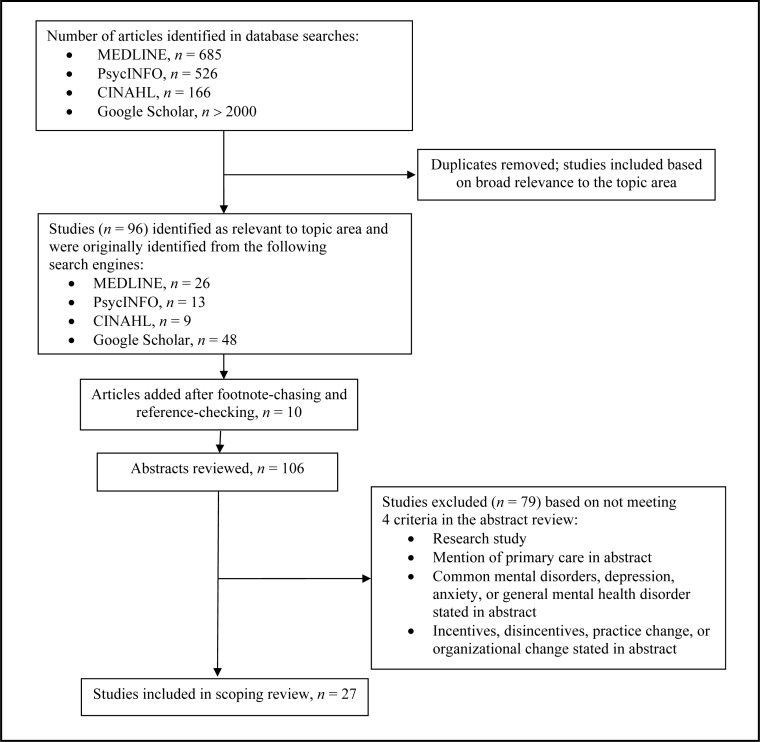
A review of the literature was conducted to answer the question, how are incentives and disincentives conceptualized in studies investigating the treatment of common mental disorders in primary care? A comprehensive search of MEDLINE, PsycINFO, CINAHL, and Google Scholar was undertaken using Arksey and O'Malley's 5-stage methodological framework for scoping reviews.
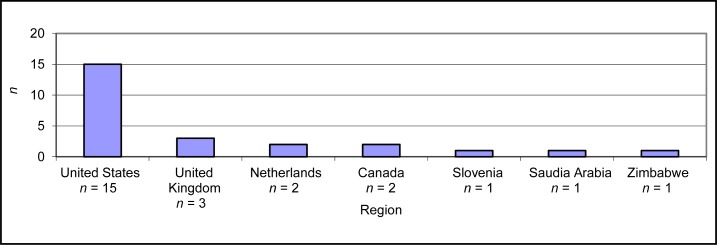
We identified 27 studies. A range of incentives and disincentives influence the success of primary mental health care initiatives to treat depression and anxiety. Six types of incentives and disincentives can encourage or discourage treatment of depression and anxiety in primary care: attitudes and beliefs, training and core competencies, leadership, organizational, financial, and systemic.
Understanding that there are 6 different types of incentives that influence treatment for anxiety and depression in primary care may help service planners who are trying to promote improved mental health care.
广泛支持初级保健以帮助应对日益增长的精神卫生保健需求。激励措施和抑制因素广泛用于医疗保健系统的设计中,以帮助实现预期目标。由于缺乏帮助理解影响初级精神卫生保健提供的一系列因素的概念模型,因此对文献进行了范围审查。了解在初级保健环境中促进治疗抑郁症和焦虑症的激励因素以及阻碍治疗的抑制因素,将有助于实现更多获得精神卫生保健的目标。
对文献进行了综述,以回答以下问题:在研究初级保健中常见精神障碍的治疗方法时,如何对激励因素和抑制因素进行概念化?使用 Arksey 和 O'Malley 的 5 阶段方法学框架对 MEDLINE、PsycINFO、CINAHL 和 Google Scholar 进行了全面搜索。
我们确定了 27 项研究。一系列激励因素和抑制因素影响了初级精神卫生保健计划成功治疗抑郁和焦虑的能力。有 6 种类型的激励因素和抑制因素可以鼓励或阻止初级保健中对抑郁和焦虑的治疗:态度和信念、培训和核心能力、领导力、组织、财务和系统。
了解影响初级保健中焦虑和抑郁治疗的 6 种不同类型的激励因素,可能有助于尝试促进改善精神卫生保健的服务计划者。